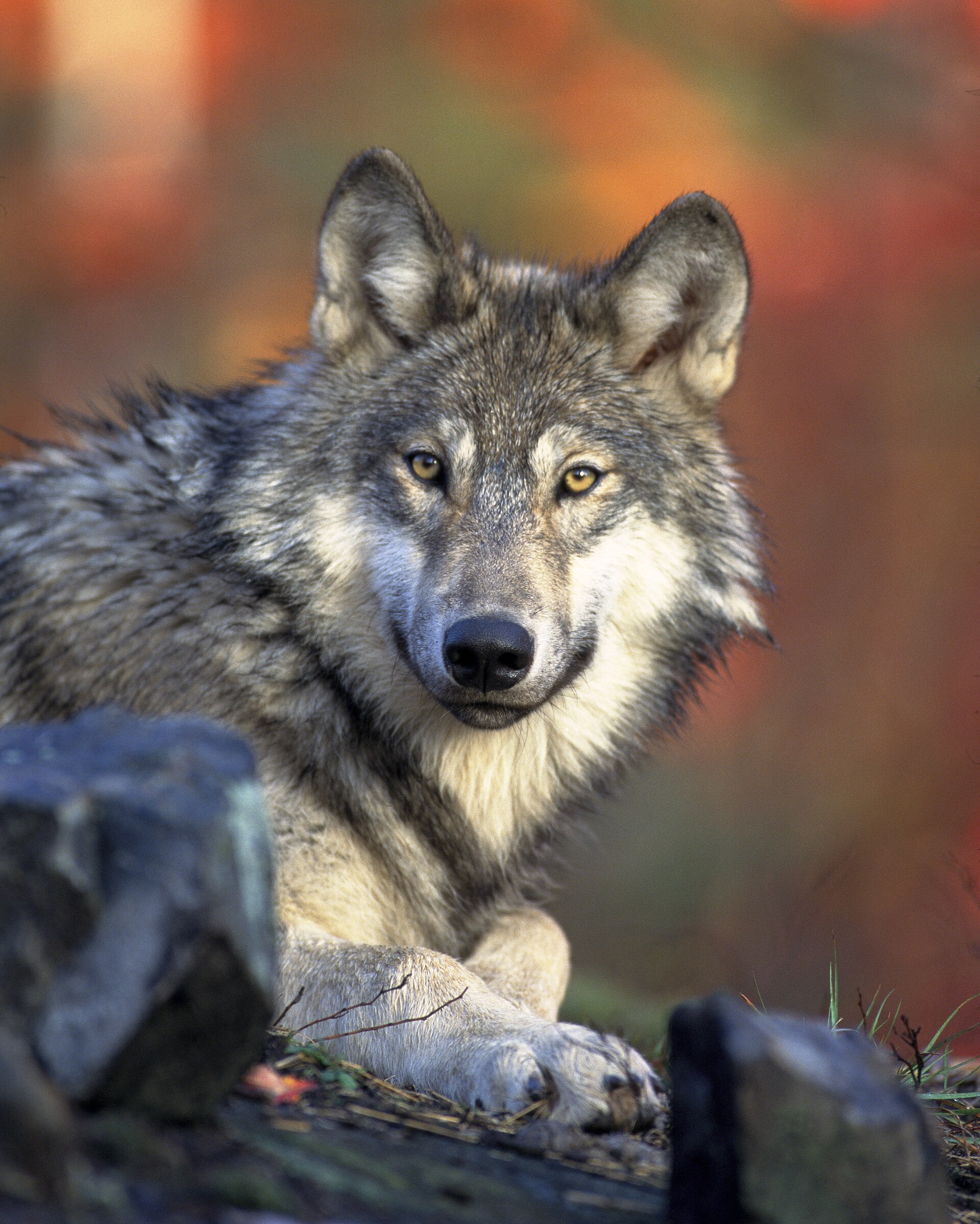
Grey Wolf
Canis lupus
Characteristics
Temperament
Highly social: family packs led by "alpha" pair. Apex predator of wild ungulates. Cooperative hunting. Ancestor of all domestic dogs (domesticated 14,000-30,000 years ago).
Diet
Strict carnivore: deer, moose, roe deer, wild boars, caribou (main); small mammals when big game lacks. 2-5 kg of meat per day. Cooperative pack hunting.
The Grey Wolf (Canis lupus) is the largest living canid in the world and the wild ancestor of all domestic dogs. An apex predator of the forest and mountain ecosystems of the boreal hemisphere, it is a highly social species organised in family packs with a complex cooperative structure. After being extirpated from much of Europe in the 20th century, it has reappeared in many regions thanks to legal protection and spontaneous recolonisation, becoming an emblematic case of conservation success.
Classification and category
The Grey Wolf belongs to the order Carnivora, family Canidae, subfamily Caninae, genus Canis. It is the type species of the genus and includes about 30 living subspecies distributed in Eurasia, North America and North Africa. Among the best known: the Eurasian Common Wolf (C. l. lupus), the Tundra Wolf (C. l. albus), the Arctic Wolf (C. l. arctos), the North American Grey Wolf (C. l. nubilus), the Indian Wolf (C. l. pallipes) and the Apennine Wolf (C. l. italicus), endemic to peninsular Italy and the Alps. It is a large mammal: body length ranges from 100 to 160 cm, with a 30-50 cm tail; average adult weight is 25-60 kg, with males noticeably larger and Arctic and Siberian subspecies reaching 80 kg.
Habitat and distribution
The Grey Wolf's habitat is extraordinarily varied, reflecting the ecological flexibility of the species: taiga and boreal forests, Arctic tundra, temperate forests, steppes, arid plains, mountains up to 4,500 metres and semi-deserts. Its historical range was the largest of any terrestrial mammal after humans, but persecution between the 18th and 20th centuries reduced it by 70%.
Today it survives in the entire boreal belt of Russia, Canada and Alaska (populations of tens of thousands), and in smaller but growing populations in Europe: Scandinavia, Poland, Carpathians, Balkans, Spain, France, Germany, Switzerland. In Italy, the Apennine Wolf went from about 100 individuals in the 1970s (on the verge of extinction) to over 3,300 in 2022 (ISPRA monitoring), spontaneously recolonising the entire Apennine arc and the Alps. Conservation status is listed as Least Concern (LC) by the IUCN globally, but protected at European level by the Bern Convention and the Habitats Directive (Annex II and IV).
Diet
The Grey Wolf is a strict carnivore specialised in predation of wild ungulates. The diet varies by region: deer, roe deer, moose, caribou, wild boars, bison, ibex, chamois are the main prey. It hunts in packs with complex cooperative techniques: group pursuit to tire prey (wolves can sustain a trot of 30-40 km/h for hours), encirclement and targeted bites to the legs and neck.
A large prey item (e.g. a 100 kg deer) can feed a pack of 6-8 wolves for 3-4 days. Average daily individual consumption is 2-5 kg of meat, but a wolf can fast for over two weeks and then ingest up to 9 kg in a single meal. In the absence of large ungulates, it supplements the diet with hares, rabbits, marmots, rodents, birds, fish, fruit and occasionally carrion. In human-modified territories it may prey on domestic livestock, a historic source of conflict with humans.
Physical features
The Grey Wolf has a robust and proportionate body, with deep chest, long powerful legs, massive head with elongated muzzle. The coat is double: woolly insulating undercoat (denser in winter) and longer, coarser guard coat. Colouration varies enormously by subspecies and individual: from classic grey-brown with tawny shades on muzzle and legs (Eurasian, Apennine) to pure white (Arctic) to almost uniform black (some North American populations).
The legs are digitigrade, with long, webbed toes for walking on snow; claws are non-retractable. Eyes are generally yellow-amber, with excellent night vision. The sense of smell is extraordinary: 100 times more sensitive than human, capable of detecting prey 2-3 km away. Hearing is equally acute. The famous howl is the main form of long-distance communication: each wolf has an individual "vocal signature"; pack chorus howls have functions of cohesion, territorial marking and localisation. They travel up to 10 km in ideal conditions.
Behaviour and curiosities
The Grey Wolf is a highly social species: it lives in family packs generally composed of a breeding pair ("alpha"), their cubs and sometimes adult offspring from previous seasons. Average size is 5-10 individuals, but can vary from 2 to over 30. The pack defends a territory ranging from 100 km² (in areas with abundant prey) to over 3,000 km² in Arctic tundras, marking it with urine, droppings and claw marks on trunks.
Social structure revolves around the breeding pair: the female gives birth to only one litter per year (generally 4-6 cubs) in an underground den, from April to June. The whole pack contributes to rearing: young adults act as "babysitters" and bring regurgitated food. Wolf domestication began between 14,000 and 30,000 years ago (genetic and archaeological dating still debated), with the slow selection of more sociable individuals that gave rise to the domestic dog (Canis lupus familiaris) — the most ancient and profound relationship of domestication between humans and an animal. Despite legends, attacks on humans by wild wolves in Europe in the last century have been very few and almost all linked to rabid specimens or dog-wolf hybrids. Lifespan is 6-8 years in the wild, up to 15-20 in captivity.
Pros
- Specie chiave per gli ecosistemi (regola popolazioni ungulati)
- Reintroduzione spontanea successo in Italia e Francia
- Intelligenza sociale paragonabile ai primati
- Antenato del cane domestico, legame ancestrale con l'uomo
Cons
- Specie selvatica protetta, NON è un animale da compagnia (illegale ovunque)
- Conflitto storico con pastorizia e zootecnia
- Predisposto all'ibridazione con cane domestico (problema genetico)
- Vita breve in natura (6-8 anni)