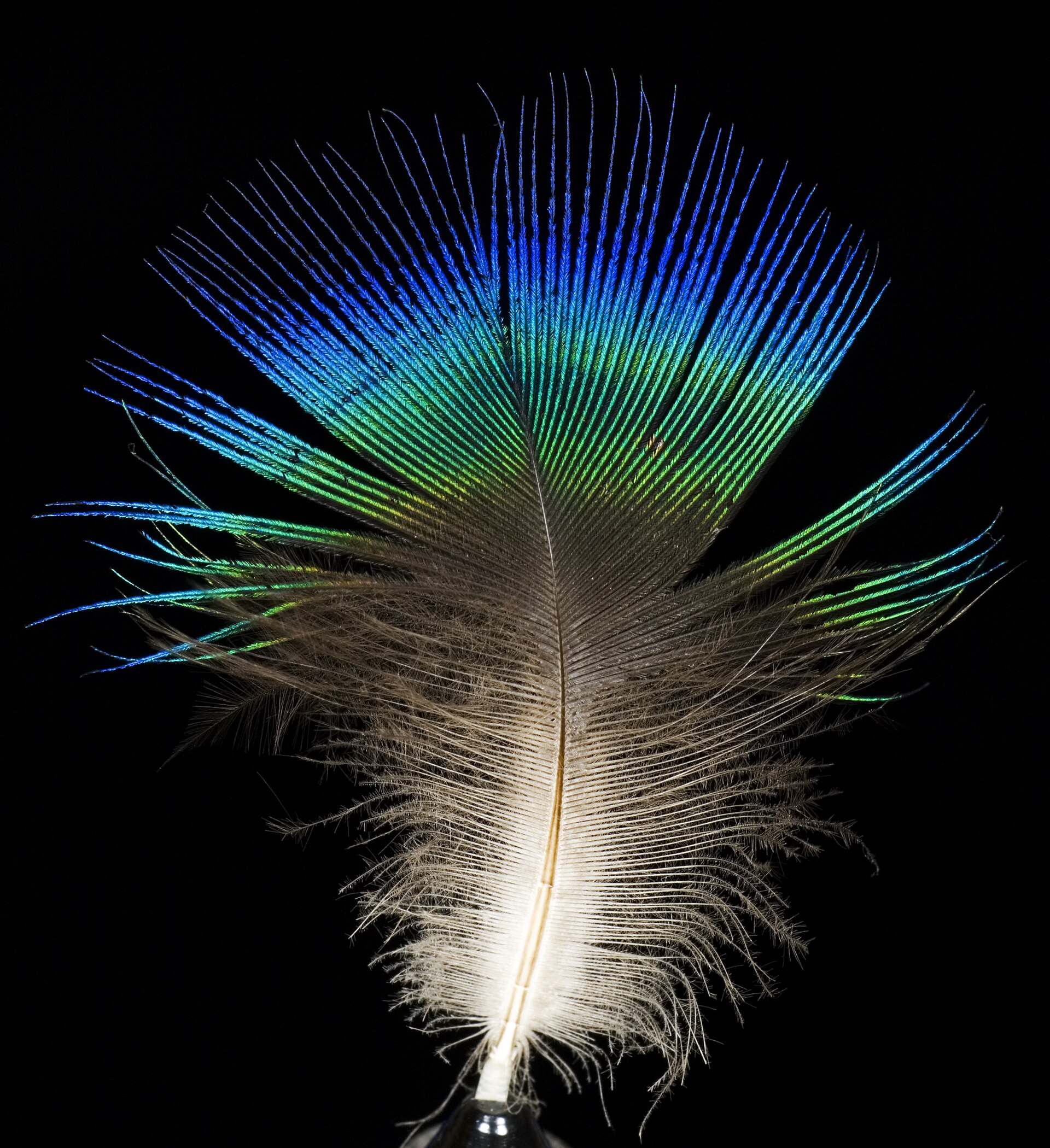
Indian Peafowl
Pavo cristatus
Characteristics
Temperament
Diurnal, gregarious, polygamous. Male displays iridescent "train" during courtship. "May-awe" call audible for km. Flies short distances but sleeps on tall trees for safety.
Diet
Generalist omnivore: seeds, cereals, berries, fruit, insects, small reptiles (including venomous snakes), amphibians, young rodents. 150-200 g/day.
The Indian Peafowl (Pavo cristatus), commonly known as the Peacock, is one of the most recognisable birds in the world. Native to the Indian subcontinent, it is famous for the spectacular "train" of tail-coverts of the male, which opens like a fan during the courtship display revealing over 150 iridescent "eyes". National bird of India since 1963, it is the object of religious veneration in Hinduism and a cultural symbol ubiquitous in art and mythology around the world.
Classification and category
The Peafowl belongs to the order Galliformes, family Phasianidae (the same as pheasants, chickens and partridges), genus Pavo. The genus includes two living species: the Indian Peafowl (P. cristatus), subject of this profile, and the Green or Burmese Peafowl (P. muticus), classified as Endangered. There is also the Congo Peafowl (Afropavo congensis), in a separate genus. It is a large bird: the length of the adult male, train included, can reach 2.3 metres (of which 1.5 m is train); body length without train is 100-115 cm. Average weight is 4-6 kg, with males noticeably larger than females (peacock and peahen respectively).
Habitat and distribution
The Peafowl's natural habitat consists of deciduous forests, open woodlands, wooded savannas, cultivated land and semi-arid zones of the Indian subcontinent. It prefers areas with mixed vegetation (tall trees for sleeping safe from nocturnal predators and open areas for foraging) and access to water sources. It is perfectly at ease in human-modified environments: parks, gardens of temples and rural residences host semi-free populations.
The natural range covers India, eastern Pakistan, Nepal, Sri Lanka, Bhutan and parts of western Myanmar. Thanks to aesthetic and symbolic appreciation, the Peafowl has been introduced worldwide: today naturalised populations live in California, Florida, Bahamas, Hawaii, Australia, New Zealand and in many historic European parks (Windsor, Versailles, Caserta). Conservation status is listed as Least Concern (LC) by the IUCN. In India it is protected by the Wildlife Protection Act of 1972: hunting is strictly forbidden, but poaching for train feathers remains a local threat.
Diet
The Peafowl is a generalist omnivore with a surprisingly varied diet. It feeds mainly on seeds (cereals, wild legumes), berries, fruits, shoots, flowers, but supplements with a significant animal component: insects (grasshoppers, beetles, termites), small reptiles (lizards, young snakes — including, according to some sources, venomous snakes like the king cobra, against which it has notable resistance), amphibians, young rodents.
The ability to catch and eat snakes underlies religious veneration in Hinduism: the Peafowl is associated with Kartikeya, god of war, and considered a symbol of victory over "poison" (evil). In practical terms, daily food requirement is about 150-200 g. It feeds mainly in the morning and late afternoon, alternating foraging activity with rest periods during the hottest hours.
Physical features
The male (peacock proper) is one of the most spectacular creatures in the animal kingdom. The body is iridescent blue-green, with a characteristic "train" formed by 100-150 elongated tail coverts (not true tail feathers), which can reach 1.5 m in length. Each covert ends with a pattern called "eye" (ocellus): a circular iridescent spot with rings of blue, gold and copper that, during the display, shines like a real eye thanks to the crystalline microstructure of the barbules, capable of refracting light in different ways depending on the viewing angle (structural colour, not pigments).
On the head the male bears a characteristic fan-shaped crest of erect feathers ending in small iridescent "paddles". The female (peahen) is much more discreet: brown-grey body with green reflections on the neck, no train and a smaller crest — a sexual dimorphism among the most extreme of birds. The legs are sturdy, grey, with a well-developed spur in males. Flight is short but powerful: the Peafowl spends nights on high branches for safety.
Behaviour and curiosities
The Peafowl is famous for its courtship display: during the breeding season (March-September in India), the male spreads the train opening it like a fan and makes it vibrate with a characteristic rustle. Peahens assess the male's genetic quality based on the symmetry of the train, the number of ocelli and their brilliance — one of the classic examples of sexual selection studied by Darwin (who initially found it so "useless" he wrote: "The sight of a feather in a peacock's tail, whenever I gaze at it, makes me sick!").
The train is completely shed every year after the breeding season (autumn) and regrows for the following spring — an enormous metabolic cost. Vocalisation is equally famous: the characteristic call "may-awe" or "meow" is audible for kilometres, especially at dawn and dusk, and was used as an alarm in ancient Indian residences to signal the presence of tigers or leopards nearby. The Peafowl is polygamous: a dominant male can mate with 4-6 females. Females lay 4-8 eggs in a well-hidden ground nest; chicks are precocial and follow the mother a few hours after hatching. Lifespan is 10-25 years in the wild, up to 40-50 in captivity.
Pros
- Specie iconica con piumaggio unico al mondo
- Simbolo nazionale dell'India dal 1963
- Longevo (fino a 50 anni in cattività)
- Facile da osservare in parchi e giardini storici
Cons
- Specie selvatica protetta in India, NON è un pet adatto
- Verso molto forte e disturbante (allevamento sconsigliato in centro abitato)
- Necessita spazi ampi e protezione da predatori notturni
- Maschi aggressivi durante la stagione riproduttiva