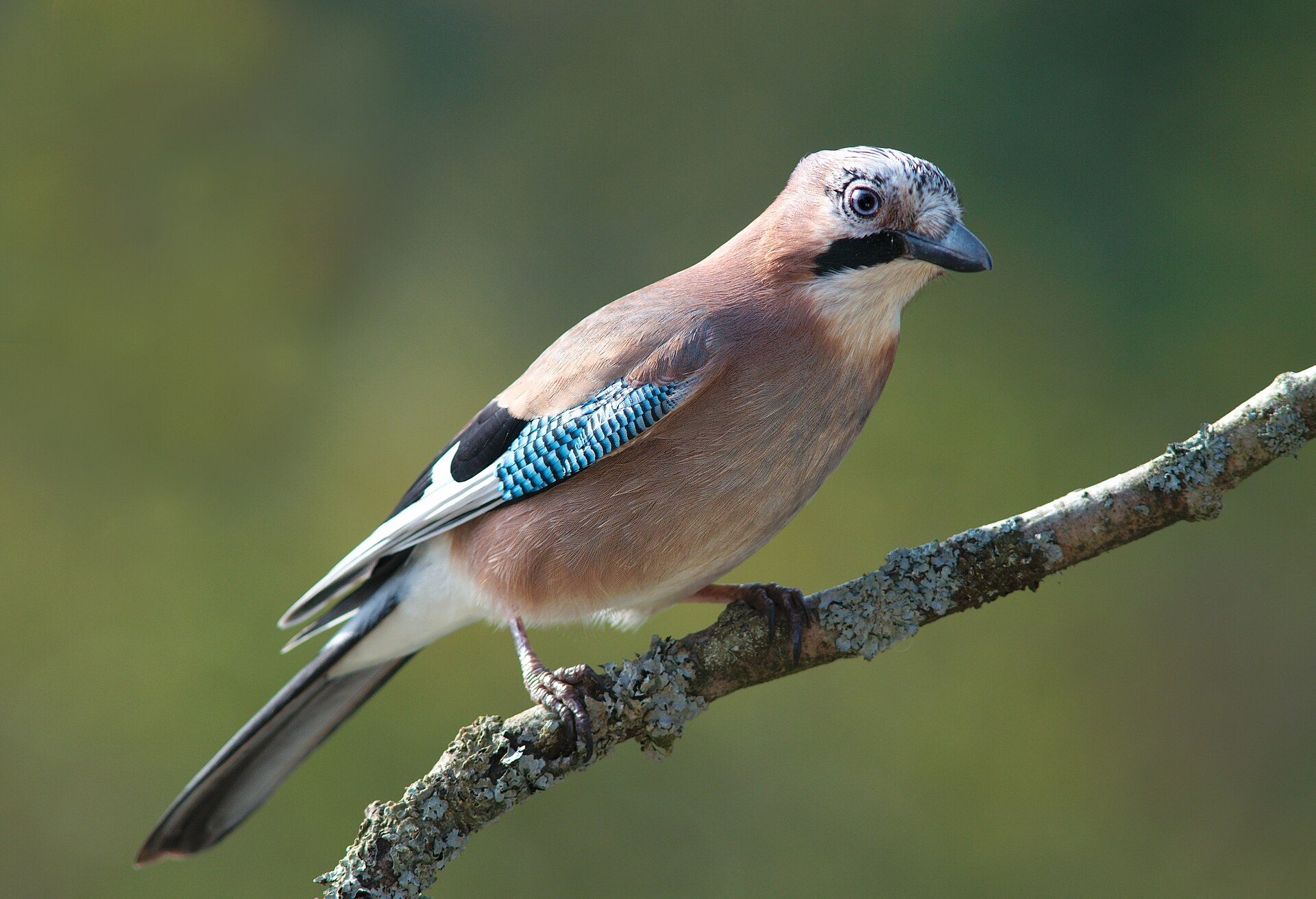
Eurasian Jay
Garrulus glandarius
Characteristics
Temperament
Intelligent, watchful and noisy, like all corvids. Often shy in the thick of the woods, where it betrays itself with its harsh call, but bolder in parks. Diurnal; outside the breeding season it may form small groups. Tireless and methodical in its autumn acorn-hoarding, which it relocates thanks to an exceptional memory. A skilled mimic and a "watchman" that raises the alarm in the woods. Not a pet: a wild bird, valuable for oak regeneration.
Diet
An omnivore with a varied diet, with acorns as the signature autumn food. It also eats other seeds, nuts, beechnuts and fruit, insects (especially caterpillars in spring/summer, vital for the young), eggs and nestlings of other birds, and small vertebrates. In autumn it hides thousands of acorns, carrying several at a time in its throat and bill and burying them one by one; it relocates them thanks to an exceptional spatial memory, even under snow. The forgotten acorns sprout: it is one of the most effective oak dispersers, flying them far away.
The Eurasian Jay (Garrulus glandarius) is the most colourful and striking of European corvids and a familiar presence in Italy's woods. Famous for:
- Bright colours: a brownish-pink body and, above all, the unmistakable black-barred blue wing patches, among the most beautiful in the European bird world
- The white rump: clearly visible in flight, contrasting with the black tail
- The "watchman of the woods": with its harsh, raucous call it raises the alarm when a predator or a human approaches, alerting all the animals
- A skilled mimic: like a good corvid, it is intelligent and can imitate other birds' calls (even the buzzard)
- A passion for acorns: its very name, Italian and scientific, comes from this link
- The "oak planter": it hides thousands of acorns each autumn, and the forgotten ones sprout
IUCN status: Least Concern (LC), common and widespread. It is the first corvid in this portal, the great family of the most intelligent birds (crows, magpies, jackdaws). And it shares with the Eastern gray squirrel and the Eastern chipmunk a valuable role: carrying and sowing acorns, helping oak forests grow.
Classification and category
Order Passeriformes (the perching/songbirds), family Corvidae (the corvids) — the same as crows, magpies and jackdaws, considered among the most intelligent birds of all. It is therefore a colourful "cousin" of the crow and the raven. Not to be confused with: the European roller (Coracias garrulus) — despite the similar name (in Italian "ghiandaia marina") and a comparable blue patch, it is NOT a corvid but a coraciid, related to bee-eaters and kingfishers; the magpie (Pica pica), another European corvid but black-and-white with a long tail; and the American jays (such as the blue jay, Cyanocitta), New World corvids, different and generally bluer. Etymology: everything in the name turns on acorns — "Garrulus" is Latin for "chatty, talkative" (for the noisy call), while "glandarius" means "of acorns" (from glans, acorn); the Italian name "ghiandaia" also comes from "ghianda" (acorn). Parameters: Length 32-35 cm. Wingspan 52-58 cm. Weight 140-190 g. Longevity on average a few years in the wild (high juvenile mortality), with records around 16-18 years. Reproduction: monogamous; it builds a twig nest among the branches; it lays 4-6 eggs, incubated by both sexes, with the young cared for by the parents.
Habitat and distribution
The Eurasian Jay has a vast Old World range: much of Europe (including Italy, where it is common and widespread), North Africa and temperate Asia, to Japan. Preferred habitats — mainly woodland: deciduous and mixed forests, especially oak woods (on which it depends for acorns); coniferous forests, scrub and woodland edges; and urban parks and treed gardens (increasingly frequented, where it becomes bolder). It is especially tied to oaks: acorn availability shapes its distribution, its movements and even, in scarce years, small migrations. In the woods it is often shy, betraying itself mainly by its call; in towns and parks it becomes bolder. It is diurnal and, outside the breeding season, may form small groups. IUCN: Least Concern. A common, adaptable, unthreatened species, helped by its bond with a widespread, hardy tree like the oak — a bond that, as we will see, is mutual.
Diet
The Eurasian Jay is an omnivore with a varied diet and one absolute star in autumn: the acorn. It eats: acorns (the signature food, gathered and stored in huge quantities in autumn); other seeds, nuts, beechnuts and fruit; insects (especially caterpillars and grubs in spring and summer, vital for the young); eggs and nestlings of other birds (a component that makes it feared by small songbirds); and small vertebrates and various invertebrates. Feeding strategies: acorn caching (in autumn a single jay can hide thousands of acorns, carrying several at a time in its throat and bill and burying them one by one in scattered spots); extraordinary memory (it relocates much of the hidden acorns even months later, even under snow, thanks to remarkable spatial memory); and corvid opportunism (intelligent and adaptable, it exploits every seasonal resource, from insects to fruit). Crucially, the acorns it forgets sprout, and because the jay tends to carry them far from the parent tree, often into clearings and open habitats ideal for growth, it is one of nature's most effective oak dispersers — even more than the squirrel, because it flies them over great distances.
Physical features
A medium-sized bird with surprising colours for a corvid. Colours and pattern: a warm brownish-pink/wine body; a black-barred blue wing patch (its most famous trait, a "tile" of iridescent feathers, once much prized); a bright white rump, obvious in flight, against the black tail; and a black moustache at the sides of the bill and a pale crown with dark streaks (raisable into a small crest). The body: a sturdy corvid build, with a strong, versatile bill; rounded wings (the flight is rather "flappy" and undulating, not elegant like some birds'); and a lively, alert look. Performance: corvid intelligence (among the most "brainy" birds, capable of problem-solving and planning); spatial memory (to relocate thousands of hidden acorns); vocal mimicry (it reproduces other birds' calls and ambient sounds); and acorn transport (its throat and bill let it carry several at a time).
Behaviour and curiosities
The Eurasian Jay is an intelligent, watchful, noisy bird. Though often shy in the thick of the woods, it betrays its presence with its characteristic harsh call. Outside the breeding season it may form small groups, and in autumn it is tireless in gathering and hiding acorns. Its corvid intelligence makes it a subject of study for ethologists.
The "watchman of the woods": the jay is famous for its role as a "living alarm" — when it spots a predator (a raptor, a fox, or a hunter) it gives a harsh, penetrating call that warns not only other jays but all the woodland animals; hunters often regard it as a "spy" that scares off game, while for other animals it is a valuable free alarm system. The "oak planter": the bond between jay and oak is one of nature's finest examples of mutualism — in autumn the bird gathers a huge quantity of acorns and hides them underground, one by one, often carrying them hundreds of metres or more from the parent tree; those it forgets sprout, and because the jay tends to bury them in open, sunny places ideal for a young oak's growth, it is considered one of the main natural agents of oak reforestation, able to "move" the forest much farther than a squirrel can. Prodigious memory: to exploit the hidden acorns, the jay must remember thousands of caches scattered through the woods, which it does thanks to an exceptional spatial memory, relocating its stores even months later and even under a layer of snow — one of the many proofs of corvid intelligence, a family famous for its cognitive abilities. The mimic: like many corvids, the jay is a notable mimic, inserting into its repertoire other birds' calls and various ambient sounds; it is especially known for imitating the buzzard's call, perhaps to scare rivals or fool other animals — vocal versatility added to its characteristic harsh scream. The "blue feathers": the jay's splendid black-barred blue wing patches are among the most beautiful structures in European plumage; their colour is not due to a blue pigment (very rare in nature) but to the microstructure of the feathers, which reflects blue light; these feathers were once much sought after, for example for ornament and for tying fishing lures. The portal's first corvid: with the jay, this portal welcomes the first member of the corvids, the family that brings together some of the planet's most intelligent birds — crows, magpies, jackdaws and nutcrackers; choosing such a colourful, forest-friendly species is a fine way to introduce this extraordinary group.
Pros
- Il più colorato dei corvidi europei, primo corvide del portale
- 'Piantatore di querce': fondamentale per la rinnovazione dei boschi
- Intelligentissima (memoria spaziale, imitazione, problem solving)
- 'Sentinella del bosco': dà l'allarme a tutti gli animali; IUCN Least Concern
Cons
- Non è un animale da compagnia (uccello selvatico)
- Predando uova e nidiacei, può impattare i piccoli passeriformi
- Vista talora con sospetto dai cacciatori (mette in allarme la selvaggina)
- Schiva nei boschi: non sempre facile da osservare da vicino