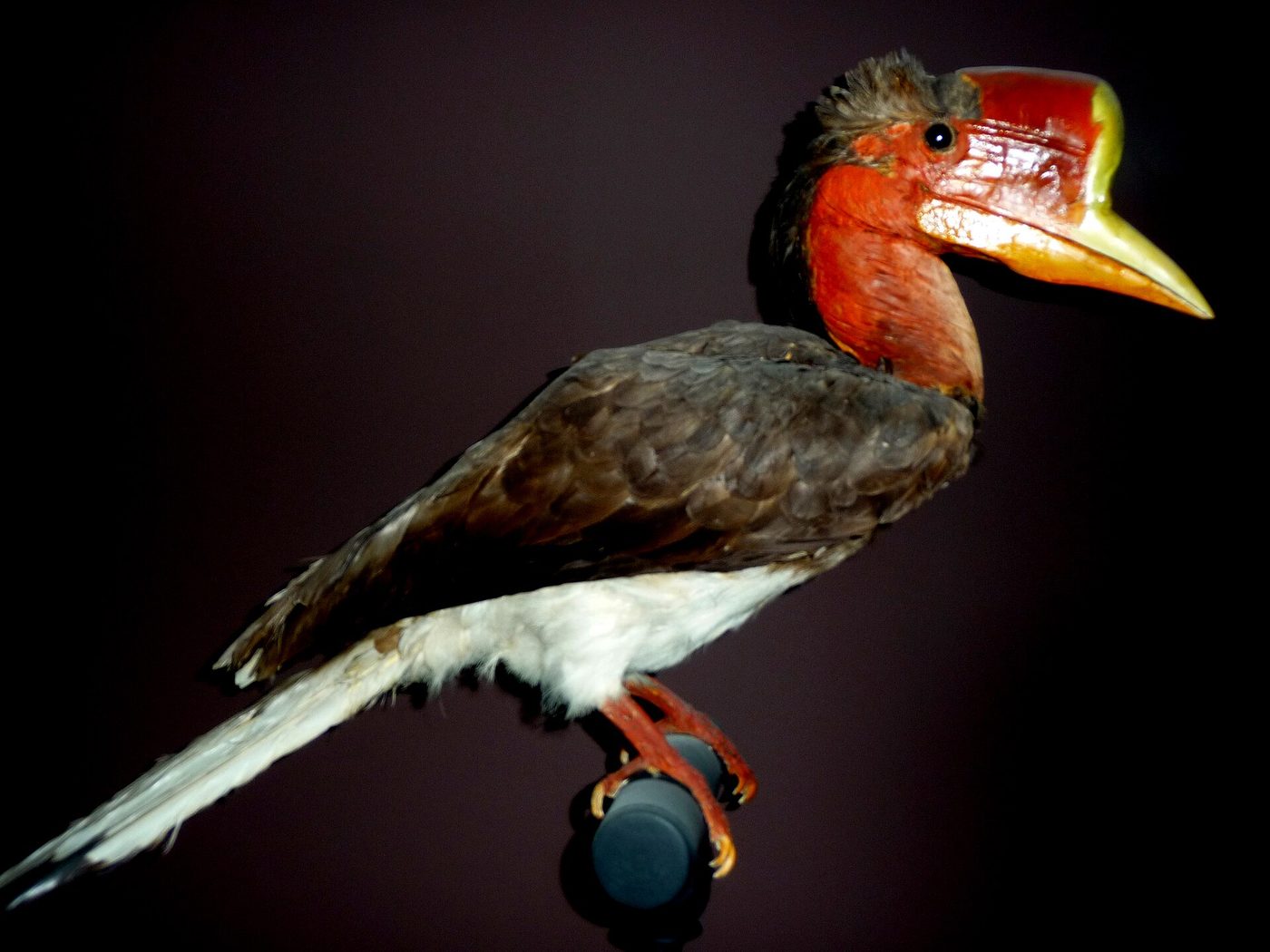
Photo: Citron · CC BY-SA 3.0
Helmeted hornbill
Rhinoplax vigil
The helmeted hornbill is a large Southeast Asian bird with a solid casque, used in aerial jousts, and a call audible for kilometres.
Characteristics
Temperament
Territorial; males in spectacular aerial casque duels.
Diet
Frugivorous: mainly figs and fruit, plus small animals.
The bird with an ivory helmet
The helmeted hornbill (Rhinoplax vigil) is one of the largest members of the hornbill family, about 1.2 metres long and weighing around 3 kg. Its most unusual feature is the casque above its bill: while in other hornbills it is hollow and light, in this species it is almost solid — a block of keratin making up some 11% of the bird's weight. The male has bare red skin on neck and throat, the female blue. Its long tail bears two greatly elongated central feathers.
Habitat and range
It lives in the rainforests of Southeast Asia: the Malay Peninsula, Sumatra, Borneo, Thailand and Myanmar. It is closely tied to mature forests with large trees, where it nests in natural cavities.
Behaviour and diet
It feeds mainly on fruit, especially figs, but also on small animals. Males use their solid casque in spectacular aerial duels: they collide head-on in flight, banging casque against casque, to contest the richest fruiting trees. Its call, a crescendo of notes ending in a booming "laugh", is among the loudest sounds of the forest and can be heard up to two kilometres away.
Did you know?
The solid casque, called "hornbill ivory", has for centuries been carved and traded as a precious material — which has made it a victim of intense poaching. Among the Punan Bah people, a great helmeted hornbill is believed to guard the river between life and death.
Conservation
The IUCN lists it as Critically Endangered. Hunting for the ivory casque, combined with rainforest destruction, has caused populations to collapse across its range. It is now the focus of urgent protective measures.
Pros
- A solid casque unique among hornbills
- Spectacular aerial duels between males
- A call among the loudest in the forest
Cons
- Critically endangered by poaching
- Hunted for the casque 'ivory'
- Depends on mature rainforest