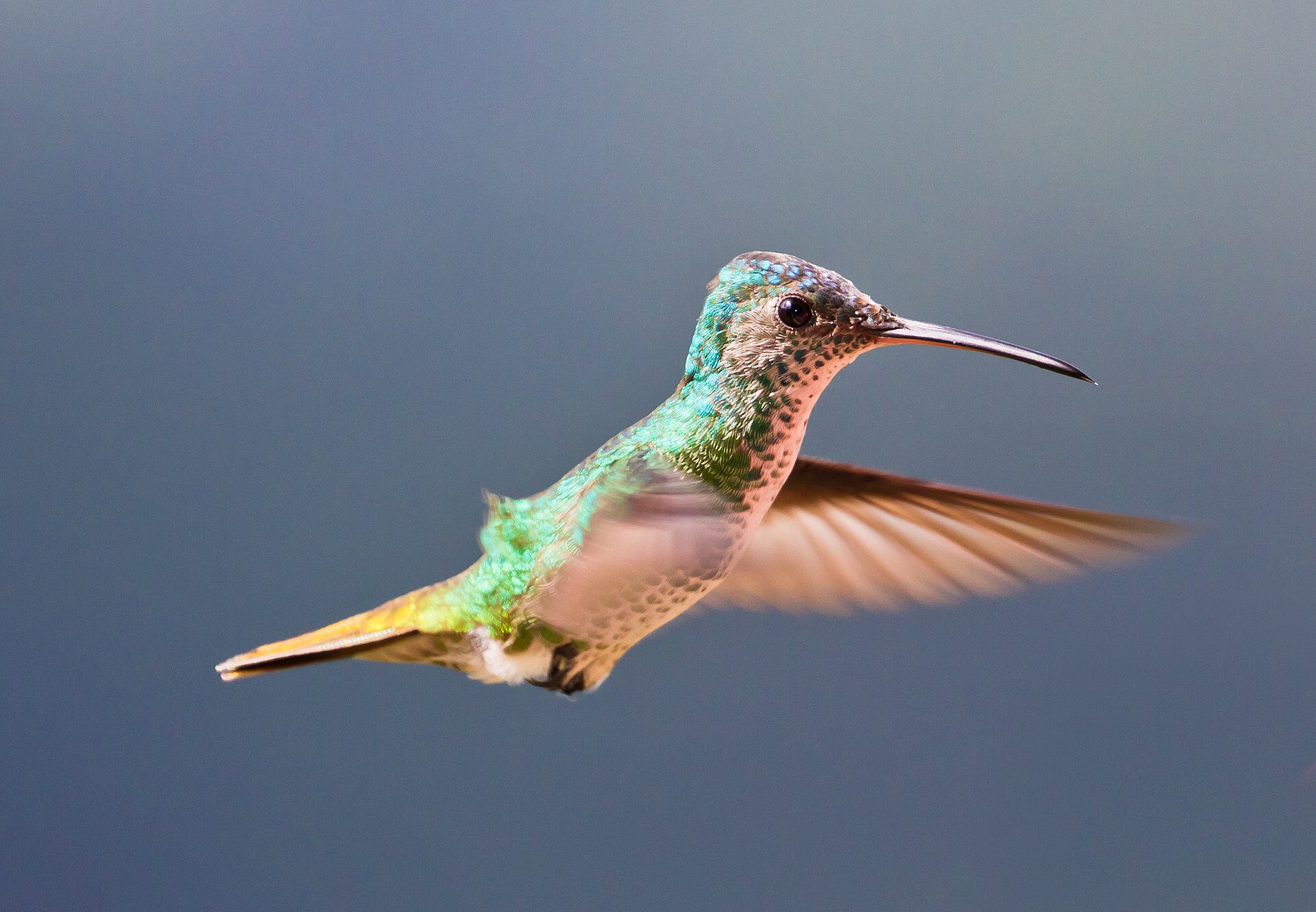
Hummingbird
Mellisuga helenae
Characteristics
Temperament
Solitary, territorial, diurnal, intelligent. Exceptional spatial memory (remember thousands of flowers). Aggressive fighters against intruders. Enter night torpor (temp from 39 to 18 °C). Only birds that fly backwards and upside down.
Diet
Specialised nectarivores (80-90% nectar): visit 1,000-2,000 flowers/day, consume nectar = double body weight. Supplement with small insects (spiders, midges). Tongue twice beak length with elastic pump.
Hummingbirds (family Trochilidae) are extraordinary birds, considered among the most fascinating evolutionary miracles in the world. They are the smallest birds on the planet, the only ones capable of hovering, flying backwards and even upside down, thanks to a unique anatomical and physiological evolution. Endemic to the Americas (from Alaska to Chile), they include 366 distinct species, from the tiny Mellisuga helenae (Cuban Bee Hummingbird, 5 cm and 1.8 g) to the "giant" Patagona gigas (Giant Hummingbird of Andean America, 23 cm and 24 g). Their extreme physiological characteristics — hyper-fast metabolism, heart rate up to 1,260 beats/minute, ability to enter night torpor — make them fundamental scientific models for the study of flight, energetics and bioengineering.
Classification and category
Hummingbirds belong to the order Apodiformes (the same as swifts and swiftlets), family Trochilidae, which comprises over 366 species distributed in 113 genera, divided into two main subfamilies: Trochilinae (the "typical hummingbirds", the majority) and Phaethornithinae (the "hermits", more primitive, mainly forest-dwelling). The smallest species is the Bee Hummingbird of Cuba (Mellisuga helenae): 5 cm in length, 1.8-2 g in weight — the smallest living bird in the world. The largest species is the Patagona gigas: 23 cm, up to 24 g. Most hummingbirds weigh between 3 and 8 g (less than a 1-cent coin). In the last 30 years the systematics of the family has been deeply revised thanks to molecular genetics: 9 main clades and numerous cryptic species have been identified.
Habitat and distribution
Hummingbirds are exclusively American: their distribution covers the entire continent, from southern Alaska (Anna's Hummingbird, Calypte anna) to the tip of Patagonia (Chilean Emerald Hummingbird, Sephanoides sephaniodes). Maximum diversity is found in the tropical forests of Central and South America (in Ecuador 132 species live, in Colombia 165, more than any other country in the world). Preferred habitats are: rainforests, high-altitude cloud forests, gardens with flowers, cerrado, gallery forests, alpine grasslands.
They are very adaptable species: they live from sea level to 5,000 m altitude in the Andes. Some species are highly migratory: the Ruby-throated Hummingbird (Archilochus colubris) performs one of the most impressive migrations in the avian world, crossing the Gulf of Mexico in 18-22 hours of continuous flight (about 800 km non-stop), and travelling annually 3,000-5,000 km between Canada and Central America. The Rufous Hummingbird (Selasphorus rufus) holds the record for longest migration in proportion to size (weight 3 g, travels 8,000 km annually). Conservation status varies by species: the majority are Least Concern (LC), but 22 species are classified Endangered (EN) or Critically Endangered (CR) due to habitat loss (tropical deforestation, palm monocultures) and climate change. The Cuban species of Bee Hummingbird is particularly threatened, with population estimated at only 22,000-66,000 individuals.
Diet
Hummingbirds are specialised nectarivores: nectar from flowers constitutes 80-90% of their diet. They are the main vertebrate pollinators of many American plant species (over 7,000 plant species depend on hummingbirds for pollination, particularly the families Heliconiaceae, Bromeliaceae, Gesneriaceae). The species have coevolved with hummingbirds developing tubular, red or orange flowers (hummingbirds see red very well, while many insects do not), which reduce competition with bees and butterflies.
The metabolism of hummingbirds is the highest in the animal kingdom: to sustain it, they must feed almost continuously. An average hummingbird visits 1,000-2,000 flowers a day, consuming an amount of nectar equal to twice its own body weight. Nectar provides sugars (immediate energy) but is poor in proteins: to supplement essential proteins and amino acids, hummingbirds hunt small arthropods (spiders, midges, aphids) in flight or extracting them from flowers. Proteins constitute 10-20% of the diet. They develop an excellent spatial memory to track their food resources: they remember thousands of individual flowers, the time elapsed since the last visit, and optimise foraging. The tongue is a unique structure: twice as long as the beak, forked at the end, can extract nectar with speed of 13-17 extractions per second thanks to a hydraulic mechanism of "elastic pump" (discovered in 2011 by Prof. Alejandro Rico-Guevara, University of Connecticut).
Physical features
Hummingbirds have a compact, aerodynamic, miniaturised body. The wings are small, narrow, elongated, articulated in a unique way: unlike other birds (which articulate the wing mainly at the elbow and wrist), hummingbirds articulate almost exclusively at the shoulder, allowing a 180° rotation of the wing. This allows the "figure 8 flight": each cycle the wing traces a horizontal figure 8, generating lift both in the downward and upward beat (unlike all other birds, which generate lift only in the downward beat). Result: prolonged hovering, backward flight, lateral flight and even upside-down flight (for short stretches during courtship).
The wing frequency varies by species: 12-15 beats/sec in large species, up to 80 beats/second in the smallest hummingbirds. The characteristic "hum" buzz that gives the family its English name (hummingbird = humming bird) is produced by the rapid wing beat. The heart is enormously developed in proportion to the body: it represents 2.4% of body mass (in humans 0.5%), and beats at record frequencies (250 bpm at rest, 1,260 bpm in activity). The beak is long, thin, straight or curved (depending on species and the flowers it pollinates). The male plumage is spectacular: it contains nanoscopic chemical and physical structures that produce iridescent colours (greens, reds, purples, golds) by optical interference, similar to those of butterfly wings. The males' throat (called "gorget") is particularly bright and changes colour with the angle of observation: it is a courtship signal. Females have more subdued colouration for camouflage during nesting.
Behaviour and curiosities
Hummingbirds are solitary, territorial, diurnal, surprisingly intelligent animals. Most species live alone (except during courtship and parental care) and aggressively defend their flowered territory, attacking in flight even much larger intruders (including raptors). Communication includes shrill vocalisations, wing buzz, "U" or "V" courtship "dances" of the male.
The night torpor is one of the most extraordinary physiological adaptations: to reduce energy consumption at night, when they cannot feed, hummingbirds enter a state of controlled hypothermia: body temperature drops from 39-42 °C to 18-21 °C, heart rate from 1,200 to 50 bpm, oxygen consumption drops by 90%. In the morning they "warm up" by shivering and take off in 15-20 minutes. This allows survival in freezing nights at high altitude. The nesting is carried out by the female alone: she builds a small nest (4-5 cm in diameter) of moss, lichens, spider web and plant fibres, on a horizontal branch. She lays 2 white eggs, each about the size of a bean (12 mm × 8 mm). Incubation lasts 14-23 days, the young fly at 18-30 days. The average longevity is 3-5 years, with documented records up to 12 years for the Broad-tailed Hummingbird. Cultural curiosity: in Mayan myths hummingbirds are spirits of warriors killed in battle; for the Aztecs the war god Huitzilopochtli was represented as Hummingbird; in Amazonian cultures they are messengers between spiritual worlds. The famous "Hummingbird Effect" describes Steven Johnson's evolutionary idea: innovations in one sector produce unexpected changes in other sectors, such as the evolution of pollen has "created" the evolution of pollinators.
Pros
- Più piccoli uccelli del mondo (5 cm, 1,8 g per Mellisuga helenae)
- Unici uccelli capaci di hovering, volo all'indietro e capovolto
- Frequenza alare record (fino 80 battiti/sec)
- Impollinatori vertebrati di 7.000+ specie vegetali americane
Cons
- Detenzione vietata (specie CITES II)
- In cattività necessitano dieta nettare specifica + insetti vivi
- Molte specie minacciate da deforestazione e clima
- 22 specie EN/CR (es. Colibrì zunzuncito di Cuba)