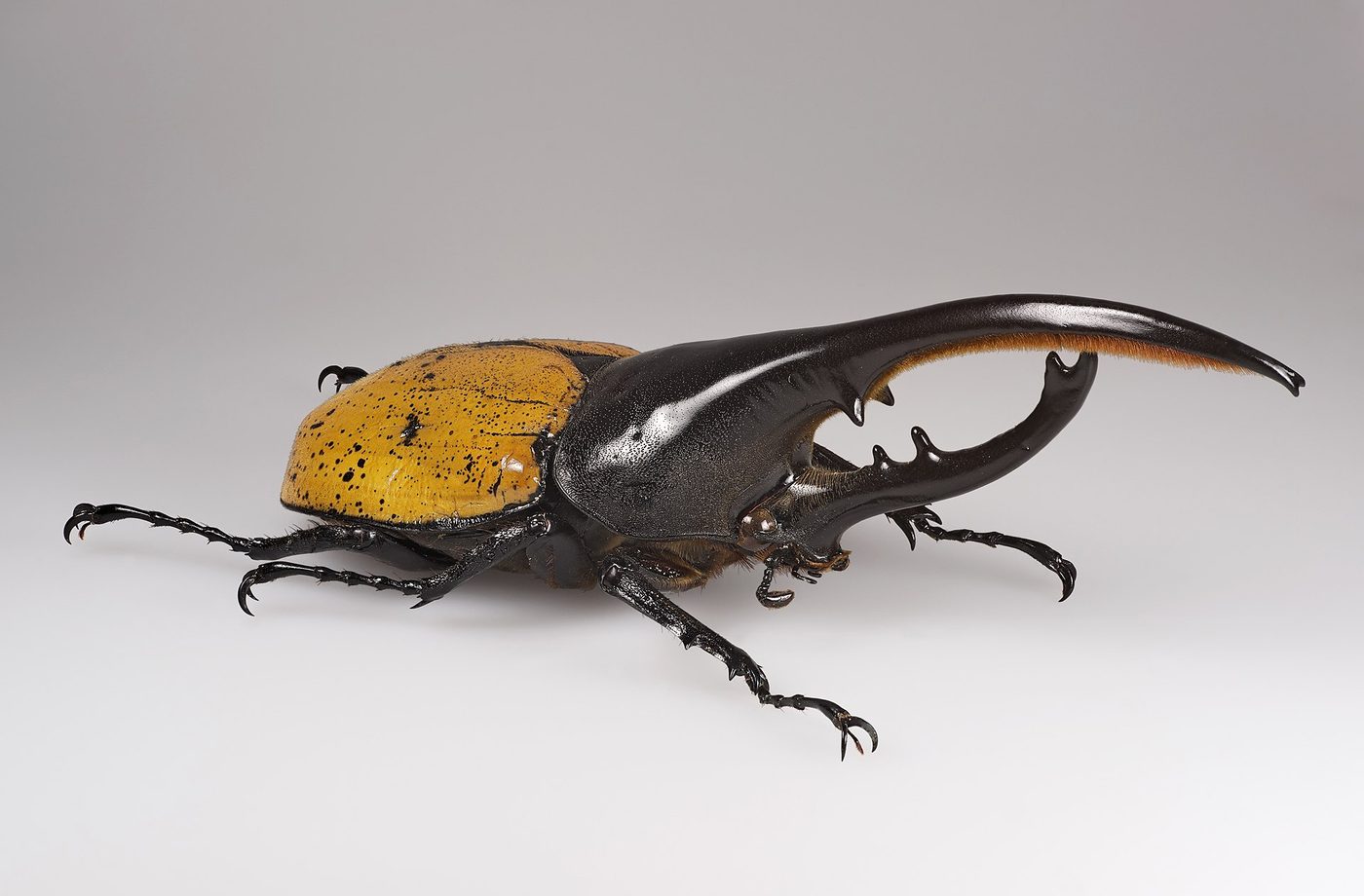
Photo: Didier Descouens · CC BY-SA 4.0
Hercules beetle
Dynastes hercules
Armed with enormous horns and able to lift extraordinary weights, the Hercules beetle is the longest beetle in the world, a giant of the American tropical forests.
Characteristics
Temperament
Harmless, nocturnal, males fight each other
Diet
Larva: rotting wood; adult: fruit and sap
A giant among insects
The Hercules beetle is one of the largest and most spectacular insects on the planet, as well as the longest beetle in existence: males can exceed 17 centimetres in total length, horn included. Its most striking feature is precisely the male's pair of horns: a long, curved one projecting from the thorax and a shorter one on the head, which together form a sort of great pincer. The elytra, the armour that protects the wings, are often of light colours, from olive green to yellowish, scattered with dark spots, and can change shade according to humidity. The females, lacking horns, are smaller and entirely black.
Habitat and distribution
It lives in the tropical forests of southern Mexico, Central and South America and the Lesser Antilles. It prefers humid, lush forests, where it finds the decaying wood and ripe fruit on which it feeds in the different phases of its life.
Extraordinary strength and behaviour
The Hercules beetle is famous for its strength: in proportion to its size, it is one of the strongest animals in the world, able to lift and move weights many times greater than its own. The males use their large horns in fights between rivals: they confront each other, trying to grip the opponent and flip it over, to win the right to mate with the females. Despite its imposing appearance, it is completely harmless to humans.
Life cycle and curiosities
The life of the Hercules beetle is divided into very different phases. The larva, a large white grub, spends one or two years feeding on rotting wood, growing to a remarkable size. After metamorphosis, the adult lives only a few months, feeding on fruit and sap, with the sole purpose of reproducing. For its impressiveness and beauty it is one of the most admired and sought-after insects by enthusiasts all over the world.
Pros
- The longest beetle in the world
- Among the strongest animals in proportion
- Spectacular horns in males
- Completely harmless to humans
Cons
- Adult life of only a few months
- Depends on humid tropical forests
- Sought after by the collector-insect trade