Iberian Lynx
Lynx pardinus
Characteristics
Temperament
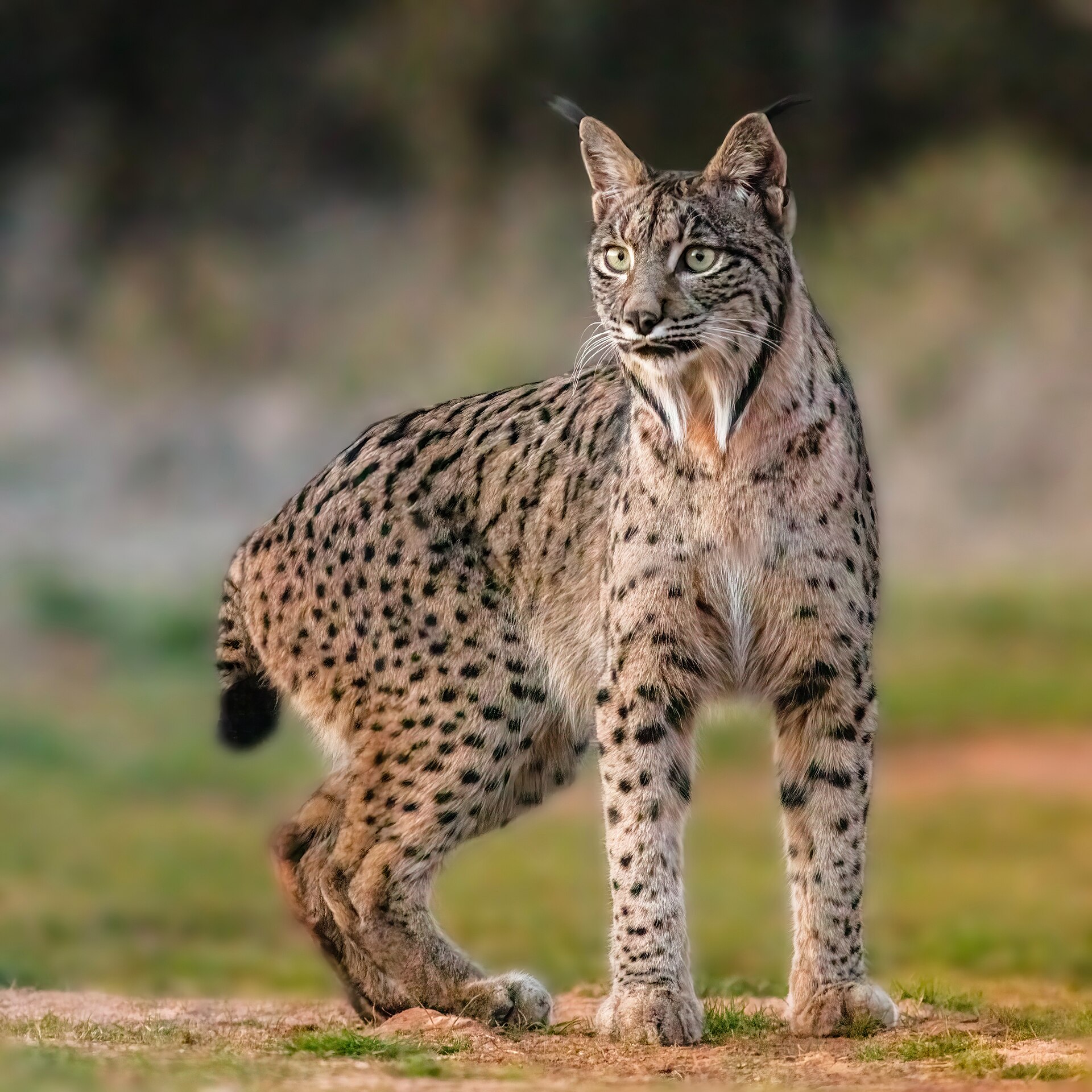
Solitary, crepuscular-nocturnal, territorial. MOST SPECIALISED felid in the world: depends almost totally on European rabbit (80-100% diet!). EXEMPLARY RECOVERY STORY: 94 individuals 2002 → 2,000+ 2024, IUCN from CR to EN. Endemic to Iberia. Short ear tufts, long "FAVORITAS" on chin (diagnostic). Very short tail (10-15 cm) with black tip. Spotted coat.
Diet
Specialised carnivore. European rabbit (Oryctolagus cuniculus) 80-100% of diet — RECORD specialisation among felids! 1-2 rabbits/day (~600-800 g meat). Other prey only when rabbits scarce: rats, mice, hares, partridges, pheasants, ducks, fawns. Ambush hunting + sprint 50-70 km/h. Requires rabbit density 1-3/ha. RHDV crisis 90s/2010 = main cause of species decline.
The Iberian Lynx (Lynx pardinus), known in Spanish as Lince ibérico, in Portuguese as Lince-ibérico, is one of the rarest felids in the world and endemic to the Iberian Peninsula (Spain and Portugal). It is a medium-sized felid (9-13 kg) characterised by:
- Extreme dietary specialisation: the European rabbit (Oryctolagus cuniculus) constitutes 80-100% of the diet — the most specialised diet among all felids in the world
- Black ear tufts: typical of lynxes, but shorter than other Lynx species
- Hairy "favoritas": long hairs around chin and jaw — characteristic and diagnostic
- Short tail: 10-15 cm, with black tip
- Spotted coat: dark spot pattern on beige-brown background — distinguished from Eurasian Lynx (more uniform)
The Iberian Lynx is famous for the most spectacular recovery story among all felids: in 2002, only 94 individuals remained in 2 isolated populations (Doñana and Sierra Morena, Andalusia) — on the brink of extinction. Thanks to one of the most ambitious conservation programmes ever (LIFE Iberlince, LIFE LynxConnect), in 2024 the population reached over 2,000 individuals in 12+ populations distributed between Andalusia, Castile-La Mancha, Extremadura and southern Portugal. In June 2024 the IUCN downlisted the species from Critically Endangered to Endangered — an unprecedented result for a large wild felid.
Classification and category
The Iberian Lynx belongs to order Carnivora, family Felidae, subfamily Felinae (NOT Pantherinae!), genus Lynx. The genus Lynx comprises 4 living species: Lynx pardinus (Iberian Lynx — smallest and most specialised), Lynx lynx (Eurasian Lynx — largest, in catalogue), Lynx canadensis (Canadian Lynx), Lynx rufus (Bobcat).
The Iberian Lynx diverged from the Eurasian Lynx about 1.1-1.6 Mya, isolated in the Iberian Peninsula during Pleistocene glaciations. It is thus a distinct species, not a subspecies of L. lynx.
Etymology: "Lynx" from Greek "lynx", related to "flashing" — reference to brilliant eyes. "Pardinus" from Latin "pardus" (panther, leopard) — reference to spotted coat. Described scientifically by Temminck in 1827.
Morphological parameters: Weight M 11-13 kg, F 9-11 kg (record M 15 kg). Head-body 85-110 cm. Shoulder height 45-70 cm. Tail 10-15 cm. Longevity: 13-15 years in nature, up to 20-25 in captivity. Sexual maturity: 2-3 years. Gestation: 65-72 days. Litter: 2-4 cubs (avg 2-3). 1 litter/year. Juvenile mortality 50-70% in first year.
Habitat and distribution
Strictly endemic to Iberian Peninsula. Historical distribution: whole peninsula; current limited to 12+ populations across Spain and Portugal. Andalusia: Doñana (~120), Sierra Morena (~500). Castile-La Mancha: 4 reintroduced populations (~900 total). Extremadura: 3 populations (~200). Murcia: ~30. Portugal: Vale do Guadiana (~250). Habitats: Mediterranean scrubland (macchia), gallery forests, pine groves, oak woodlands, dehesa pastures. IUCN: Endangered (EN) since 2024 (was CR 2002-2024). Population: ~2,000 individuals (~1,300 mature). Threats: rabbit decline (RHDV virus from 1988, RHDV2 from 2010), road accidents (main adult cause), poaching, habitat fragmentation, stray dog diseases, inbreeding, climate change. CITES: Appendix I.
Recovery history: 1900 ~100,000 → 1960 ~5,000 → 1988 ~1,000 → 2002 NADIR 94 → 2003 captive breeding started → 2009 first releases → 2024 ~2,000 → IUCN downlisted. Programmes: 4 captive breeding centres, LIFE Iberlince (€33M), LIFE LynxConnect (€18M).
Diet
Most specialised felid in the world. European rabbit 80-100% of diet (most extreme specialisation among felids). 1-2 rabbits/day per adult (~600-800 g meat). Other prey (5-10% only when rabbits scarce): rats, mice, hares, partridges, pheasants, ducklings, fawns, occasional carrion. Hunting technique: ambush + visual location + stalking + sprint 50-70 km/h + nape bite + on-site consumption. Requires minimum density 1-3 rabbits/ha. Rabbit crisis (RHDV) = main driver of species decline.
Physical features
Smallest lynx. Coat: fulvous/light brown/cream base with dark (brown-black) spots — 3 patterns (small spots common, large, intermediate). White belly, ringed tail with black tip. Head: 1-2 cm black ear tufts (shorter than other lynxes), prominent "favoritas" (long chin/jaw whiskers — diagnostic), yellow/amber eyes, pink/black nose, strong jaws. Body: long hind legs (jump adaptation), large robust paws, VERY short tail (10-15 cm) with black tip. Sprint 50-70 km/h, jump 4-5 m horizontal. Vision 6-8× human. Hearing detects rabbits underground.
Behaviour and curiosities
Solitary, crepuscular-nocturnal, territorial. Territory 5-20 km² F, 10-30 km² M. Mating January-February (vocalisations "aullidos"). Births March-April. 2-4 cubs (avg 2-3), 200-250 g at birth, blind, spotted feet. Eyes open 7-10 days. Sibling infanticide (50% mortality first year). Independence 12-18 months. Extremely shy — no fatal attacks on humans documented.
Famous curiosity: "most spectacular felid recovery". 2002 nadir 94 individuals → 2024 ~2,000 individuals via captive breeding (4 centres), releases (200+), ecological corridors, road underpasses, rabbit reintroduction, EU programmes (LIFE Iberlince/LynxConnect). IUCN downlisted 2024 — recognised as "one of the greatest conservation successes of the 21st century". Rabbit dependency: 80-100% diet on European rabbit, coevolved 1+ Mya, RHDV virus = main decline cause. "Favoritas": distinctive long chin/jaw whiskers, function unknown (signalling? face protection?). Cultural icon: Spanish/Portuguese commemorative coins, stamps, parks logos, WWF mascots. vs Eurasian Lynx: smaller (9-13 vs 18-30 kg), spottier coat, shorter tufts, more pronounced favoritas, Mediterranean macchia habitat (vs boreal forest), rabbit specialist (vs deer generalist), Iberia-only (vs Eurasia-wide). Ecological corridors: 100+ underpasses/bridges from LIFE LynxConnect reduced road mortality 60% in 5 years. Longevity: 17 years in nature, record 22 captivity.
Pros
- Storia di recupero più spettacolare tra felini (94→2000+)
- Icona della conservazione della fauna selvatica iberica
- Specie più specializzata al mondo (dipendenza coniglio)
- Programmi LIFE UE da 50+ milioni € dimostrano successo
Cons
- Dipendenza estrema dal coniglio (vulnerabile a RHDV)
- IUCN Endangered, popolazione ancora fragile
- Frammentazione genetica residua (basso pool genetico)
- Mortalità stradale rimane causa principale morte adulta