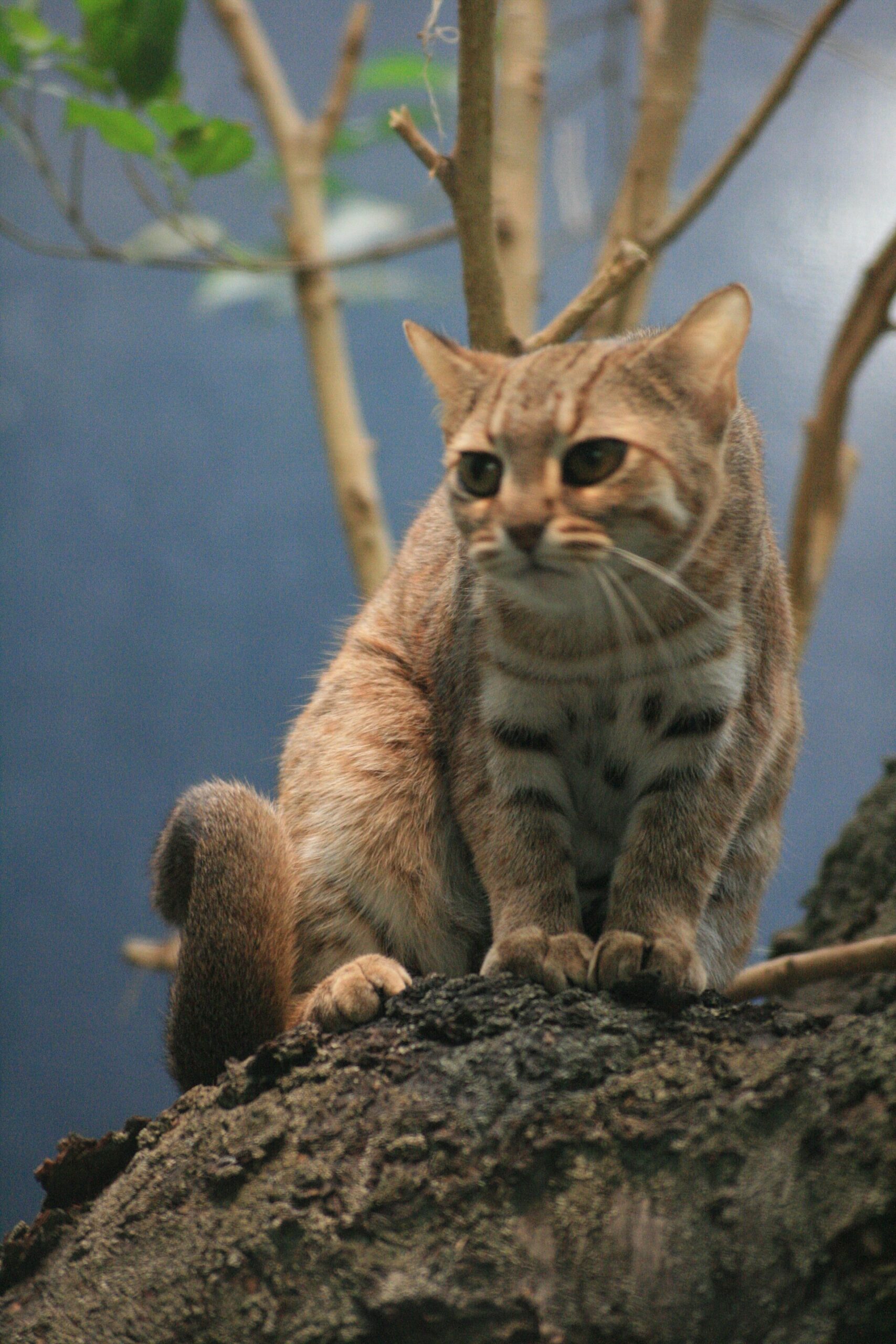
Rusty-spotted Cat
Prionailurus rubiginosus
Characteristics
Temperament
A nocturnal, solitary, shy wild feline, yet bold and very lively in temperament despite its tiny size. Very fast, nervy and tireless, it is an extremely agile hunter, nicknamed "the hummingbird of cats". Extremely elusive in the wild, it spends the day hidden and hunts in the dark. It is NOT a pet: it is a small wild predator close to being threatened, to be protected in its habitat. Its resemblance to a kitten makes it charming, but it remains a wild animal in every respect.
Diet
A carnivorous predator adapted to its tiny size. It feeds mainly on rodents and small mammals (the basis of the diet), as well as birds, lizards, frogs and insects. It hunts at night, using extraordinary agility, speed and reflexes to surprise small but numerous prey; its very keen senses and large eyes adapted to night vision amply compensate for its reduced size. It is a bold, tireless hunter, highly efficient at controlling small animals.
The Rusty-spotted Cat (Prionailurus rubiginosus) is one of the most astonishing felines in the world: the smallest wild cat on the planet, a hunter in miniature with enormous eyes. Famous for:
- Record size: it is the smallest of the wild cats, barely half the size of a common house cat
- Enormous eyes: large and bright relative to its little head, adapted to nocturnal life, giving it a perpetually "kitten-like" look
- The "rusty" coat: grey with rows of rusty spots and streaks along the back and flanks
- Prodigious agility: very fast and nervy, it is nicknamed "the hummingbird of the cat family"
- A bold nature: tiny but brave, it is a tireless predator
- Illustrious kinship: it belongs to the same genus as the leopard cat and the fishing cat
IUCN status: Near Threatened (NT). It joins the many wild felines of the portal as their most minuscule member: among lions, tigers and leopards, the Rusty-spotted Cat is a reminder that the cat family also includes true miniatures, no less fascinating than the great predators.
Classification and category
Order Carnivora, family Felidae (the felines), genus Prionailurus — the same as the leopard cat (Prionailurus bengalensis) and the fishing cat (Prionailurus viverrinus), both in the portal. Together they form the group of the small spotted Asian cats. In the portal it is placed among the Wild felines. It is useful to place it among the other small cats: the Rusty-spotted Cat is the smallest of all, contesting the record with the African black-footed cat; the leopard cat, its cousin, is larger and is the wild ancestor of the domestic Bengal breed; the fishing cat, another relative, is instead a sturdy swimmer tied to wetlands. Etymology: the scientific name "rubiginosus" means "rusty", referring to the characteristic rusty spots of the coat; the genus Prionailurus refers to "saw-/streak-backed cats". Parameters — a true featherweight: Head-body length about 35-48 cm. Tail about 15-30 cm. Weight just 0.9-1.6 kg (about half a domestic cat). Longevity little known in the wild, but in captivity it can exceed 10-12 years. Reproduction: the female usually gives birth to 1-2 kittens, tiny, raised in a hidden shelter.
Habitat and distribution
The Rusty-spotted Cat is a feline with a range restricted to the Indian subcontinent: India, Sri Lanka and, discovered more recently, Nepal. Preferred habitats — it is more adaptable than once thought: deciduous and moist forests; scrub, grasslands and rocky areas with dense vegetation; and farmland and the surroundings of villages, where it hunts rodents, sometimes sheltering in barns and abandoned buildings. Long considered very rare, it is in fact probably more widespread than believed, but extremely hard to observe due to its small size and nocturnal, shy habits. It favours environments with good plant cover, where it can hide and hunt. It is an excellent climber, but hunts mainly on the ground. Its dependence on vegetated areas makes it vulnerable to land transformation. IUCN: Near Threatened. The main threats are the loss and fragmentation of habitat due to agricultural expansion, as well as road collisions and, locally, persecution. Its biology remains in part little known.
Diet
The Rusty-spotted Cat is a carnivorous predator with agile, tireless hunting suited to its tiny size. It eats: rodents and small mammals (mice and other small animals are the basis of the diet); birds, which it catches with lightning lunges; and lizards, frogs and insects. Hunting strategies: speed and agility (it moves in very fast bursts, using extraordinary reflexes to surprise prey); nocturnal hunting (it operates mainly in the dark, when small mammals are active); and boldness (despite its size, it faces prey and situations with great courage). Crucially, for such a small hunter the diet is made of small but numerous prey. Its extraordinary agility and very keen senses amply compensate for its reduced bulk, making it a highly efficient predator in its "pocket format".
Physical features
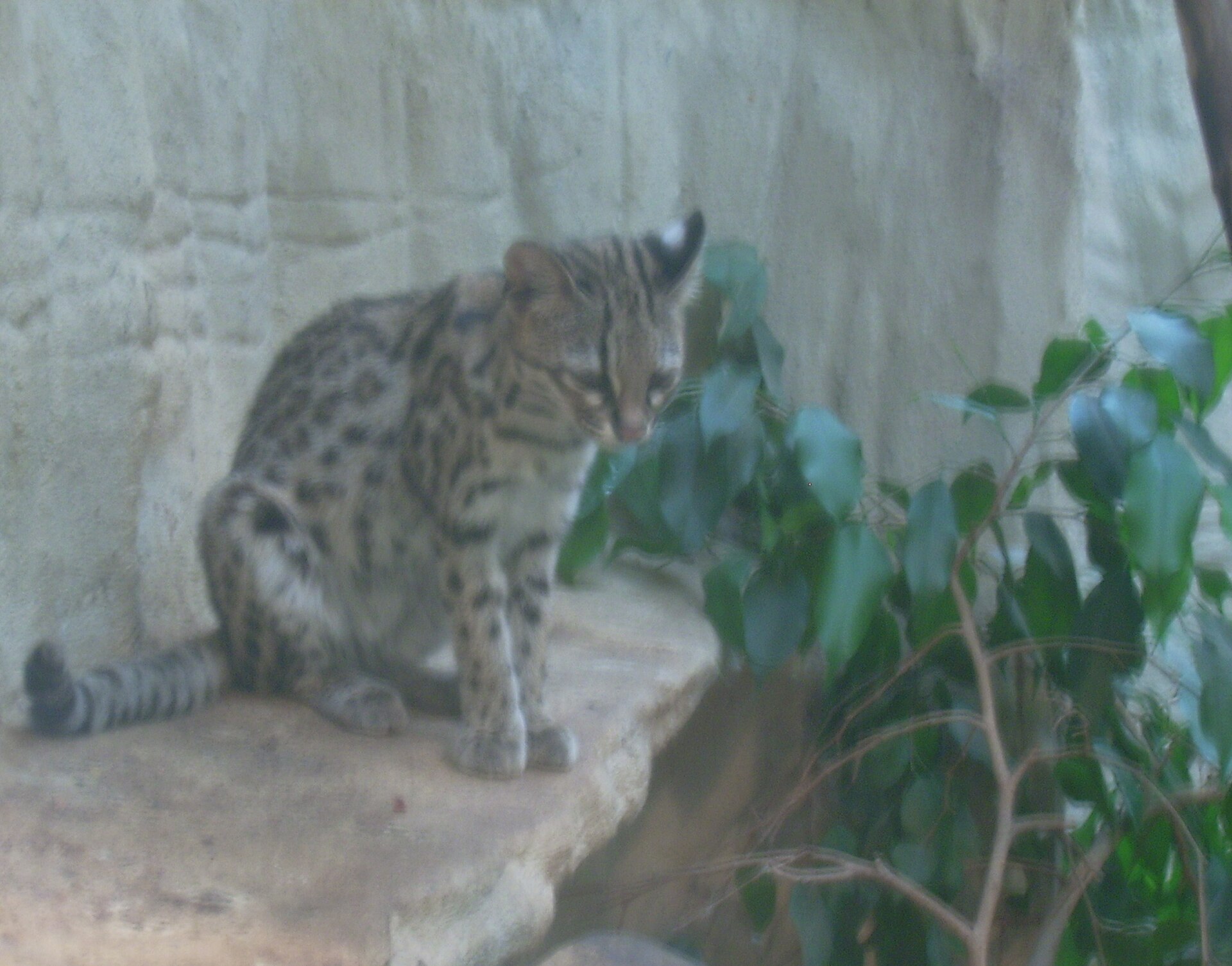
A tiny, slender feline with a perpetually youthful look. Coat and colouring: short fur, grey tending to brown at the base; rusty spots and streaks arranged in rows along the back and flanks, hence the name; white underparts with dark spots; dark streaks on the muzzle and head. The body and head: a small, slim body with relatively short legs; a round little head with very large eyes for its proportions, giving it a sweet, "kitten-like" look even as an adult; a relatively short tail, about half the body length. Performance: exceptional agility and speed (lightning, nervy movements); a good climber, though it hunts mainly on the ground; and very keen senses (night vision, hearing), typical of small cats.
Behaviour and curiosities
The Rusty-spotted Cat is a nocturnal, solitary, shy animal. It spends the day hidden in crevices, tree hollows or dense vegetation, and comes out in the dark to hunt. Precisely because of this secrecy and its small size, it is one of the hardest felines to spot and study in the wild, and much of its biology remains shrouded in mystery.
The smallest cat in the world: the Rusty-spotted Cat holds, together with the African black-footed cat, the record of the smallest wild feline on the planet — as an adult it weighs barely a kilo or a little more, about half a common house cat, and could comfortably fit in two cupped hands; a striking record, considering it belongs to the same family as lions and tigers. The "hummingbird of cats": despite its tiny size, the Rusty-spotted Cat is a bold, darting, tireless hunter; its very fast, nervy movements have earned it the nickname "the hummingbird of the cat family"; it is said that, though so small, it is anything but timid: in captivity it often shows a lively, enterprising temperament, a true feline in miniature. The eyes of an eternal kitten: one of the Rusty-spotted Cat's most endearing features is its eyes, enormous relative to its small head; this proportion, combined with its small size, means the animal keeps a kitten-like look even as an adult, making it extraordinarily "cute" to human eyes; the large eyes are, however, a very serious adaptation: they capture as much light as possible for night hunting. The Bengal's cousin: the Rusty-spotted Cat belongs to the same genus (Prionailurus) as the leopard cat, which is the wild ancestor of the popular domestic Bengal breed, also in the portal; they are thus close "relatives": small spotted Asian cats, agile and with striking coats; the Rusty-spotted Cat, however, is even smaller and has never been domesticated. The forest ghost: for decades the Rusty-spotted Cat was considered very rare, precisely because it was almost impossible to observe; more recent studies, with camera traps and new research, have shown it is probably more widespread and adaptable than thought, able to live even near villages and in farmland; it remains, however, an elusive, little-known species, and habitat loss threatens its future. The little big predator: the Rusty-spotted Cat shows that, in the world of felines, size is not everything; with its kilo of weight it manages to be a highly efficient hunter of mice, birds and lizards, occupying a valuable ecological niche in controlling small animals; it is a perfect example of how the cat family has "invented" predators of every size, from the giant lion to the tiny rusty-spotted cat.
Pros
- Affascinante primato: il più piccolo gatto selvatico del mondo
- Predatore agilissimo e utile nel controllo di roditori e piccoli animali
- Parente del gatto leopardo e del gatto pescatore: completa il quadro dei Prionailurus
- Specie elusiva e poco nota: stimola la ricerca e la curiosità naturalistica
Cons
- NON è un animale domestico: è un piccolo felino selvatico, mai addomesticato
- IUCN Near Threatened: minacciato da perdita e frammentazione dell'habitat
- Elusivo e difficile da studiare: biologia ancora poco conosciuta
- L'aspetto "da gattino" può alimentare un dannoso desiderio di tenerlo come animale esotico