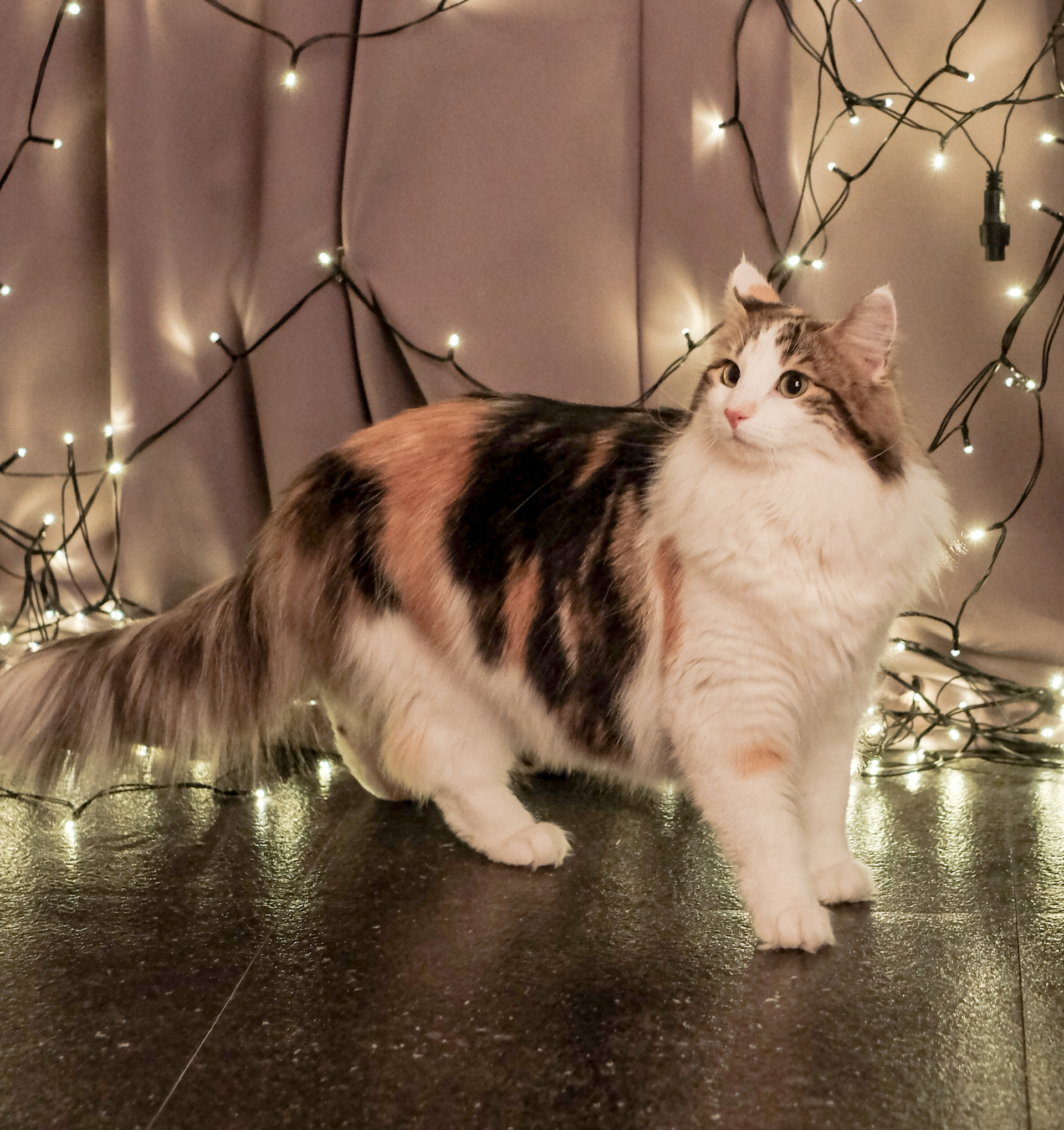
Norwegian Forest Cat
Felis catus
Characteristics
Temperament
Balanced, independent, quiet, silent. Chooses a "favourite human". Excellent hunter, loves to climb. National Norwegian breed, Viking legend. Able to descend trees head-down.
Diet
Obligate carnivore, robust metabolism. 350-500 kcal/day in 2-3 meals. High-quality kibble rich in protein (38-45% min) or wet/BARF. DNA test for glycogenosis IV recommended.
The Norwegian Forest Cat (Felis catus), known in original language as Norsk Skogkatt or Skogkatt, is one of the oldest and most fascinating cat breeds in Northern Europe. Descendant of the cats that accompanied the Vikings on their voyages across the northern seas, it has developed a double waterproof coat and robust build to survive the harsh Scandinavian winters. Protagonist of Norse mythology (the goddess Freyja's chariot was pulled by two large cats, traditionally identified as Skogkatt), it is today one of the most beloved breeds in the world for its imposing beauty, balanced temperament and extraordinary adaptability to both cold and temperate environments.
Classification and category
The Norwegian Forest Cat belongs to the species Felis catus, the domestic subspecies derived from the African wildcat (Felis silvestris lybica). It is classified by FIFe in Category II — Semi-longhair Cats (code NFO), by the British GCCF in Group 4, by TICA as Traditional. The standard provides for a large size: weight 4-7 kg for females, 6-9 kg for males (some specimens up to 11 kg), withers height 30-40 cm. The structure is imposing and harmonious, with long back, long and sturdy legs, solid bone. Physical maturity is reached late (4-5 years), much more slowly than other cat breeds. The breed was officially recognised by FIFe in 1977, declared national breed of Norway by King Olav V in the same year; TICA recognised it in 1984. There are no subtype variants: the standard is unique for coat, structure and size, but dozens of colourings are accepted.
Habitat and distribution
The Norwegian Forest Cat is a completely domestic breed, but with an exceptional predisposition for outdoor life. Its wild origins make it perfect for rural environments with garden or outdoor access, where it can express its natural skills as hunter and climber. It tolerates cold climates very well: the double waterproof coat protects it from temperatures down to -30 °C; on the contrary, it suffers extreme tropical climates, where it loses much of the undercoat in intense summer moulting.
Historical origins date back to the Viking cats brought to Scandinavia between the 9th and 11th centuries, perhaps from Turkish Angora cats that entered Nordic trade. They lived freely in Scandinavian farms, where they hunted rodents in farms and ships (cats were considered "good luck" of Viking ships and were carried on long voyages). For over 1,000 years they remained a "natural breed" not standardised, evolving freely in the forests and farms of Norway. Modern standardisation began only in the 1930s with the work of Norwegian cinephile Knut Heggen and was interrupted by World War II (which brought the breed close to extinction due to crossbreeding with stray cats). In the 1970s a genetic conservation programme selected the last "pure" specimens from the Norwegian forests, reconstituting the modern breed. Today it is widespread globally, with significant populations in Norway (country of origin), Scandinavia, USA, Russia, central Europe, Italy, Japan. The average price of a pedigree FIFe kitten is 1,000-2,000 euros; show line specimens can reach 2,500-4,000 euros.
Diet
The Norwegian Forest Cat is an obligate carnivore with a robust metabolism and typically sustained appetite, especially during slow growth (3-5 years). The daily caloric requirement of an adult is 350-500 kcal (depending on weight, sex and activity), distributed in 2-3 meals. The ideal diet consists of high-quality kibble rich in animal protein (minimum 38-45%, higher values than other breeds for the imposing muscle structure) and low in grains, or wet feeding (cans) or BARF under veterinary supervision.
The breed is generally robust, with fewer genetic predispositions than other pure breeds, but some pathologies are present: hypertrophic cardiomyopathy (HCM), glycogen storage disease type IV (rare, fatal in kittens, a DNA genetic test exists for breeders), hip dysplasia (common in large breeds). Annual cardio screening from 4 years onwards and pre-mating DNA testing are recommended. Due to its sturdy structure it also tends to develop joint problems in advanced age. Water must always be available, fresh: long hair requires greater hydration. Portions must be controlled after sterilisation (30% metabolism drop): a 6 kg neutered adult needs about 300 kcal/day.
Physical features
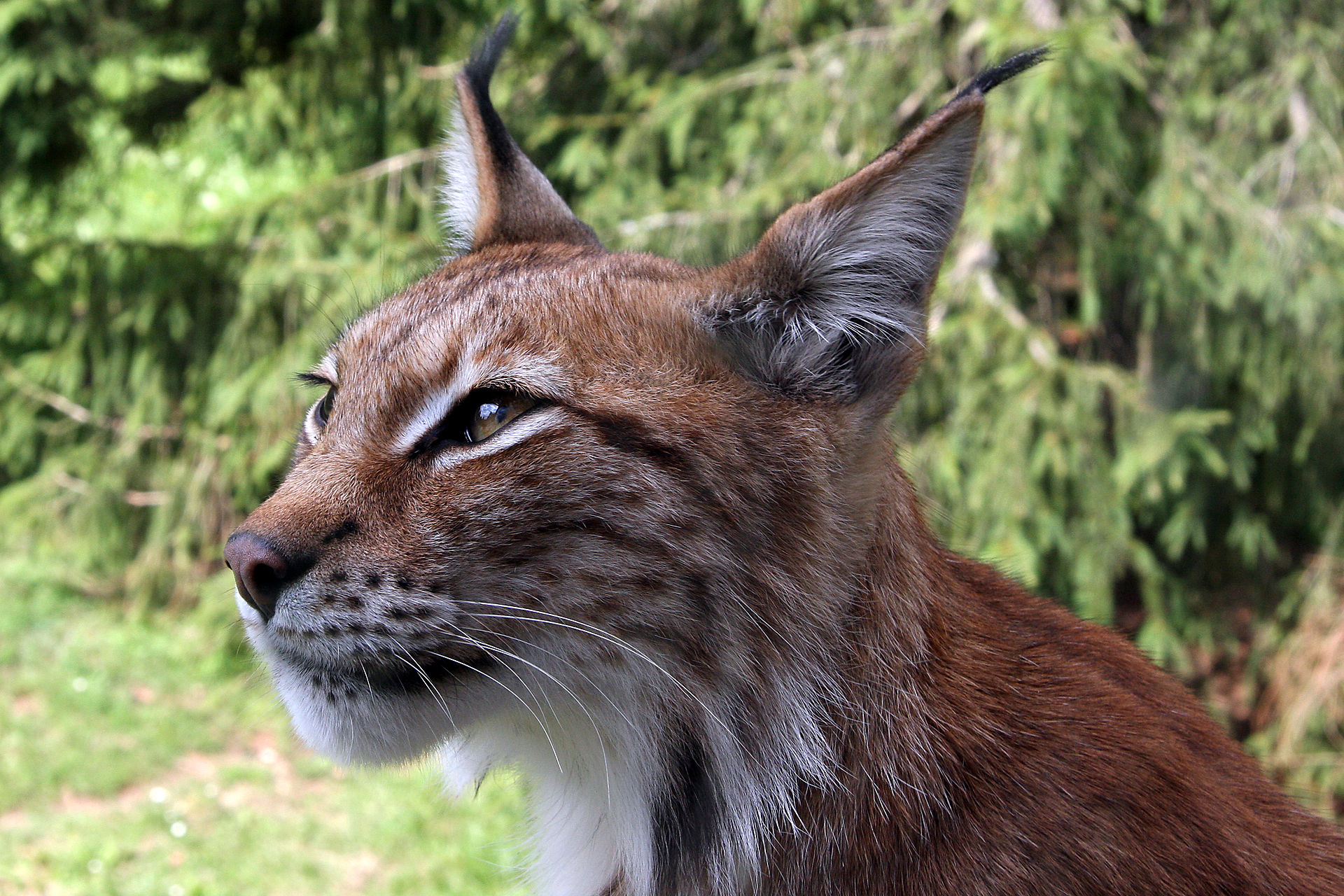
The Norwegian Forest Cat has a large, muscular, well-proportioned body. The head has triangular shape with straight profile (never stopped like the Persian, nor with long nose like the Siamese), strong chin, powerful neck. The ears are of medium size, wide at the base, with characteristic "lynx tips" (tufts of hair at the apex typical of the lynx) and long hair inside for cold protection. The eyes are large, almond-shaped, spaced, of variable colour according to the coat (green, gold, copper, blue in whites and bicolours, odd eyes in whites).
The coat is the most distinctive feature: it is double layered, perfectly adapted to the Nordic climate. The outer layer consists of long, glossy and waterproof guard hairs, naturally containing lanolin (a natural oil repellent). The inner layer is a dense, woolly, insulating undercoat. This double coat forms on the head a characteristic "lion-like mane" around the neck, "pants" on the hind legs and a very bushy brush tail. The coat adapts to the season: in summer it is lighter (loss of much of the undercoat), in winter it thickens. The accepted colourings are numerous (over 60): all tabby patterns (mackerel, classic, ticked), solid (black, blue, red, cream, white), bicolour (with white markings), tortie, smoke, silver, golden. Not allowed: colourpoint (Siamese), chocolate, cinnamon (sign of crossbreeding with other breeds). The legs are long, hind legs taller than front (forward-inclined posture), with wide pads and tufts of hair between the toes ("snowshoes"). The claws are robust, perfect for climbing: the breed is one of the few felines capable of descending from trees head-down thanks to a special rotation of the hind leg joints.
Behaviour and curiosities
The Norwegian Forest Cat has a balanced, independent, quiet temperament. It is a self-sufficient cat but affectionate with its own family, often choosing a "favourite human" to whom it particularly bonds. It is not excessively cuddly (does not like to be picked up for long periods), but loves human company and often follows the owner from room to room. It is silent: its meows are rare and generally very delicate. It adapts well to apartment life if given vertical space (cat trees, high shelves): the need to climb is very strong, inheritance of wild origins.
It gets along with everyone if well socialised: children, elderly, other cats, calm dogs. It is not aggressively territorial. It is an excellent hunter: if it has outdoor access, it prefers avian prey (more than the feline average). The mythological history of the breed is rich: in Norse religion, the goddess Freyja (corresponding to Venus) travelled on a chariot pulled by two large cats called Bygul and Trjegul, traditionally identified as Skogkatt. The Norse sagas of the 13th century (Eddas) describe these "forest cats" as magical and sacred animals. Health curiosities: the breed has a high adoption and appreciation rate because — despite being large like Maine Coon and Ragdoll — it presents generally robust health, excellent longevity (14-18 years, some specimens over 20), and imposing beauty. Moderate grooming care is required: weekly brushing (intensified in spring for moulting that can last 2-3 months), rare baths (the coat is self-cleaning thanks to lanolin). Curiosity: in Disney's animated films "Sword in the Stone" (1963), Merlin's cat "Archimedes" is inspired by a Skogkatt, and Garfield (the famous comic) is often misidentified as a British Shorthair but his creator Jim Davis has repeatedly described him as a mix between Maine Coon and Norwegian.
Pros
- Doppio mantello impermeabile, resiste a -30 °C
- Salute robusta, longevità 14-18 anni
- Razza naturale antichissima (oltre 1.000 anni)
- Mantello autopulente (lanolina naturale)
Cons
- Maturità lenta (4-5 anni)
- Muta primaverile/autunnale intensa (2-3 mesi)
- Predisposto a HCM, glicogenosi IV, displasia anca
- Soffre i climi caldi tropicali estremi