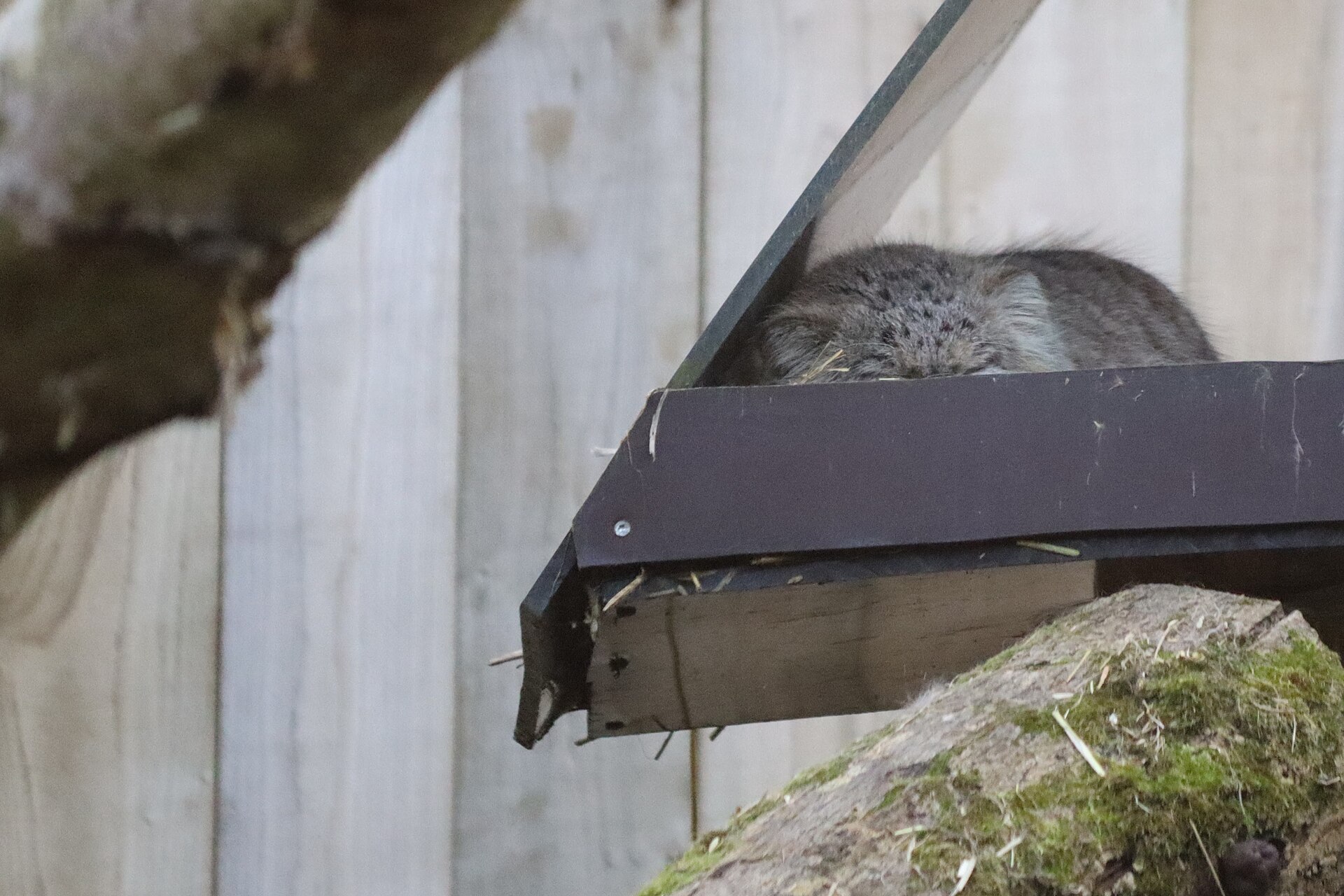
Pallas's Cat
Otocolobus manul
Characteristics
Temperament
Solitary, territorial, crepuscular-nocturnal. Endemic high-altitude Central Asian steppes (1,500-5,000 m). DENSEST coat among felids (9,000 hairs/cm², equal to chinchilla). Flat face, LOW LATERAL ears ("periscope"). ROUND pupils (unique among small felids). Pika-dependent. Internet famous for "grumpy" expressions. Vulnerable to Toxoplasma in captivity.
Diet
Specialist carnivore. Pika (Ochotona) 40-60% diet (KEY PREY), rodents, hares, birds, insects. "Sit-and-wait" hunter from crevices — can wait 6-8 hours in front of pika burrow. 50-100 g meat/day. Success 30-40%. STRICTLY DEPENDENT on pikas — pika poisoning control campaigns threaten the species.
Pallas's Cat (Otocolobus manul), also called the Manul in honour of the German naturalist Peter Simon Pallas who first described it in 1776, is one of the most expressive and distinctive wild felids on the planet. Small (weight 2.5-4.5 kg, head-body length 50-65 cm + tail 21-31 cm), it inhabits the semi-arid steppes and highlands of Central Asia between 1,500 and 5,000 metres of altitude: Mongolia, Tibet, Kazakhstan, western China, Iran, Afghanistan, Pamir, Ladakh. It is morphologically unique in the cat world: flat face with low and lateral ears (not on top of the skull like other cats — a "submarine periscope" adaptation to spy on prey among rocks without revealing itself), round pupils that contract to small dots (NOT to slits like most small cats), and an exceptionally thick coat: 9,000 hairs/cm² — the densest of any felid, equal to that of chinchilla! In the last 15 years Pallas's Cat has become "internet famous" for its "grumpy" facial expressions — viral images have made this wild cat one of the most popular creatures on the web. IUCN status: Least Concern (LC) since 2020, but local populations declining due to habitat loss, predation on key prey (pikas) through poisoning, and climate change.
Classification and category
Pallas's Cat belongs to the family Felidae, subfamily Felinae, monotypic genus Otocolobus. It is the only species in its genus — an isolated evolutionary case. Etymology: Otocolobus from Greek "ous, otos" (ear) + "kolobos" (cut short) = "short-eared", reference to its low and reduced ears. The popular name "manul" derives from Mongolian, while "Pallas's cat" honours its describer Pallas.
Phylogenetic analyses (Johnson et al., 2006; Werdelin et al., 2010) show that Pallas's Cat represents an ancient strictly isolated lineage within felids: it diverged from domestic cats (Felis catus) and other small felids about 5.9-10 million years ago. It is genetically more distant from domestic cats than lion and tiger are from each other. Its closest phylogenetic affinity is to the "Felis lineage" (5 species: domestic cat, wildcat, sand cat, black-footed cat, etc.), but in a basal position.
Historically 3 subspecies were recognised:
- O. m. manul — Nominate Manul (Mongolia, Russia, western China)
- O. m. ferrugineus — Rusty Manul (Iran, Afghanistan, west-central Asia)
- O. m. nigripectus — Tibetan Manul (Tibet, Himalayas, Ladakh)
However, genetic analyses of 2017 (Kitchener et al., IUCN Cat Specialist Group) have reduced subspecies to only one, considering the others as geographical variations.
The morphological parameters:
- Weight: 2.5-4.5 kg (M slightly larger than F, record 5 kg)
- Head-body length: 50-65 cm (record 75 cm)
- Tail: 21-31 cm (4-5 visible black rings + black tip)
- Height at withers: 30-35 cm
- Skull: wide, flattened — diagnostic feature (highest width/length ratio among felids)
Longevity: 11-12 years in captivity (record 13 years), much lower in nature (3-5 years due to high mortality from predators and harsh climate). Sexual maturity: 9-10 months. Gestation: 66-75 days; litter of 2-6 cubs (record 8). Cubs weigh 90-130 g at birth — very small for a small cat, reflecting adaptation to multiple births.
Habitat and distribution
Pallas's Cat is a specialist of extreme habitats: semi-arid steppes, rocky highlands, mountains, high-altitude deserts. Preferred habitat:
- High-altitude steppes: 1,500-5,000 m (record 5,050 m, Tibet) — among the highest of living felids
- Rocky substrates with crevices, talus, cliffs, rock formations — essential for hiding and hunting
- Vegetation: low steppe grasses (Stipa, Festuca), tilburia, artemisia — low and sparse vegetation
- Temperatures: extreme, from -50°C (Mongolian winter) to +40°C (Iranian summer). Pallas's Cat tolerates the most extreme temperatures of any other felid
- Substrate: free water absent for most of the year (brief summers, long winters)
Geographical distribution:
- Mongolia: main population estimated 10,000+ individuals (central plateau, Gobi)
- China: Tibet, Xinjiang, Qinghai, Sichuan — 5,000-10,000 individuals
- Russia: Transbaikalia, Tuva, Altai — fragmented population
- Kazakhstan: steppe population
- Central Asia: Iran (Alborz), Afghanistan, Pakistan, Tajikistan, Kyrgyzstan
- India: Ladakh, Sikkim, Himachal Pradesh — isolated populations
- Bhutan, Nepal: confirmed presence, small population
IUCN status: Least Concern (LC) since 2020 (previously Near Threatened 2008-2020). Global population: >50,000 mature individuals, stable. Threats:
- Pika poisoning (Ochotona): in China and Mongolia, "control" campaigns of pikas (considered agricultural pests) have also poisoned manuls that eat them. The pika is the main prey of Pallas's Cat (50% diet)
- Traditional hunting: in some areas for fur or traditional Chinese "medicine"
- Stray domestic dogs: predation on cubs
- Habitat loss: excessive grazing by domestic livestock (goats, sheep) reduces steppe vegetation
- Climate change: alteration of snow conditions and pika availability
- Habitat fragmentation: roads, urbanisation
CITES: Appendix II. Conservation: the IUCN's "Pallas's Cat Working Group" (PCWG) coordinates research and protection. Active reintroduction programme at the "Manul Lab" in Mongolia for captive study. Zoos around the world (Moscow, Berlin, Edinburgh, San Diego) participate in EAZA/AZA programmes.
Diet
Pallas's Cat is a strict specialist carnivore with a diet dominated by pikas (genus Ochotona) — small lagomorphs of the steppes, similar to tailless rabbits. Diet:
- Pikas (Ochotona): 40-60% of diet, preferred prey — Pallas's Cat co-evolves with the pikas of the Asian steppes
- Rodents: voles (Microtus), gerbils (Meriones), desert mice, young marmots — 20-30%
- Hares: Tolai hare (Lepus tolai), Yarkand hare — occasional large prey
- Birds: larks, finches, partridges — 10-15%
- Large insects: grasshoppers, locusts, beetles — especially in summer
- Reptiles: lizards, small snakes
- Carrion: occasional
The hunting technique is specialised. Pallas's Cat is a "sit-and-wait" or "stalk-and-pounce" hunter:
- Crevice ambush: Pallas's Cat hides in rock crevices or marmot burrows, with only the muzzle and lateral ears emerging — its "periscopic" anatomy (low ears + high eyes) allows it to observe the environment without exposing the body
- Stalking: when a pika emerges from its burrow, the cat approaches slowly, using vegetation and rocks
- Pounce: rapid sprint of 2-3 metres, leap on the prey
- Killing bite: lethal bite to the nape
Important feature: Pallas's Cat is strictly dependent on pikas. "Control" campaigns of pikas in China (poisoning with rodenticides) in the 2000s had a devastating effect on Pallas's Cat populations. When a local pika population collapses, the cat must emigrate or starves. Quantity: 50-100 g of meat/day. Hunting success: 30-40% (average for a small cat).
Physical features
Pallas's Cat has an exceptionally specialised anatomy for survival in extreme steppe environments. The most distinctive features:
ULTRA-DENSE coat: Pallas's Cat has the densest coat of any living felid.
- Density: 9,000 hairs/cm² on the belly, 6,000 on the back — comparable to chinchilla (one of the densest in the animal kingdom)
- Length: belly hairs up to 7 cm — the longest relative to the body among cats
- Structure: double layer — dense undercoat of "down feathers" + long guard hairs
- Function: extreme insulation for temperatures of -50°C, even more effective than that of the snow leopard
- Colour: grey-brown-ochre in summer, lighter in winter (camouflage with snow)
- Stripes: characteristic black bands on muzzle, forehead, flanks (4-5 transverse stripes on the back)
Flat face and lateral ears — the distinctive trait:
- Flat and wide skull: highest width/length ratio among felids — Pallas's Cat appears almost "flattened" frontally
- Ears: small, rounded, positioned low and on the sides of the head (not on top of the skull like other felids!)
- "Periscopic" function: this configuration allows Pallas's Cat to peek over rocks and dens without exposing the body — unique feature among mammals
- "Grumpy" expression: the combination of flat face + low ears + thick eyebrows creates a "human" expression, characteristically "scowling" — source of internet fame
The eyes are further unique:
- Large, bright yellow-amber
- Round pupils that contract to small circular dots in bright light — unlike most small felids that have vertical slit pupils. Only Pallas's Cat and big cats (Pantherinae) have round pupils!
- The difference is due to environment: slit pupils are useful for small cats hunting prey near the ground, round pupils are optimal for open steppe hunters
The legs are short, sturdy, well adapted to the cold: foot pads covered with dense fur (like fennec) for walking on snow and ice. The whiskers are short (the low ears leave no space for long whiskers). The tail is bushy, comparable to a "fox", with 4-7 black rings and black tip — used for balance and thermoregulation (wrapped around the body when sleeping).
Behaviour and curiosities
Pallas's Cat is a solitary, territorial, crepuscular-nocturnal animal. It comes out mainly at dusk and dawn; on cold days it can be partially diurnal. Territory: males 7-23 km², females 4-12 km². Males' territories partially overlap with those of 2-3 females. It always lives in rocky areas with crevices for dens: prefers abandoned marmot burrows, crevices between rocks, and talus. Does not dig its own dens.
Defensive behaviour: Pallas's Cat is a small cat very vulnerable to larger predators (foxes, wolves, golden eagles, hawks, snow leopards). Strategy:
- Camouflage: its striped coat blends perfectly with the steppe-rocky landscape. It is difficult to spot even from a few metres
- Immobility: when it detects a predator, it freezes completely — can remain motionless for hours. The low ears help not to reveal the position
- Den: escapes quickly to rocky crevices when threatened
- Fights if necessary: effective scratches and bites with curved claws
Reproduction is one of the most delicate aspects. Season: December-March (winter). The female's oestrus is extraordinarily brief: only 26-42 hours (one of the shortest among felids) — this creates evolutionary pressure for rapid mating. Gestation: 66-75 days; birth: April-May (spring). Litter: 2-6 cubs (record 8). Cubs are altricial (90-130 g, blind, covered in down). Rapid growth: open eyes at 8-10 days, leave the den at 4 weeks, autonomous at 4-5 months.
Pallas's Cat has a high juvenile mortality: 65-70% of cubs die in the first year. Causes: predation (foxes, eagles, hawks), freezing, diseases. For this reason litters are large (2-6 vs 1-3 of domestic cats). In captivity, juvenile mortality is still high due to susceptibility to Toxoplasma gondii: Pallas's Cat is a very sensitive felid to toxoplasmosis (lack of immunity due to clean steppe environment), which often kills cubs in zoos.
Famous curiosities: the "Internet fame". Pallas's Cat is one of the most internet famous wild cats since 2010. Viral photos show characteristically "human" expressions grumpy, scowling, surprised. The flat face, thick eyebrows, and yellow eyes create an illusion of "sadness" or "anger" that has generated thousands of memes. Famous Pallas's Cat advocates: Karen the Pallas's Cat (Moscow zoo), Manyul (Russian network), and many others. Pallas's Cat is often compared to "Grumpy Cat" of the domestic cat world for similar expressions.
"Flat face" curiosity: the flat face of Pallas's Cat is a unique evolutionary adaptation among felids. Biomechanical studies (Anton 2013) show that the combination of flat skull + low ears + high eyes significantly reduces the cat's "visual profile" when peeking behind rocks or low vegetation. It works as a biological periscope — Pallas's Cat can observe the environment without exposing the body. No other felid has this degree of "facial compression".
Pupils curiosity: Pallas's Cat is the only small felid with round pupils that contract to circular dots. All other small felids (domestic cat, lynx, ocelot, serval) have vertical slit pupils. Only the big cats (lion, tiger, leopard) and Pallas's Cat share this character. Possible explanation: evolution in open steppe favours round pupils for long-distance vision; slit pupils are optimised for close ambush hunting.
Coat curiosity: Pallas's Cat coat is the densest among living felids (9,000 hairs/cm²). For comparison:
- Pallas's Cat: 9,000 hairs/cm²
- Chinchilla: 9,000-12,000 hairs/cm² (the terrestrial animal with the densest fur)
- Snow leopard: 4,000-5,500
- Domestic cat: 1,500-3,000
- Human: 200-300 (on the head)
The density is essential to resist temperatures of -50°C of Asian steppes. Winter fur is 50% longer than summer.
2 fur phases curiosity: Pallas's Cat changes coat twice a year with a notable visual effect. Summer coat: short, brownish-grey with well-visible stripes (warm). Winter coat: long, cream-white in colour (camouflaged with snow). This "moult" can significantly alter the appearance. Toxoplasmosis curiosity: in captivity, Pallas's Cat has very high juvenile mortality (50-70%) for Toxoplasma gondii, a common parasite in urban environments that other domestic felids tolerate (innate immunity). Pallas's Cat, evolved in clean steppe environment, has no immunity — toxoplasmosis is devastating to cubs. Modern zoological facilities have strict protocols to prevent exposure. "Sit-and-stare" curiosity: typical Pallas's Cat behaviour: remain motionless in front of a pika burrow for hours (sometimes 6-8 hours!) waiting for the prey to come out. Ethological studies describe it as one of the most "patient" felids — can remain completely motionless longer than any other cat. "Not a climber" curiosity: unlike most cats, Pallas's Cat is terrestrial: does not climb trees (even though the steppe habitat offers few). Short and sturdy legs are for rocky terrain, not climbing. Fur trade curiosity: historically, Pallas's Cat fur was one of the most valued among felids (due to exceptional density). In USSR, tens of thousands of manuls were caught annually until 1988, when it was banned. Russia maintains the ban. Vocalisations curiosity: Pallas's Cat is relatively silent but can emit: high "yelp" (courtship), low "chuff" (greeting), "hiss" and "yowl" (threat), "purr" (in captivity, rare in nature). Does not roar like big cats. "Zoo star" curiosity: Pallas's Cat is a zoo attraction, but is very difficult to breed. Only ~150 specimens in captivity worldwide. Moscow, Berlin, San Diego, Edinburgh zoos, and the Cincinnati Zoo have active programmes.
Pros
- Morfologia unica tra i felidi (faccia piatta, orecchie laterali)
- Pelliccia più densa di qualsiasi felide (9.000 peli/cm²)
- Adattamento a temperature estreme (-50°C)
- Lignaggio genetico antico isolato (5,9-10 Mya divergenza)
Cons
- Vulnerabile a controllo pika (preda chiave) tramite avvelenamento
- Mortalità giovanile 65-70% in natura
- Sensibile a Toxoplasma in cattività (no immunità)
- Vita media corta in natura (3-5 anni)