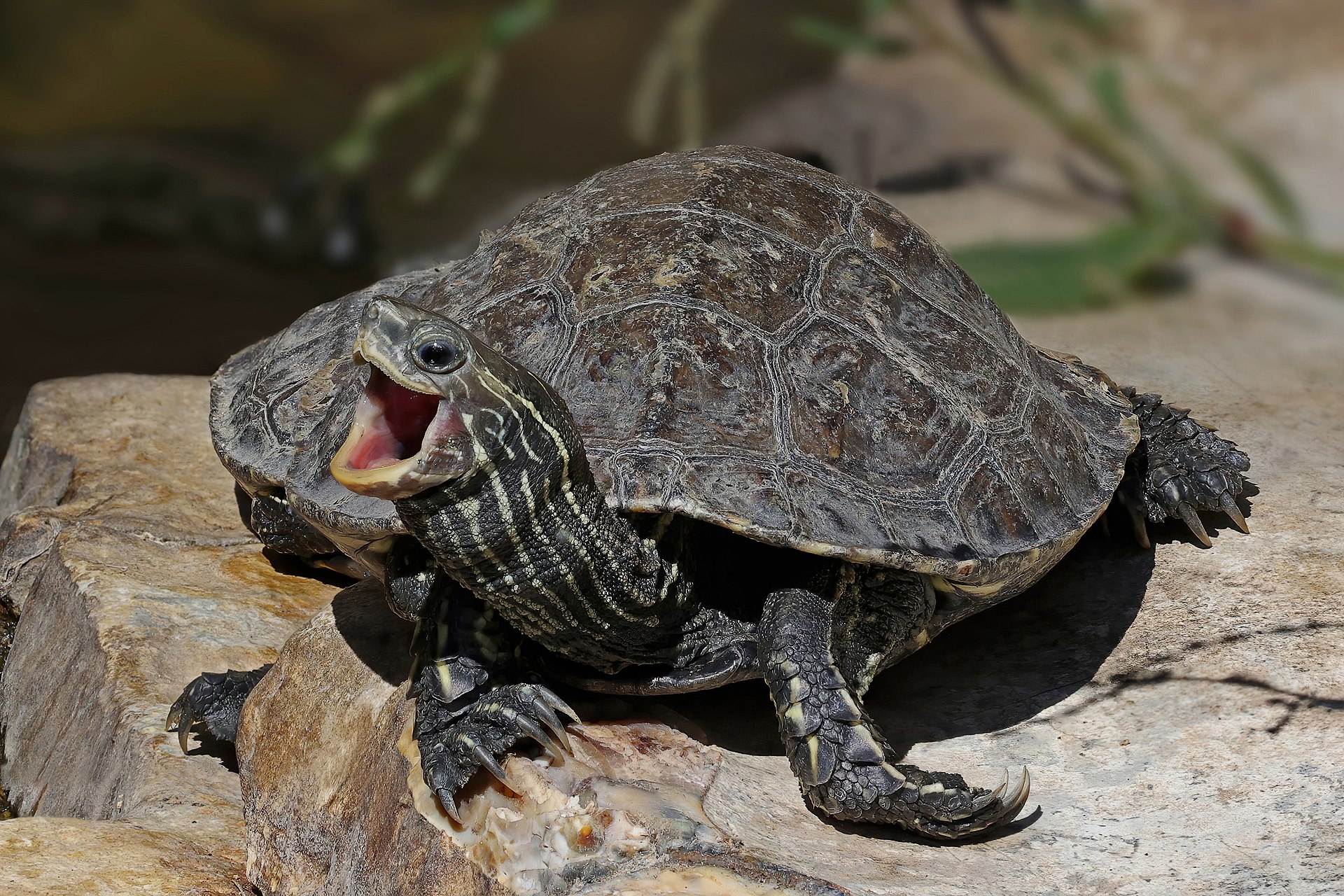
European Pond Turtle
Emys orbicularis
Characteristics
Temperament
A wild aquatic reptile, diurnal, cautious and shy, sun-loving. It alternates long hours of basking on logs and banks with dives into the water to hunt and take cover: at the slightest alarm it dives very fast. Solitary and tied to its pond, it hibernates in winter. It is NOT a home-aquarium animal nor one to take from the wild: it is native wildlife, protected and threatened, to be observed and safeguarded in wetlands. Never release exotic turtles where it lives, as they would compete with it.
Diet
Mainly carnivorous, especially when young, and a little more omnivorous with age. It feeds on aquatic invertebrates (insects and larvae, worms, molluscs, crustaceans), tadpoles, small amphibians and small fish, carrion and animal remains, and to a lesser extent aquatic plants. It habitually hunts and eats underwater, since it needs the aquatic medium to swallow, and it is an opportunistic predator that takes any available prey or carrion, also acting as a "scavenger" of wetlands.
The European Pond Turtle (Emys orbicularis) is the only freshwater turtle native to much of Europe, Italy included: an elegant, shy reptile tied to wetlands. Famous for:
- Being "our" water turtle: it is the native of European marshes and ponds, unlike the exotic aquarium turtles
- The speckled livery: dark body and shell, scattered with fine yellow dots and rays
- The long tail: unusually long for a turtle
- A love of the sun: it spends hours basking on logs and banks, diving at the slightest alarm
- Great longevity: it can live for many decades
- Conservation value: it is threatened and has become a symbol of wetland protection
IUCN status: Near Threatened (NT), and in many areas of Italy in serious decline. It enters the portal in the Turtles group, alongside exotic species such as the snapping turtle and the matamata: its arrival finally brings the voice of a native turtle, the freshwater turtle of our ditches and ponds.
Classification and category
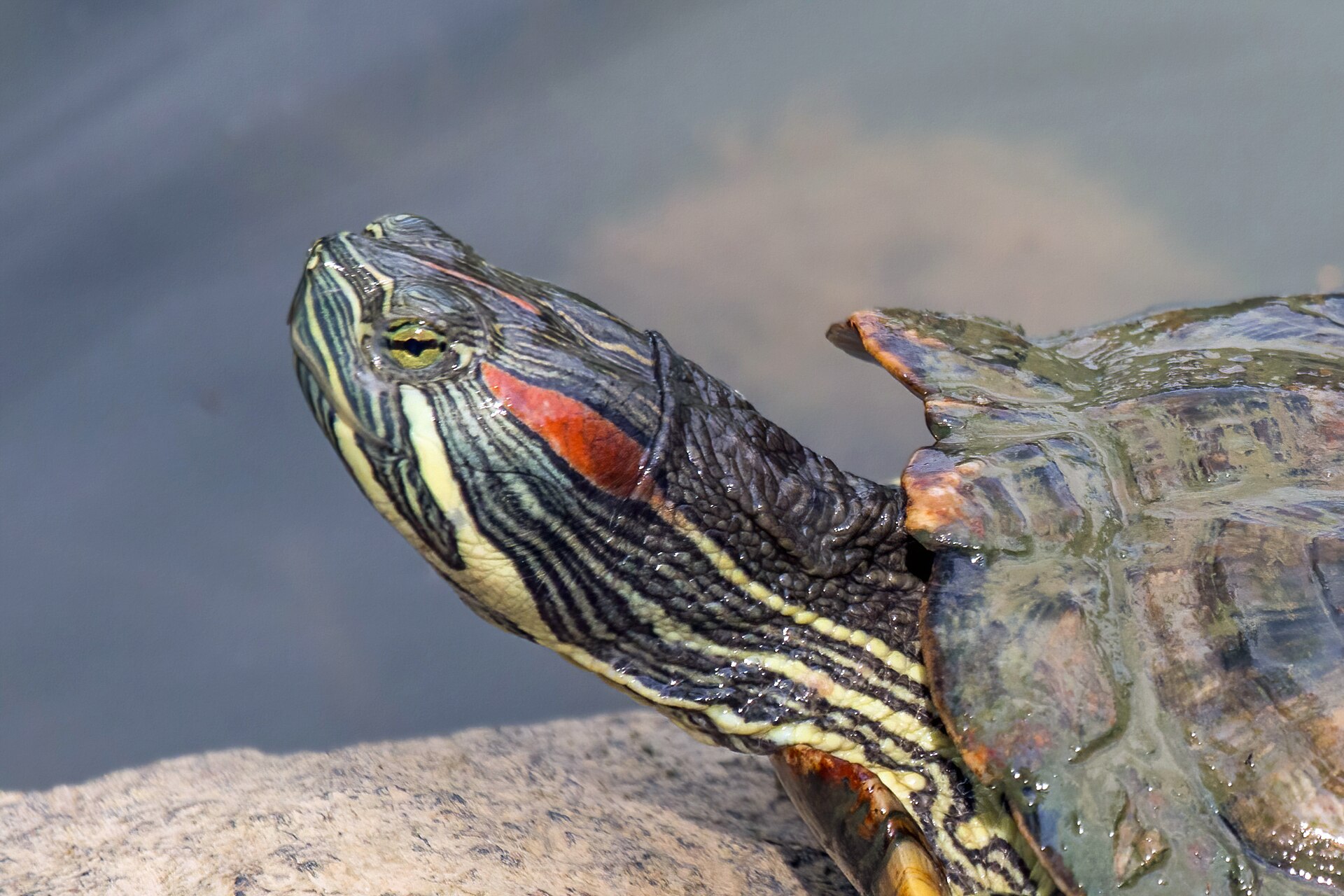
Order Testudines (the turtles and tortoises), family Emydidae (the pond turtles), genus Emys. In the portal it is placed among the Turtles. It is essential to tell it apart from other turtles it can be confused with: the red-eared slider (Trachemys scripta elegans), the classic imported "aquarium" turtle, has conspicuous red patches on the sides of the head and a paler, streaked shell — it is an alien, invasive species, not to be confused with our pond turtle; Hermann's tortoise, also in the portal, is a terrestrial tortoise, with a very domed shell and non-webbed legs: it lives on land, not in water; the European Pond Turtle, instead, has a dark, flattened shell, yellow-speckled skin, webbed feet and a long tail. Etymology: the genus name "Emys" comes from Greek and means a freshwater turtle; "orbicularis" refers to the rounded shape of the carapace. Parameters: Carapace length generally 12-20 cm (females are larger than males). Weight usually about 0.4 to 1 kg. Appearance: an oval, smooth, slightly domed shell. Longevity very remarkable — commonly over 40-50 years, with specimens that can live even longer. Reproduction: the female leaves the water and lays 3-9 eggs in a hole dug in the ground; as in many reptiles, the sex of the young depends on the incubation temperature.
Habitat and distribution
The European Pond Turtle is tied to still or slow fresh water: its range is much of Europe (including Italy), western Asia and North Africa, with populations now often fragmented. Preferred habitats: ponds, marshes, swamps and oxbow lakes; ditches, canals and slow rivers, with muddy bottoms; and environments rich in aquatic vegetation and with logs or sunny banks to bask on. It is a thermophilic, sun-loving species: it spends much time basking on emerging logs and banks to warm up, then dives quickly into the water at the slightest sign of danger. In winter it hibernates, usually buried in the mud on the bottom or in the banks. Its survival depends closely on the presence of well-preserved wetlands: drainage, pollution and the concreting of banks have made it disappear from many areas where it was once common. IUCN: Near Threatened globally, but in many European and Italian regions it is considered endangered and strictly protected. The main threats are the loss of wetland habitats, pollution, illegal collection and above all competition from exotic aquatic turtles.
Diet
The European Pond Turtle is mainly carnivorous, especially when young, becoming a little more omnivorous with age. It eats: aquatic invertebrates (insects and their larvae, worms, molluscs, crustaceans); tadpoles, small amphibians and small fish; carrion and animal remains; and, to a lesser extent, aquatic plant matter. Feeding habits: hunting in the water (it catches prey by swimming; it habitually eats underwater, where it can swallow); opportunism (it takes any available prey or carrion, helping to "clean up" aquatic environments); and ambush and active search (it alternates waiting with exploring the bottom and the vegetation). Crucially, like many water turtles, the pond turtle can only feed while submerged, because it needs water to swallow its food. Its role as a predator and scavenger of small animals makes it a useful link in the wetland ecosystem.
Physical features
A dark, elegant reptile, finely speckled with yellow. Shell and colouring: an oval, smooth, slightly domed carapace (the upper part of the shell), dark in colour — blackish, brown or olive-green; fine yellow dots and rays scattered over the carapace and the dark skin of the body, head and legs; a paler, yellowish plastron (the lower part). The body: sturdy, partially webbed legs with claws, suited both to swimming and to walking and digging; a long tail, unusual for a turtle, particularly developed in males; a dark, yellow-speckled head with lively eyes. Performance: an excellent swimmer, agile and fast in the water; the ability to dive for a long time and stay on the bottom; and keen senses, especially sight and smell, and great caution: it dives at the slightest alarm.
Behaviour and curiosities
The European Pond Turtle is a diurnal, cautious, sun-loving animal. It spends much of the day alternating sunbathing on logs with dives into the water to hunt and take shelter. It is rather shy: approaching a pond full of pond turtles, one often hears only the "plops" of the animals diving from their perches before even seeing them. It hibernates in winter and becomes active again in spring.
The "real" European turtle: many people, seeing a water turtle in a pond, think it is an exotic species — in fact the European Pond Turtle is a native species, present in our waters since ancient times: it is the freshwater turtle "of our home", the only one native to much of Europe, and for this very reason it deserves particular conservation attention. The "aquarium" threat: one of the main threats to the European Pond Turtle is the red-eared slider (and similar species), the classic little turtle imported and sold in shops — once grown, many of these exotic turtles have been released into the wild, where they compete with the pond turtle for food and sunny perches, often prevailing; it is a classic example of how releasing exotic animals can harm local wildlife: this is why aquarium turtles must never be released into the wild. The long-lived one of the marshes: the European Pond Turtle is an extraordinarily long-lived animal — in the wild it can easily exceed 40-50 years, and some specimens are thought to live even longer; this longevity, combined with late sexual maturity and the low number of young that survive, makes its populations very vulnerable: the loss of even a few breeding adults can compromise the species' local survival for a long time. The sex decided by the sun: as in many turtles, in the pond turtle the sex of the offspring is not written in the genes, but depends on the incubation temperature of the buried eggs — broadly, higher temperatures tend to produce more females and lower temperatures more males; this means the climate of the place and the year directly influences the sex ratio — a fascinating mechanism, but one that makes these species especially sensitive to climate change. The underwater eater: the European Pond Turtle habitually eats underwater — this is no small detail: many freshwater turtles in fact need the aquatic medium to swallow, and cannot swallow food on dry land; this is why it is seen hunting and feeding submerged, grabbing prey and morsels among the bottom vegetation. The sentinel of wetlands: together with amphibians and other aquatic animals, the European Pond Turtle is a good indicator of the health of wetland environments — its presence signals still well-preserved ponds and marshes; its disappearance, conversely, is often a symptom of the degradation or destruction of these environments, among the most threatened and at the same time most precious for biodiversity.
Pros
- Unica tartaruga d'acqua dolce nativa d'Italia e di gran parte d'Europa
- Predatore e spazzino utile negli ecosistemi delle zone umide
- Straordinariamente longeva (oltre 40-50 anni)
- Simbolo della conservazione delle zone umide e indicatore di acque sane
Cons
- NON è un animale da acquario: è fauna selvatica autoctona protetta
- IUCN Near Threatened; in molte aree italiane in pericolo e in declino
- Minacciata dalla concorrenza delle tartarughe esotiche (es. dalle orecchie rosse) liberate
- Vulnerabile per maturità tardiva, perdita di habitat e prelievo illegale