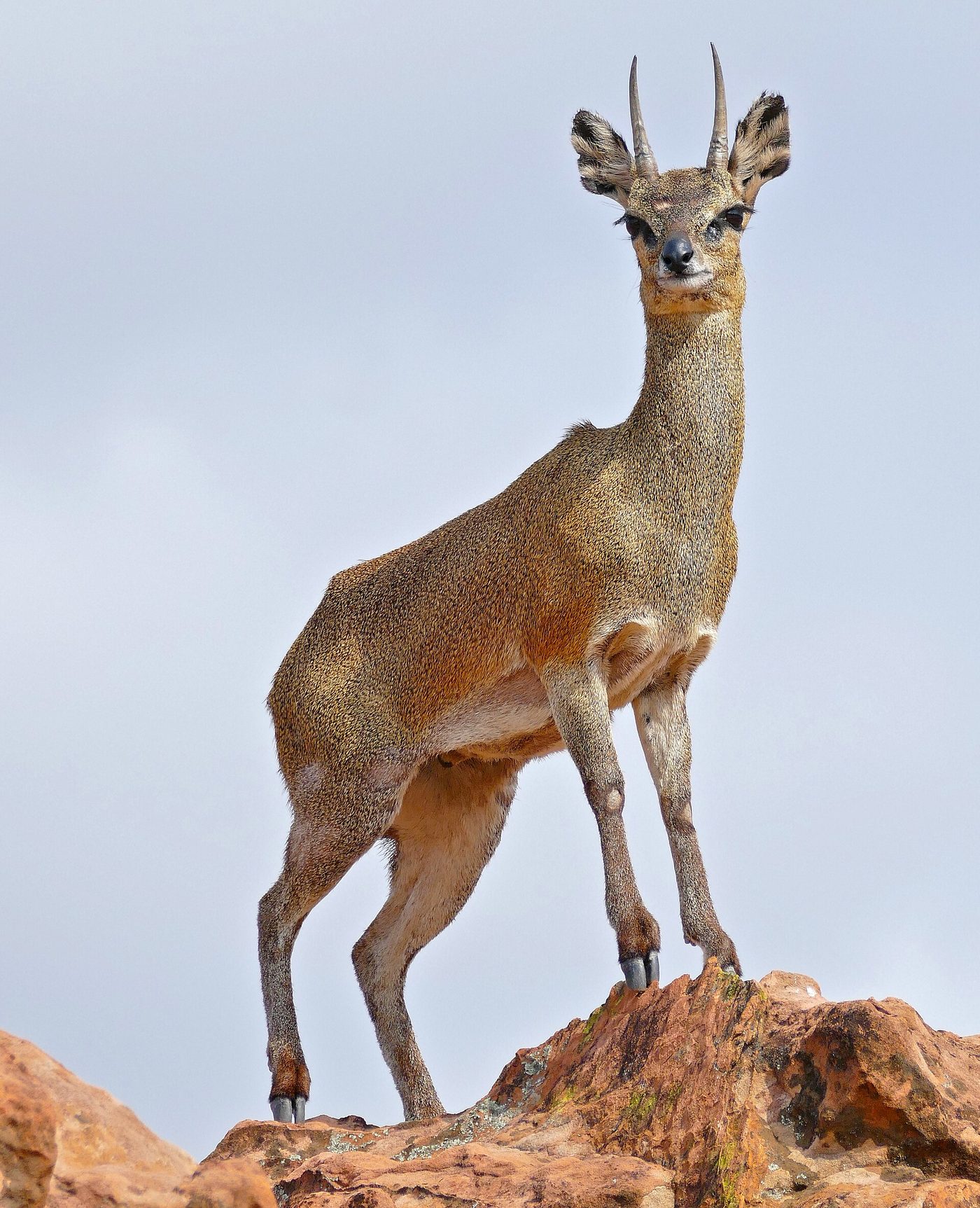
Photo: Bernard DUPONT from FRANCE · CC BY-SA 2.0
Klipspringer
Oreotragus oreotragus
Small and highly agile, able to walk on the tips of its hooves and leap from rock to rock, the klipspringer is the acrobat antelope of the African mountains.
Characteristics
Temperament
Agile, watchful, lives in a monogamous pair
Diet
Herbivore: leaves, shoots, flowers and fruit
The antelope that leaps on rocks
The klipspringer is a small and fascinating African antelope, whose name in Afrikaans means precisely 'rock jumper'. It has a stocky, compact body, covered with coarse, thick fur of a grizzled yellowish-brown colour, which camouflages it perfectly among the rocks. Its most extraordinary feature is its hooves: small, cylindrical and rounded, which allow it to stand on their tips, like a ballerina on her shoes. Thanks to these special hooves, the klipspringer moves with incredible agility and confidence on steep rock walls and tiny footholds. Only the males bear horns, short and pointed.
Habitat and distribution
It lives across much of eastern and southern Africa, always tied to rocky environments: mountains, gorges, rock outcrops and steep walls, where few other herbivores can venture. It is an animal specialised for a vertical life, using the rocks both for feeding and as a refuge from predators.
Behaviour
The klipspringer is a herbivore feeding on leaves, shoots, flowers and fruit that it finds among the rocks. A fascinating trait of its behaviour is its pair life: it forms stable, monogamous bonds, and the two partners stay close, defending their territory together. While one feeds, the other often keeps watch, perched on top of a rock, ready to give an alarm whistle at the slightest danger.
Curiosities
The klipspringer is a true acrobat: it can leap with precision from one foothold to another and land on surfaces barely the size of a coin. Its fur, hollow inside, not only insulates it from the cold of high altitudes but also cushions impacts against the rocks.
Conservation
The klipspringer is classified as a species of least concern, with large, widespread populations. Its habit of living in rugged rocky environments partly protects it from human activities. Locally it can suffer from hunting and disturbance, but on the whole it is not considered threatened.
Pros
- Extraordinary acrobat of the rocks
- Unique hooves for walking on their tips
- Fascinating monogamous pair life
- Large, unthreatened populations
Cons
- Tied to specific rocky environments
- Locally sensitive to hunting and disturbance
- Small and vulnerable to ground predators