Photo: Charles J. Sharp · CC BY-SA 4.0
Sloth
Bradypus variegatus
A living symbol of slowness, the sloth spends its life hanging upside down among the branches of tropical forests, in a world of slowed-down rhythms.
Characteristics
Temperament
Extremely slow and tranquil, almost always hanging from the branches. Solitary and cryptic; its energy saving and stillness are its main defence.
Diet
Herbivore: almost entirely leaves, poor in nutrients and digested extremely slowly.
The master of slowness
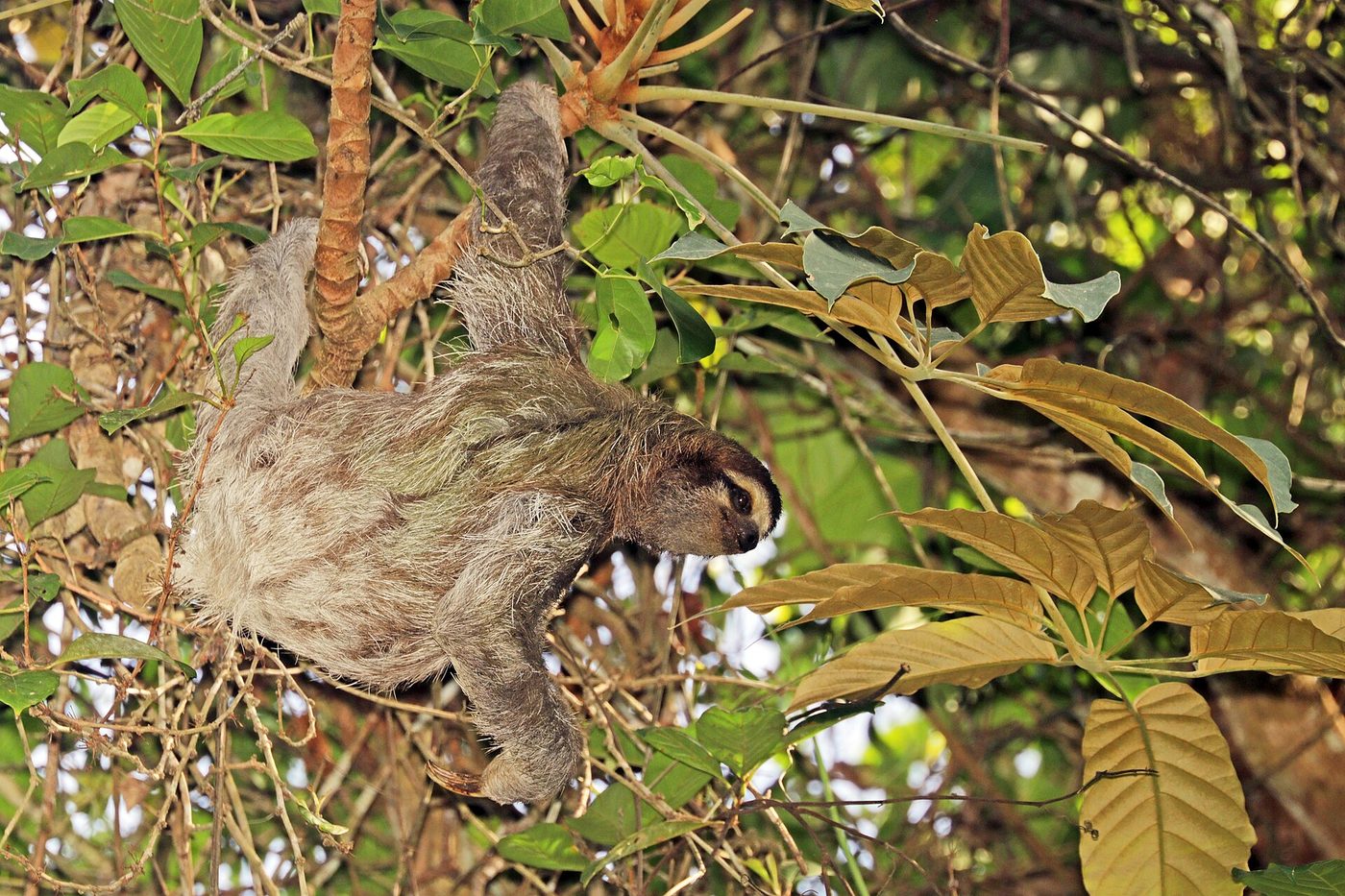
The sloth is one of the most singular mammals on the planet, famous for its extreme slowness. It lives in the tropical forests of Central and South America, almost always hanging upside down among the branches, held up by long limbs with strong curved claws. The body is covered with long, coarse fur of a grey-brown colour, and the face has a characteristic expression that looks like a perpetual, tranquil smile. This species, the brown-throated three-toed sloth, has three toes on each limb.
Why is it so slow?
The sloth's slowness is not laziness but a refined adaptation. Its diet, based almost entirely on leaves that are poor in nutrients and hard to digest, provides very little energy. To make it last, the sloth has a very slow metabolism, moves the bare minimum and sleeps many hours a day. Even digestion is extremely slow: it can take weeks to digest a single meal. This energy-saving strategy lets it survive where more active animals could not.
A miniature ecosystem
Such slow movement has a curious side effect: algae grow in the sloth's fur, giving it a greenish tinge and helping it blend into the foliage. Insects and other tiny organisms also live in that fur, so much so that the sloth is almost a walking ecosystem. Its slowness and camouflage are its main defence: it goes unnoticed by predators that hunt by sight.
Curiosities
Despite its clumsiness on the ground, where it drags itself with difficulty, the sloth is a surprisingly capable swimmer. It comes down from the trees rarely, usually to defecate, in a ritual it performs at intervals of many days. Its long arms and claws instead make it perfectly adapted to a life suspended among the branches.
Conservation
The brown-throated three-toed sloth is classified as least concern and its populations are still large. Like all forest-dependent species, however, it depends on the conservation of tropical habitats, threatened by deforestation. Protecting the forests is essential to secure a future for this tranquil dweller of the canopy.