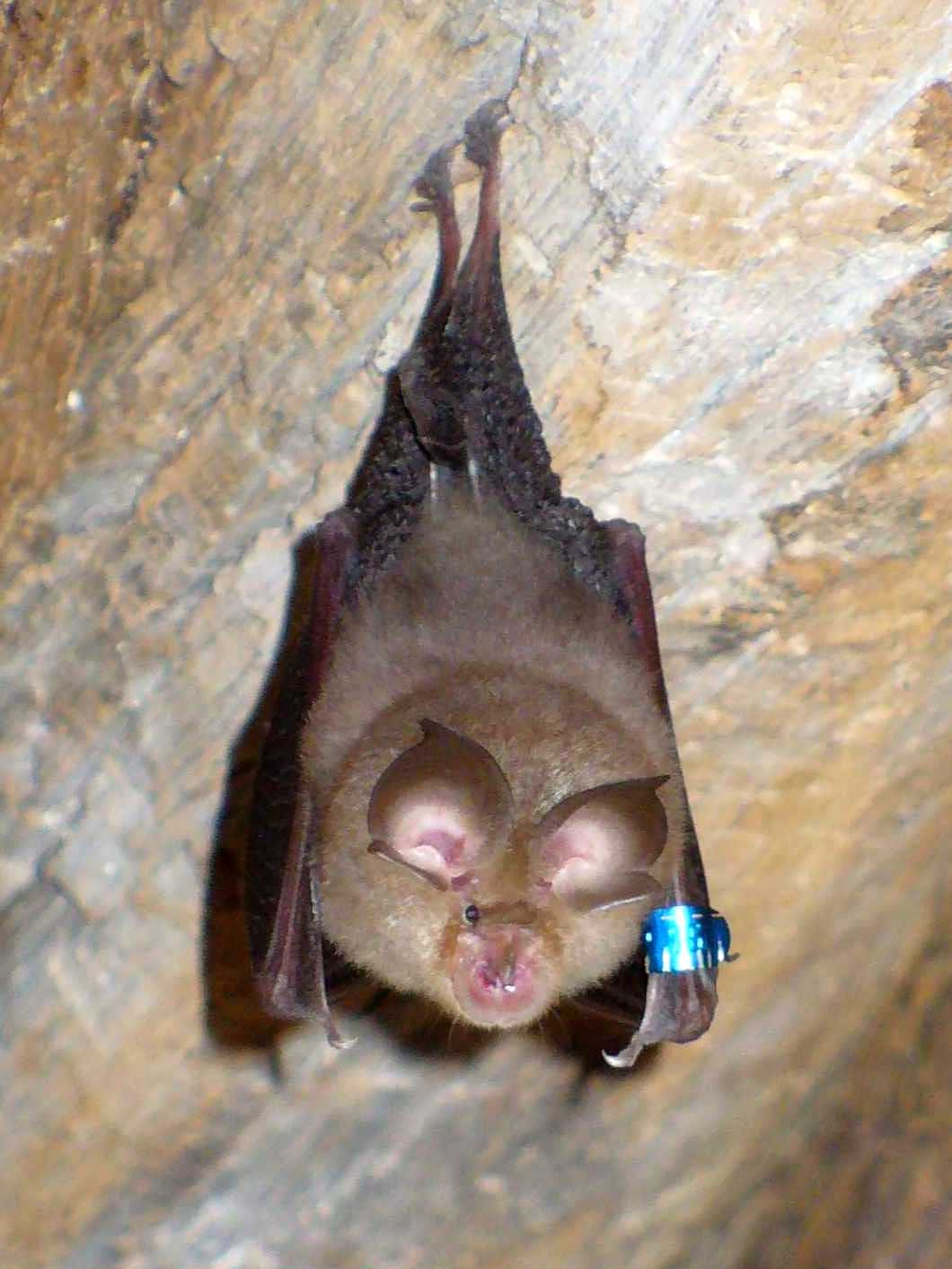
Lesser horseshoe bat
Rhinolophus hipposideros
The lesser horseshoe bat is a tiny European bat with a distinctive horseshoe-shaped noseleaf, which wraps itself in its wings to rest.
Characteristics
Temperament
Nocturnal, delicate, sensitive to disturbance
Diet
Insectivore: small insects caught in flight
Description
The lesser horseshoe bat is one of the smallest bats in Europe, the smallest of its genus. Its body is only about 4 centimetres long, with a wingspan of up to 25 centimetres. Its most distinctive feature is the complex skin outgrowth around the nose, the 'noseleaf', shaped like a horseshoe, which serves to direct the ultrasound of its echolocation. Its fur is grey-brown above and paler below. At rest it wraps itself completely in its wings, as in a little cloak.
Habitat and distribution
It is widespread across much of Europe, North Africa and western Asia. It favours varied landscapes with woods, hedgerows and watercourses, and hibernates in caves, cellars and damp underground sites. In summer the breeding colonies settle in warm attics and quiet buildings.
Behaviour
It is an insectivorous bat that hunts at dusk and by night, catching small insects on the wing, often near vegetation. To navigate and locate prey it emits ultrasound through its nose, not through the mouth like many other bats. It hibernates during the winter.
Did you know?
Its habit of wrapping itself completely in its wings while resting makes it unmistakable. Despite its tiny size, it can live surprisingly long. It is very sensitive to disturbance of its roosts.
Conservation
It is classed as least concern, but is protected throughout Europe and has suffered sharp declines in many areas. The main threats are disturbance of roost sites, building renovation and the loss of insects due to pesticides.
Pros
- Valuable natural controller of small insects
- Refined echolocation through the noseleaf
- Long-lived, can reach twenty years
Cons
- Very sensitive to disturbance of roosts
- Threatened by insect decline from pesticides
- Protected species: must not be disturbed