Photo: frank wouters · CC BY 2.0
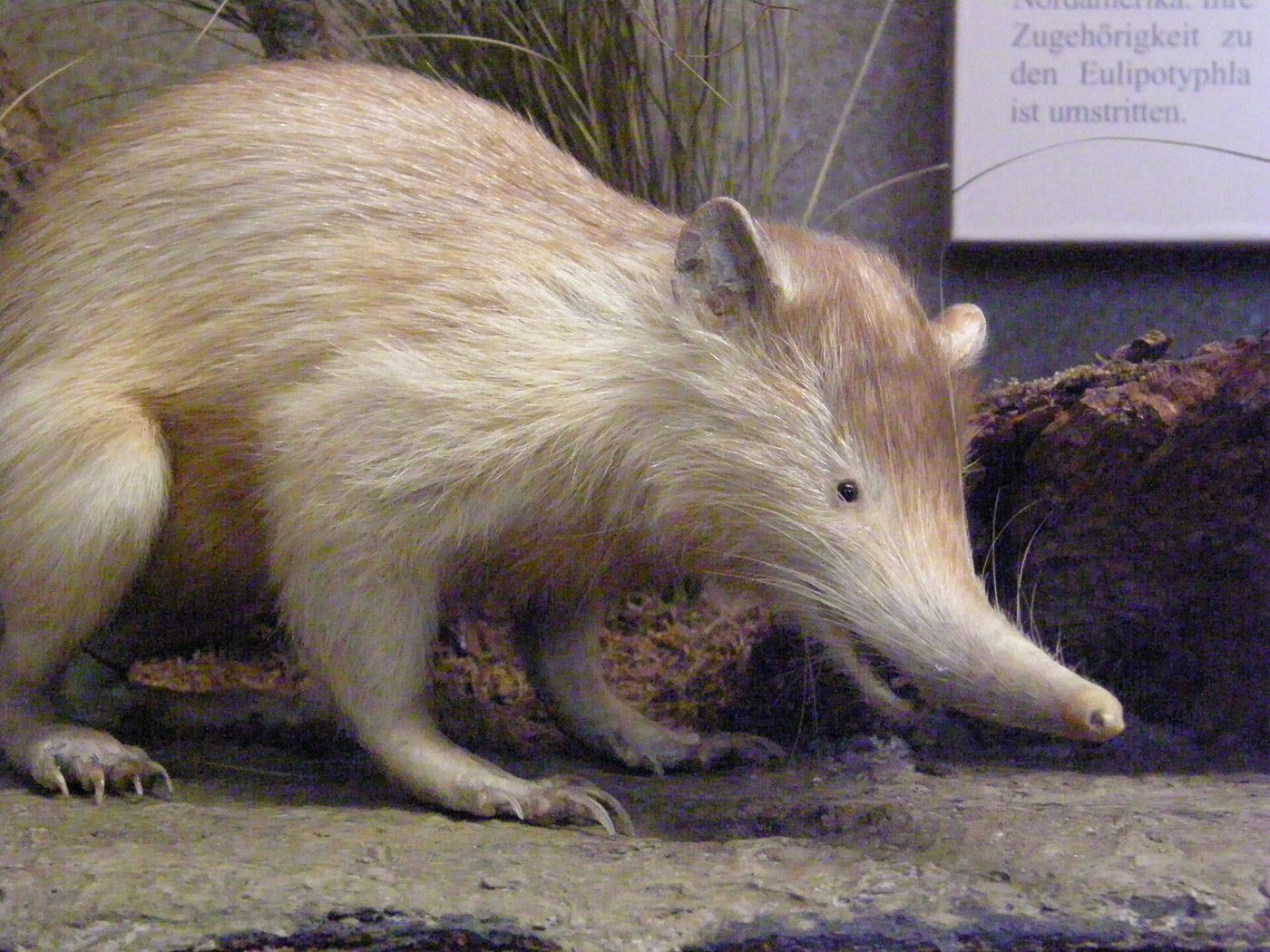
Hispaniolan solenodon
Solenodon paradoxus
The Hispaniolan solenodon is a rare nocturnal mammal of the Caribbean, one of the very few venomous mammals on Earth and a true living fossil.
Characteristics
Temperament
Nocturnal, solitary and secretive; clumsy but an able digger.
Diet
Insectivorous: soil invertebrates, small vertebrates, roots and fruit.
A giant, venomous shrew
The Hispaniolan solenodon (Solenodon paradoxus), also known as the agouta, is a small, furry, shrew-like mammal of the family Solenodontidae. It is one of the very few venomous mammals alive: it injects toxic saliva through a groove in one of its lower incisors, and that "grooved tooth" gives the animal its name. It has an extraordinarily long, mobile, cartilaginous snout, hinged at the base by a ball-and-socket joint unique among mammals, which lets it probe soil and crevices.
Habitat and range
It is endemic to the island of Hispaniola, shared by Haiti and the Dominican Republic, where it lives in forests, scrub and rocky areas. It spends the day sheltered in burrows and tunnels dug in the ground or among rocks, emerging only after dark.
Behaviour and diet
It is nocturnal and insectivorous, feeding mainly on soil invertebrates — insects, earthworms, millipedes — but also on small vertebrates, roots and fruit. Its venom helps subdue prey. It moves with a clumsy, waddling gait, relying more on smell, hearing and touch than on sight.
Did you know?
It belongs to a very ancient lineage that arose around 60 million years ago, just after the dinosaurs died out; its closest relatives are moles and shrews. Together with the Cuban solenodon, it is the only living member of its family.
Conservation
The IUCN lists it as Least Concern, but it remains a focus of conservation efforts: it is vulnerable to forest destruction and above all to predators introduced by humans — dogs, cats and mongooses — against which it has no evolved defences.
Pros
- One of the very few venomous mammals
- A true 60-million-year-old living fossil
- A mobile snout unique among mammals
Cons
- Threatened by introduced predators (dogs, cats, mongooses)
- Dependent on Hispaniola's forests
- Rare and elusive, hard to study