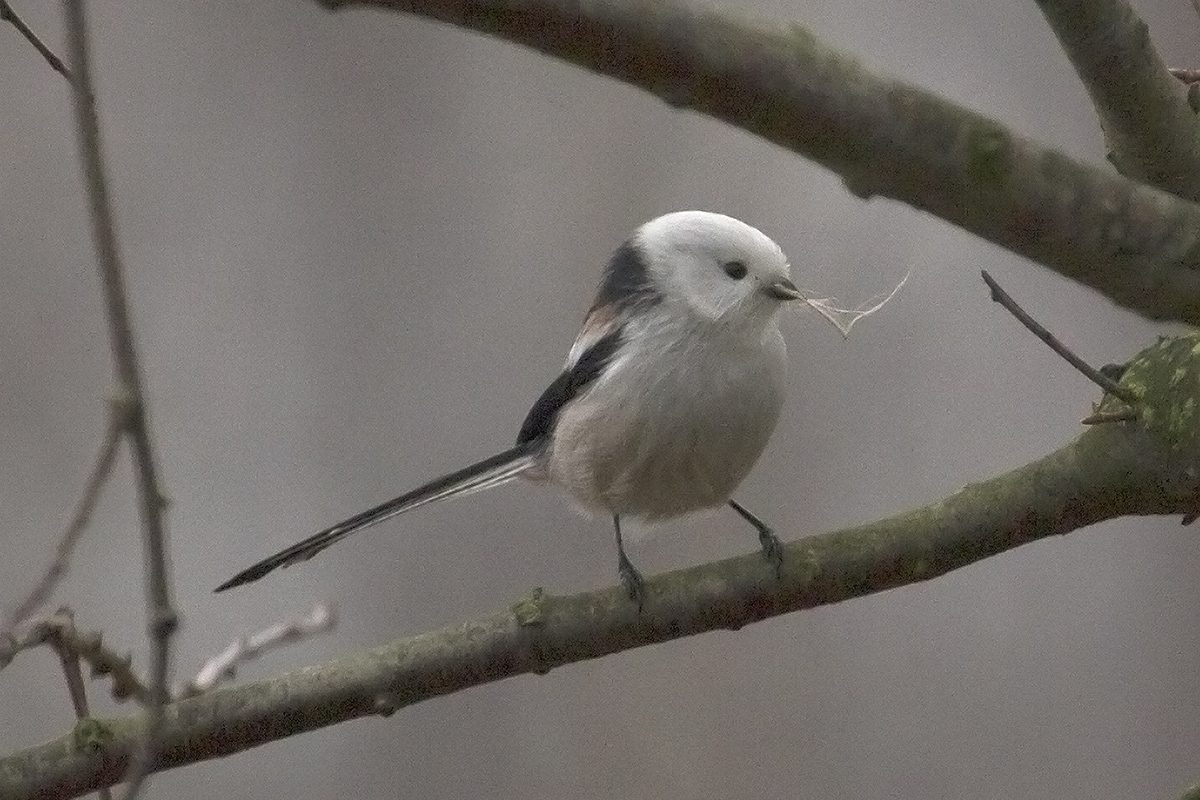
Photo: Jerzy Strzelecki · CC BY 3.0
Long-tailed tit
Aegithalos caudatus
Tiny and plump, with a tail longer than its body, the long-tailed tit is a lively passerine of the European woods, famous for its elaborate nest.
Characteristics
Temperament
Lively, sociable, in close-knit groups
Diet
Insectivore: small insects, spiders, larvae, seeds
A ball of feathers with a tail
The long-tailed tit is one of the smallest and most endearing birds in Europe. It has a tiny, rounded body, giving it the look of a soft ball of feathers, topped by a little white head and an extraordinarily long tail, longer than the body itself. Its plumage is a delicate combination of white, black and pinkish tones. With its comical look and lively behaviour, it is one of the most beloved little birds among nature enthusiasts.
Habitat and distribution
It is widespread across much of Europe and temperate Asia, where it inhabits woods, scrubland, hedges, parks and gardens rich in trees and shrubs. It is a bird tied to vegetation, among whose branches it moves with ceaseless agility, often hanging upside down while searching for food. In the cold season it also readily approaches garden feeders.
Social behaviour
The long-tailed tit is an extremely social bird. Outside the breeding season it moves in close-knit family groups, which cross the woods in a line, constantly communicating with high-pitched calls so as not to lose sight of one another. It feeds mainly on small insects, spiders and larvae that it flushes out among the foliage, supplementing its diet with seeds. In the winter months, the members of the group sleep pressed close together on a branch to keep warm, a behaviour crucial for surviving the cold given their tiny bodies.
The extraordinary nest
One of the long-tailed tit's marvels is its nest, a true masterpiece of natural engineering. The pair builds an oval, closed structure, soft and elastic, weaving together moss and spider silk and covering the outside with lichen to camouflage it. Inside it lines it with hundreds and hundreds of feathers, creating a warm and safe refuge for the eggs and the young.
Conservation
The long-tailed tit is classified as a species of least concern, with large, widespread populations. Particularly harsh winters can temporarily reduce their numbers, but the species recovers easily. Conserving woods, hedges and gardens rich in vegetation is important to ensure it has suitable habitats.
Pros
- Comical, endearing look with a very long tail
- Extraordinary nest, a masterpiece of weaving
- Very social and lively
- Large, unthreatened populations
Cons
- Very small, vulnerable to intense cold
- Relatively short life
- Sensitive to the loss of hedges and woods