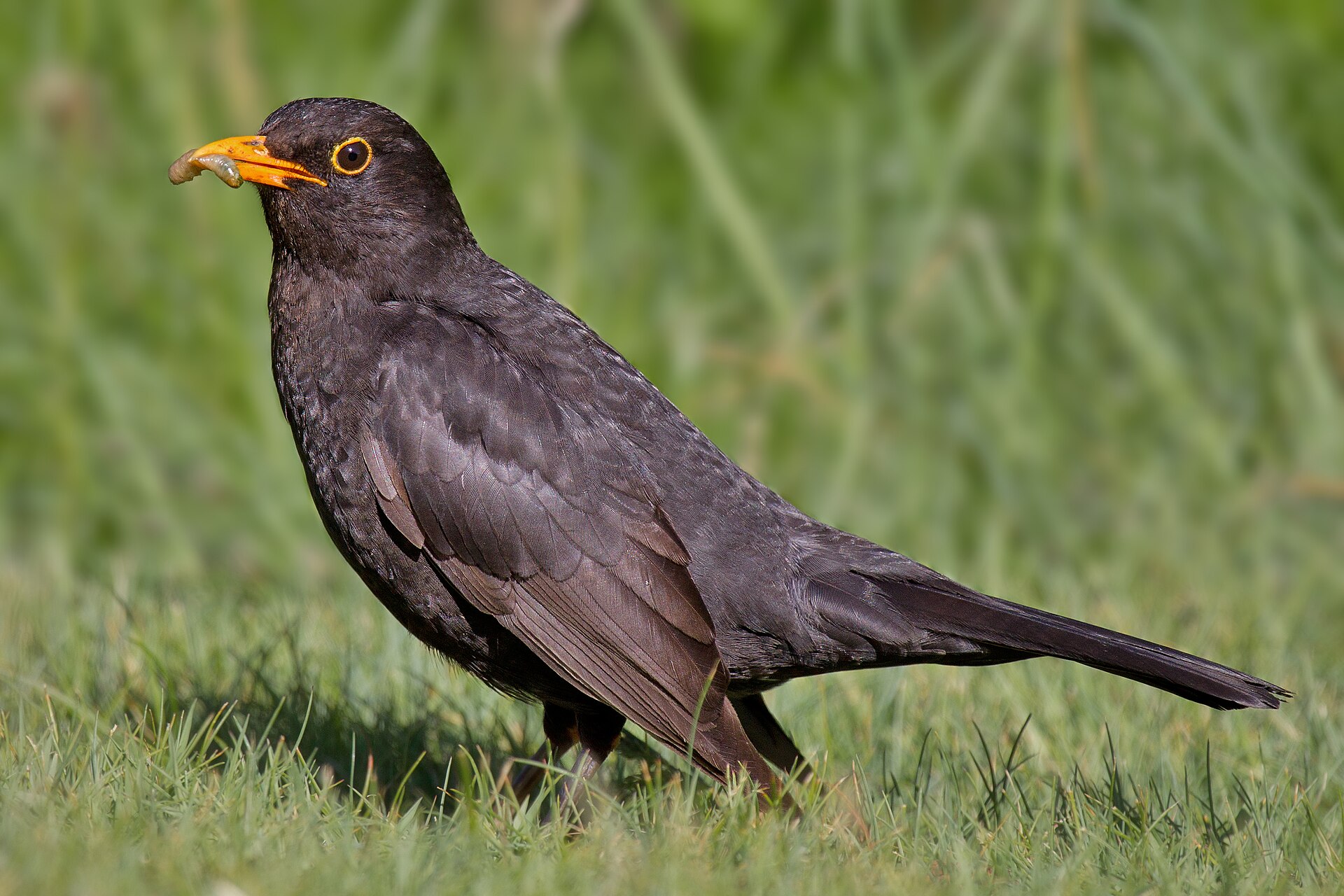
Common Blackbird
Turdus merula
Characteristics
Temperament
A diurnal, territorial wild bird, shy but very adaptable and confiding, among the most familiar of gardens, parks and cities. It feeds mainly on the ground, hopping and rummaging in the leaf litter, and is famous for its fluty, melodious song, one of the symbol-voices of the European spring. It is NOT a cage bird: it is protected wild birdlife, to be observed and safeguarded in freedom; it can be helped by keeping lawns, hedges, trees and berry plants, and by avoiding the excessive use of pesticides that reduce its prey (earthworms and insects).
Diet
An omnivore with a markedly seasonal diet: in spring-summer it feeds above all on earthworms and soil invertebrates (worms, larvae, insects, spiders, snails), essential for feeding the young too; in autumn-winter it shifts largely to berries and fruits (brambles, elderberry, ornamental fruits). It feeds mainly on the ground: it hops on lawns and rummages noisily in the leaf litter with its bill, and is famous for its ability to locate and extract earthworms from the ground. The flexible diet and the exploitation of gardens' lawns, hedges and fruiting plants are among the keys to its success in cities too.
The Common Blackbird (Turdus merula) is one of the most familiar and loved passerines of the continent: a thrush with a jet-black male and a wonderful song, a fixture of gardens, parks and cities. Famous for:
- The black male with the orange bill: glossy black plumage, a yellow-orange bill and eye-ring
- The brown female: dark brown, with a paler, mottled throat
- The melodious song: one of the richest and most beautiful among European birds, a voice of spring
- Garden life: confiding and very widespread in parks, gardens and urban centres
- Hunting earthworms: it forages on lawns and "pulls" worms from the ground
- The bond with humans: among the most familiar wild birds of all
IUCN status: Least Concern (LC). It enters the portal among the passerines, alongside the Robin and the Goldfinch: together they form a little trio of classic garden birds, each representing a different family of songbirds.
Classification and category
Order Passeriformes (the passerines, the songbirds), family Turdidae (the thrushes and blackbirds). The species is Turdus merula. In the portal it is placed among the passerines. It is useful to tell it apart from similar or confusingly named species: the other European thrushes (song thrush, mistle thrush, fieldfare) — they have a pale, spotted breast, quite different from the male blackbird's uniform black; the starling (Sturnus vulgaris) — also dark, but with metallic sheen and pale speckles, a different bill and a more "stocky" bearing; the crows and ravens (corvids) — black but much larger, with a stout bill and of an entirely different family; the so-called American "blackbird" (e.g. Agelaius) — despite the identical English name, it is NOT a thrush but an icterid, a quite different family. The combination of glossy black male + yellow-orange bill and eye-ring + fluty song makes the blackbird unmistakable among European black birds. Etymology: "Turdus" is the Latin word for "thrush"; "merula" means precisely "blackbird"; from this Latin root come the Italian name and those of many other languages. Parameters: Length about 24-25 cm. Weight roughly 80-125 g. Dimorphism: sharp, with a black male and a brown female. Longevity: in the wild on average a few years, but in exceptional cases it can live much longer. Reproduction: it builds a cup nest in hedges, shrubs or recesses, and can have several broods in a season.
Habitat and distribution
The Common Blackbird is a bird widely distributed across the western Palearctic and beyond: its range covers much of Europe, North Africa and western Asia; it has also been introduced to Australia and New Zealand. Northern populations are partly migratory, temperate ones (including Italy) largely resident. Preferred habitats — environments with trees, shrubs and ground to look for food: woods, forest edges and hedgerows; gardens, parks and urban green areas, where it is particularly common and confiding; and cultivated countryside and semi-open areas. The blackbird is one of the wild species that have best adapted to life beside people: the garden, with its lawns, hedges and berry plants, is an ideal environment for it. It is a territorial bird, especially in the breeding season, and active by day, from dawn to dusk, with the most intense singing in the early morning and the evening. It is often seen hopping on lawns or rummaging with its bill in the leaf litter in search of food. IUCN status: Least Concern (LC). It is a common, abundant and healthy bird, and one of the most familiar presences of parks and gardens.
Diet
The blackbird is omnivorous, with a diet that changes a lot with the seasons. It feeds on: earthworms and soil invertebrates (worms, larvae, insects, spiders, snails); berries and fruits (very important in autumn and winter — brambles, elderberry, ornamental fruits, etc.); and seeds and other plant material. Feeding habits: ground foraging (it hops on lawns and rummages noisily in the leaf litter with its bill, "flipping" leaves in search of prey); pulling out earthworms (the scene of the blackbird pulling a worm from the lawn, holding it firmly in its bill, is famous); and the seasonal diet (insects and worms especially in spring-summer, also for the young, berries and fruits in autumn-winter). Crucially, the flexible diet and the ability to exploit gardens' lawns, hedges and fruiting plants are among the reasons for the blackbird's great success in urban and human-modified environments.
Physical features
A medium-sized thrush with marked sexual dimorphism. The male — the best-known face: entirely black, glossy plumage; a bright yellow-orange bill; a well-evident yellow eye-ring. The female and the young: a dark-brown female, with a paler throat and a slightly mottled breast; a darker bill; brown young, densely speckled with rufous. General traits: a slender body with a rather long tail, often raised after landing; thrush's legs and bill, suited to foraging; a direct flight and the typical hopping on the ground.
Song, curiosities and behaviour
The blackbird is a diurnal, territorial bird with an extraordinary song. Although very common and familiar, it is precisely its voice that makes it special: few European species sing in such a rich and melodious way.
The great singer: the blackbird's song is considered one of the most beautiful among European birds: a fluty, rich, varied and never harsh warble, often given from a prominent perch, especially in the early morning and at dusk; it is one of the symbol-voices of spring in gardens and cities, and has inspired poets and musicians (famously, for example, the Beatles' song "Blackbird"). The "masked" male: the contrast between the jet-black plumage and the bright yellow-orange of bill and eye-ring makes the male blackbird unmistakable; these vivid colours play a role in communication and courtship: a brighter bill is often a sign of an individual in good health. The earthworm hunter: anyone with a lawn knows the scene of the blackbird that, after a few steps and a brief "listening" pause, sinks its bill into the ground and extracts a worm, pulling it firmly; the blackbird locates prey in the soil thanks to very keen sight and hearing, and is a tireless sifter of lawns and litter. The "days of the blackbird": in Italy the last three days of January are called "i giorni della merla" (the days of the female blackbird) and, by tradition, are said to be the coldest of the year; one legend ties this name to the blackbird itself: a once-white female blackbird is said to have sheltered from the great cold in a chimney, coming out all black with soot — and that, the story goes, is why blackbirds have been black ever since. The coloniser of cities: the blackbird is a classic example of a bird that has "conquered" the cities; originally tied to woods, it has very successfully colonised gardens, parks and urban centres, where it finds abundant food, nesting sites and a slightly milder climate; in urban areas it may even sing at night, "tricked" by artificial lighting. The multiple broods: the blackbird is a prolific breeder: in the good season a pair can rear several broods, building well-hidden cup nests among hedges and shrubs; this reproductive capacity, combined with adaptability, helps keep its populations numerous and widespread.
Pros
- Uccello bellissimo e familiare, dal canto tra i più melodiosi d'Europa
- Facilissimo da osservare: comune e confidente in giardini, parchi e città
- Utile in giardino: si nutre di lombrichi, insetti e altri invertebrati
- IUCN Least Concern: comune, abbondante e molto adattabile
Cons
- NON è un uccello da gabbia: è avifauna selvatica protetta
- Risente dell'uso eccessivo di pesticidi (che riducono lombrichi e insetti)
- In città il rumore e l'illuminazione artificiale possono alterarne canto e ritmi
- Può beccare frutti e bacche in orti e frutteti, talvolta in conflitto con l'uomo