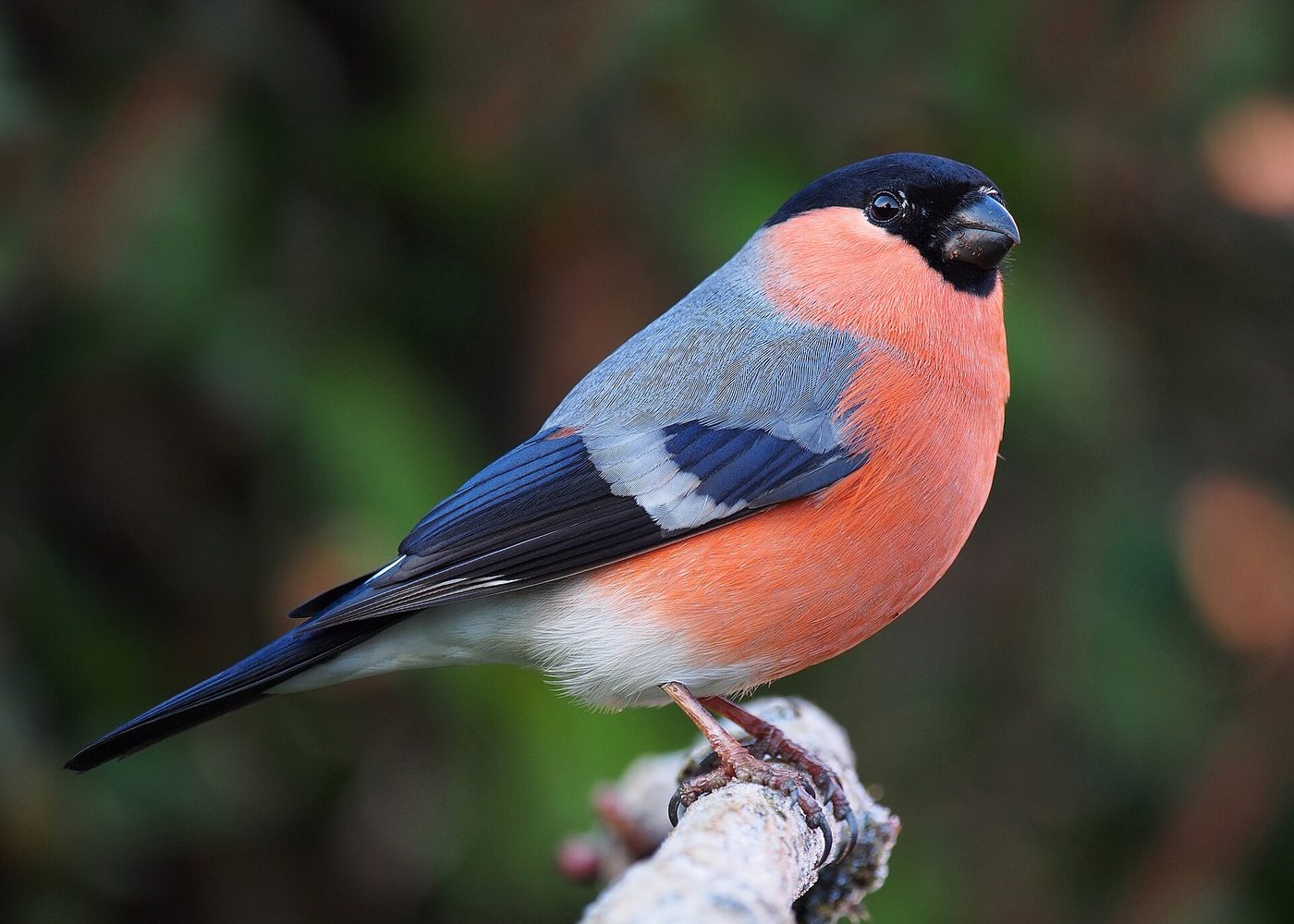
Photo: Francis Franklin · CC BY-SA 3.0
Eurasian bullfinch
Pyrrhula pyrrhula
With its bright rose-red breast and glossy black cap, the male Eurasian bullfinch is one of the most beautiful and recognisable finches of the European woods.
Characteristics
Temperament
Shy, calm, often in pairs
Diet
Granivore: seeds, buds, berries, small invertebrates
A finch of vivid colours
The Eurasian bullfinch is a small bird of stocky, plump build, among the most beautiful and recognisable of the European finches. The male is unmistakable: it has a breast and cheeks of an intense rose-red, a bluish-grey back, a glossy black cap on its head, black wings with a white bar and a white rump. The female has the same patterns but in more muted colours, brownish-grey rather than red. Its bill is short, thick and sturdy, suited to handling buds and seeds.
Habitat and distribution
It is widespread across much of Europe and temperate Asia, where it inhabits coniferous and broadleaf woods, mixed forests, scrubland, orchards, parks and gardens with trees and hedges. It is a rather shy and discreet bird, which is often noticed more for the vivid colour of the male or for its melancholy call than for any conspicuous activity.
Behaviour and feeding
The bullfinch feeds mainly on seeds, but is particularly fond of tree buds, including those of fruit trees, which it eats in spring: for this reason it was in the past sometimes considered an unwelcome guest in orchards. It supplements its diet with berries and small invertebrates. It often lives in pairs or small groups, and has a soft, gentle song, not among the most powerful, but with a characteristic fluted and melancholy call.
Curiosities
The bullfinch is known for its calm nature and its strong pair bond. In the past it was sometimes kept in captivity precisely for its appearance and its docility, and it was even said to be capable of learning to repeat simple tunes. Today, like all European wild birds, it is protected.
Conservation
The bullfinch is classified as a species of least concern, with large, widespread populations. Locally it can suffer from the loss of woods and hedges and from changes in agricultural environments. Conserving mixed woods and countryside rich in vegetation is important to ensure it has suitable habitats.
Pros
- Male of splendid, unmistakable colours
- Calm nature and strong pair bond
- Large, unthreatened populations
- Gentle, characteristic song
Cons
- Can damage the buds of fruit trees
- Shy and not always easy to observe
- Sensitive to the loss of woods and hedges