Peregrine Falcon
Falco peregrinus
Characteristics
Temperament
Fastest animal on the planet (390+ km/h in dive). Monogamous, territorial, strongly attached to the nesting site. Has colonised modern cities by nesting on skyscrapers.
Diet
Carnivore: birds in flight (pigeons 80% in cities, ducks, gulls, starlings, even herons). 70-100 g/day. Hunting "stoop" dive at 390+ km/h. Nasal tubercle inspires jet engines.
The Peregrine Falcon (Falco peregrinus) is one of the most fascinating and iconic birds in the world, holding the record as the fastest animal on the planet: in a hunting dive it can exceed 390 km/h, a speed that places it above any other living being. Cosmopolitan, it is present on every continent except Antarctica and is one of the few raptors that has perfectly adapted to urban life: today it nests successfully on the skyscrapers of cities like New York, London, Rome and Milan, exploiting pigeons and other urban birds as main prey. Saved from extinction in the 1970s after the DDT disaster, it is today one of the most important successes of modern conservation.
Classification and category
The Peregrine Falcon belongs to the order Falconiformes, family Falconidae, genus Falco. The genus comprises about 40 species of falcons distributed worldwide. F. peregrinus is the most cosmopolitan species and is divided into 19 recognised subspecies, distributed on all continents except Antarctica. The main ones are: F. p. peregrinus (Europe and Central Asia), F. p. brookei (Mediterranean), F. p. anatum (North America), F. p. tundrius (North American Arctic), F. p. cassini (South America), F. p. macropus (Australia). It is a medium-sized raptor: length 36-58 cm, wingspan 95-115 cm, weight 0.6-1.5 kg. Females are significantly larger and heavier than males (reverse sexual dimorphism common in raptors, up to 30% weight difference).
Habitat and distribution
The Peregrine Falcon is the terrestrial vertebrate with the widest distribution in the world after humans: it lives on all continents except Antarctica, from the Arctic tundra to the tropics, from oceanic cliffs to the steppes of Central Asia, from hot deserts to modern metropolises. The preferred natural habitat consists of rocky cliffs, sea cliffs, mountains with vertical walls where it can nest safely. It prefers territories with wide visibility to hunt birds in flight.
The most surprising adaptation is the urban one: from the 1980s onwards, the peregrine falcon has actively colonised large cities worldwide, recognising in skyscrapers, bell towers and bridges the artificial equivalent of natural cliffs. New York hosts over 25 breeding pairs, London just as many, and in Italy the Milan Cathedral, Castel Sant'Angelo in Rome, and numerous industrial towers have become regular nesting sites. Conservation status is listed as Least Concern (LC) by the IUCN, but with a dramatic history: in the 1960s-1970s the species was almost extinct in many regions due to DDT (the insecticide caused eggshell thinning). International reintroduction programmes (captive breeding + release) and the DDT ban in 1972 have allowed a spectacular recovery, today cited as one of the greatest successes of world conservation.
Diet
The Peregrine Falcon is a specialised aerial predator: it hunts almost exclusively birds in flight, of variable size from the small sparrow to the large heron. The diet is dominated by: pigeons (Columba livia), which constitute up to 80% of the diet in urban areas; doves, swifts, starlings, ducks, gulls, plovers, snipes, bats (rarely, at night). Larger species caught include herons, geese, moorhens, even small raptors. In some cases it has been observed attacking birds as large as its own body mass or greater.
The hunting technique is the "stoop", a dive from great heights (even 1,000-1,500 m): the falcon spots its prey from above, folds its wings and lets itself fall in a perfectly aerodynamic "V" trajectory. The documented dive speed exceeds 390 km/h (record: 389 km/h measured in 2005 with altimeter on a trained specimen, Frightful, of breeder Ken Franklin). At the moment of impact, the falcon strikes the prey with its tarsi (legs) clenched as fists, generating a lethal blow equivalent to 200-300 kg of force, which often decapitates the prey or stuns it instantly. Daily requirement is 70-100 g of meat; a single captured pigeon can sustain the falcon for 1-2 days.
Physical features
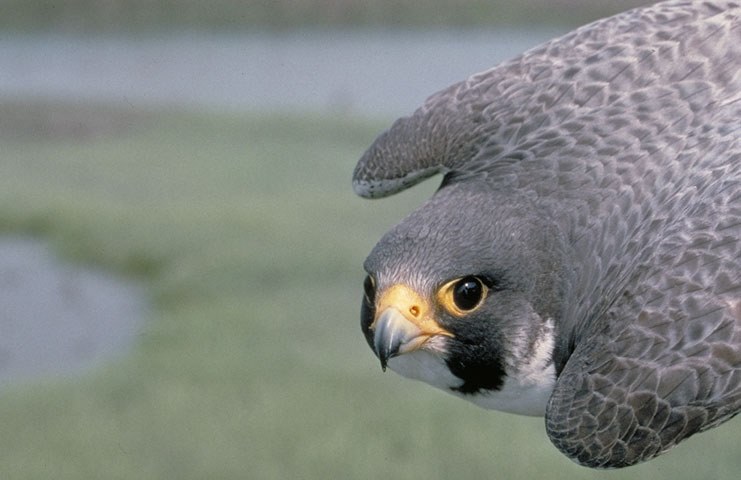
The Peregrine Falcon has a compact, aerodynamic, muscular body, perfect for aerial manoeuvres at high speed. The adult plumage is characteristic: back and wings slate-grey, belly and breast white with fine transverse black bars, head with dark cap and vertical black "moustache" (malar stripe) under the eye, which acts as a glare reducer during dives (similar to the "black under the eyes" of athletes). Juveniles have brown plumage with longitudinal streaks.
The wings are long, narrow, pointed, perfect for fast flight. The wing beat is frequent and powerful, but the Peregrine's specialty is high-speed gliding and diving. The nostrils contain a cylindrical bony structure called "tubercle" (never seen in other birds) that slows the air flow during the dive, preventing lung collapse at high speeds — the system has inspired the design of supersonic jet engines. The eyes are huge in proportion to the skull: vision is 8 times sharper than human, and the nictitating membrane (third eyelid) protects the eye during impact. The beak is short, curved, with a characteristic sharp "tomial tooth" on the upper jaw, used to break the cervical vertebrae of prey. The legs are yellow, the claws black and curved.
Behaviour and curiosities
The Peregrine Falcon is a monogamous, territorial animal strongly attached to the nesting site. A pair maintains the same partner for many years (wild longevity 15-20 years, in captivity documented up to 27 years) and defends a territory of 30-200 km². Nesting takes place on rocky walls, skyscraper ledges, old corvid nests: the falcon does not build a true nest, but uses a simple scrape in the substrate to lay the eggs. The female lays 2-5 reddish spotted eggs in March-April; incubation lasts 32-35 days, conducted mainly by the female while the male hunts for both.
Chicks are born covered in white down and depend on parents for about 40-45 days. At first flight (fledging) the juveniles must learn within a few days to hunt in flight, an activity requiring great neuromuscular coordination. Sexual maturity is reached at 2-3 years. Falconry with the Peregrine Falcon has very ancient roots: practised in Central Asia, the Middle East and Europe for over 4,000 years, it is today protected by UNESCO as Intangible Cultural Heritage of Humanity. In international falconry tournaments, Peregrines are the most admired protagonists. Curiosity: the trained specimen named "Frightful" belonging to Ken Franklin set the world speed record in 2005 with 389.46 km/h, certified by scientific telemetry. In the wild operational dives are normally 200-280 km/h. The Peregrine is also the subject of scientific study for the aerodynamic and neurophysical properties of its dives (reaction time, centre of gravity, deceleration).
Pros
- Animale più veloce del pianeta (record 389 km/h)
- Vertebrato terrestre più cosmopolita dopo l'uomo
- Esempio di successo della conservazione (recupero post-DDT)
- Falconeria UNESCO patrimonio immateriale
Cons
- Specie protetta in tutto il mondo, detenzione vietata senza permessi
- Minacciato da elettrodotti, vetri di grattacieli, pesticidi
- Falconeria richiede competenze altamente specializzate
- In picchiata può colpire uomo o auto in città