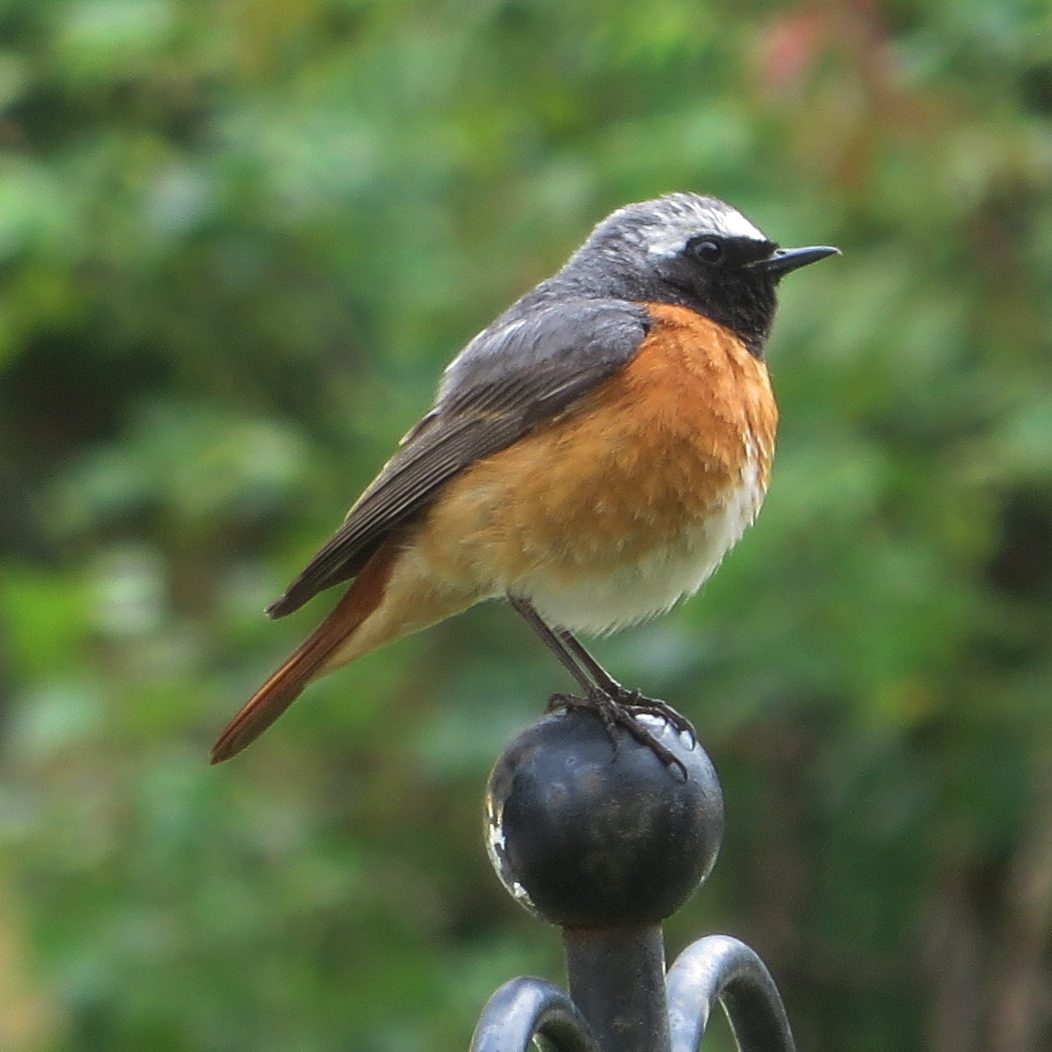
Photo: Aconcagua (talk) · CC BY-SA 3.0
Common redstart
Phoenicurus phoenicurus
The common redstart is a small migratory passerine with a constantly quivering red-orange tail, found in woods, parks and old gardens.
Characteristics
Temperament
Lively, territorial, migratory
Diet
Insects, spiders and small berries in autumn
Description
The common redstart is a small, brightly coloured bird, a little more slender than a robin. The male in breeding plumage is unmistakable: white forehead, black throat and face, a bright orange breast and the characteristic rust-red tail, which it keeps in constant, nervous quivering. The female is plainer, greyish-brown, but shares the male's vibrant red tail, the hallmark of the species.
Habitat and distribution
It is a trans-Saharan migrant: it breeds across Eurasia and part of North Africa, wintering in sub-Saharan Africa. It nests in cavities, favouring open broadleaf woodland, old orchards, parks and gardens with mature trees, as well as buildings and walls, hence its German and French folk name of "wall nightingale".
Behaviour
It is a lively, territorial bird. It hunts insects and spiders, caught in flight or picked from the ground in short dashes, and in autumn supplements its diet with small berries. The male has a pleasant, melodious song, often delivered from a high perch.
Did you know?
The constant quivering of the red tail is typical of the genus and probably serves to communicate and to disturb hidden insects, making them move. Thanks to its abundance and appeal, it has been voted bird of the year in several European countries.
Conservation
It is classed as least concern. It benefits from old hollow trees and traditional farmland; putting up suitable nest boxes can encourage it into gardens.
Pros
- Brightly coloured, unmistakable male
- Pleasant, melodious song
- Useful insect predator in gardens
Cons
- A migrant, present only in the warm season
- Depends on old hollow trees to nest
- Sensitive to the loss of traditional orchards