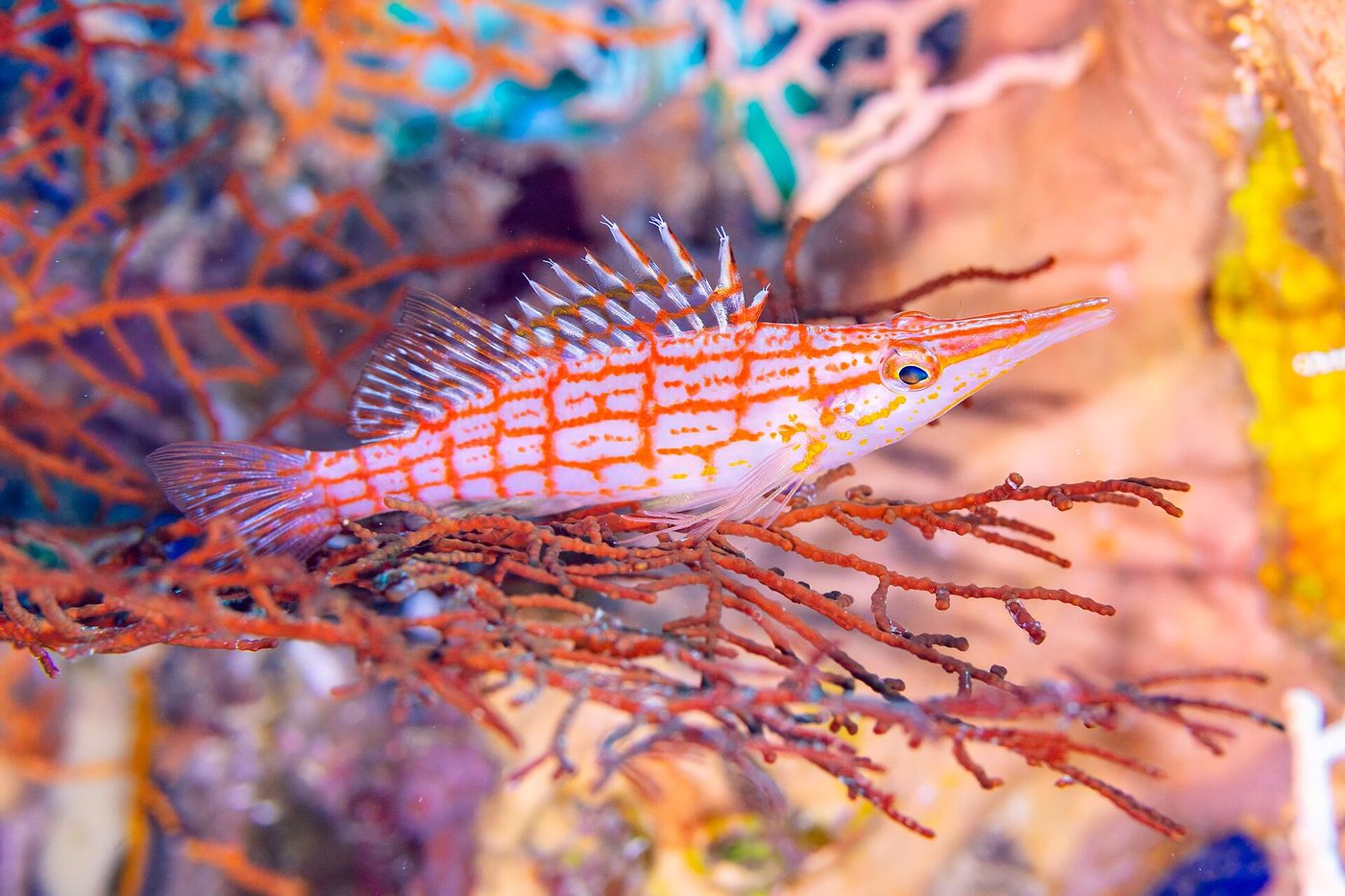
Photo: Diego Delso · CC BY-SA 4.0
Longnose hawkfish
Oxycirrhites typus
The longnose hawkfish is a small reef fish with an elongated snout and a red-and-white checkerboard pattern, fond of perching among gorgonians.
Characteristics
Temperament
Sedentary, curious, territorial with its own kind
Diet
Small crustaceans and plankton
Description
The longnose hawkfish is a small reef fish with an unmistakable appearance. Its body, reaching about 13 cm, is covered with a dense grid of red and white lines in a checkerboard pattern, ending in a slender, elongated snout resembling a beak. It is the only species in its genus.
Habitat and distribution
It lives on tropical coral reefs of the Indian and Pacific Oceans, at depths of about 10 to 100 metres. It favours the steep outer walls of reefs, where it perches among the branches of gorgonians and black corals, which it uses as a lookout and refuge.
Behaviour
Like all hawkfish, it lacks a swim bladder and does not swim continuously: it prefers to perch among the corals, propped up on its sturdy pectoral fins, from which it darts to catch small crustaceans and plankton passing in the current. Its elongated snout lets it reach prey hidden among the branches.
Aquarium care
It is a prized fish in marine reef aquariums for its striking pattern and curious behaviour. It needs a well-structured tank with crevices and branches to perch on, excellent water quality and a diet of small invertebrates. It can be territorial towards other hawkfish.
Conservation
It is classed as least concern. Like all reef species, it depends on the health of the corals; collection for the aquarium trade should be managed sustainably so as not to affect local populations.
Pros
- Striking red-and-white checkerboard pattern
- Unusual behaviour, perches among the corals
- Relatively hardy in a reef aquarium
Cons
- Can be territorial towards other hawkfish
- Preys on small ornamental crustaceans
- Needs excellent water quality and perching structures