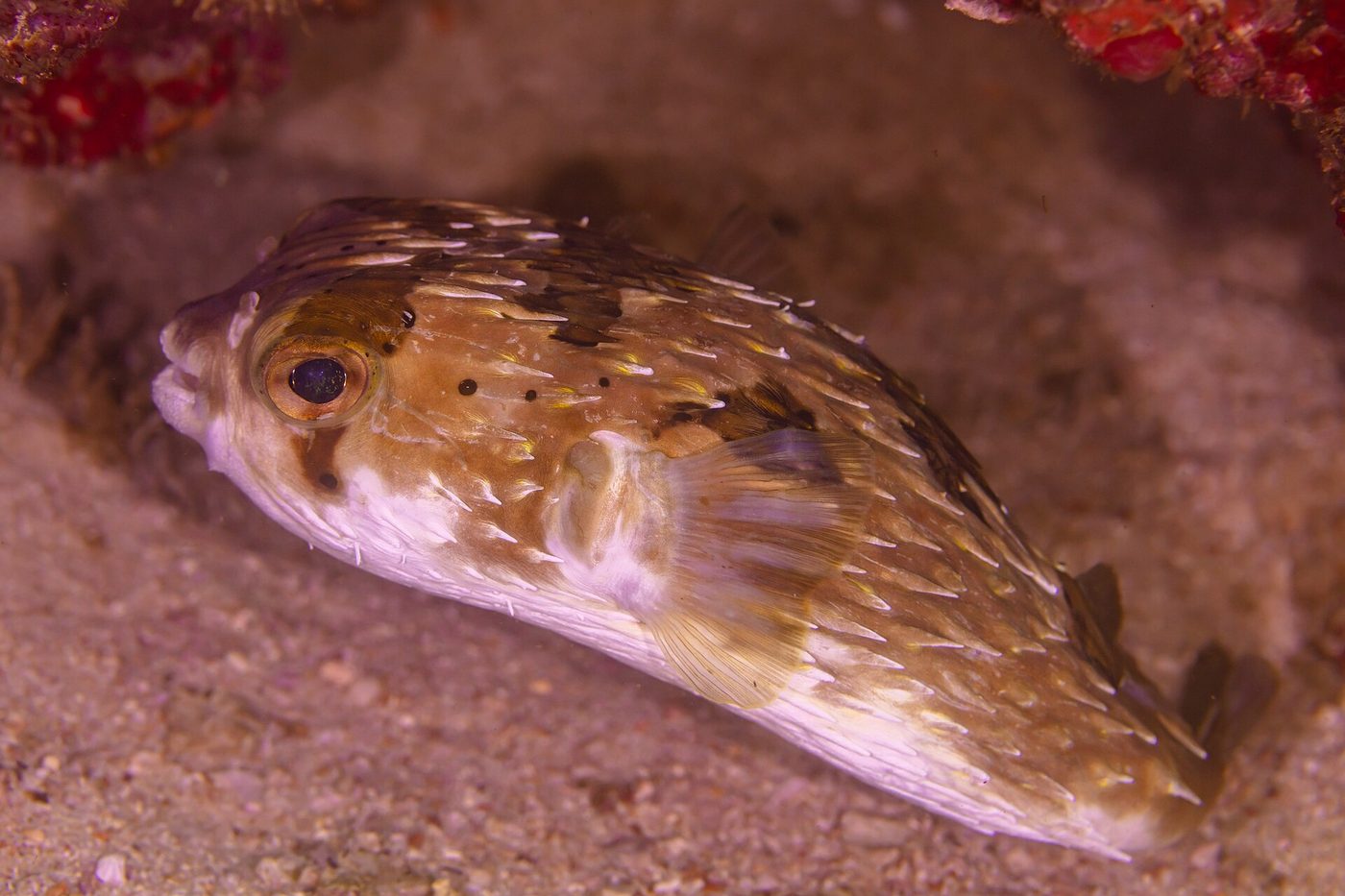
Photo: Diego Delso · CC BY-SA 4.0
Long-spine porcupinefish
Diodon holocanthus
The long-spine porcupinefish is a tropical sea fish that can inflate into a spiny balloon to fend off predators.
Characteristics
Temperament
Solitary, nocturnal, calm if undisturbed
Diet
Carnivorous: molluscs, urchins, crabs and hard-shelled invertebrates
The fish that turns into a ball of spines
The long-spine porcupinefish, also called the balloonfish or spiny puffer, is a medium-sized marine fish reaching about 50 cm in length, with a stout body and large eyes. Its most extraordinary feature is the long spines covering the body: usually folded back, they stand erect when the animal quickly gulps water and inflates into a bristling sphere that is almost impossible to bite. The colour is pale brown with scattered dark spots.
Habitat and range
It is a circumtropical species, found in the Indo-Pacific and the tropical and subtropical Atlantic. It lives in warm coastal waters, among coral reefs, seagrass beds and rocky bottoms, where it finds shelters to hide in during the day.
Behaviour and diet
It is a largely nocturnal, solitary fish. Its powerful jaws, fused into a kind of beak, let it crush the shells of molluscs, sea urchins, crabs and other hard-bodied invertebrates. Inflation is an extreme defence mechanism: a predator trying to swallow it faces a spiny ball too large and dangerous to take.
Notable facts
Like many relatives in the pufferfish family, it can contain tetrodotoxin in its tissues, making it potentially dangerous if eaten. Despite its comical look when puffed up, inflation is stressful for the animal and should never be deliberately provoked.
Conservation
The species is listed as Least Concern by the IUCN and is widespread. Populations are considered stable, though locally it faces pressure from fishing and the trade in dried specimens sold as curios.
Pros
- Spectacular balloon-like defence mechanism
- Long-lived, can exceed 10 years
- Widespread and not threatened
Cons
- Potentially toxic tissues (tetrodotoxin)
- Inflation is highly stressful for the fish