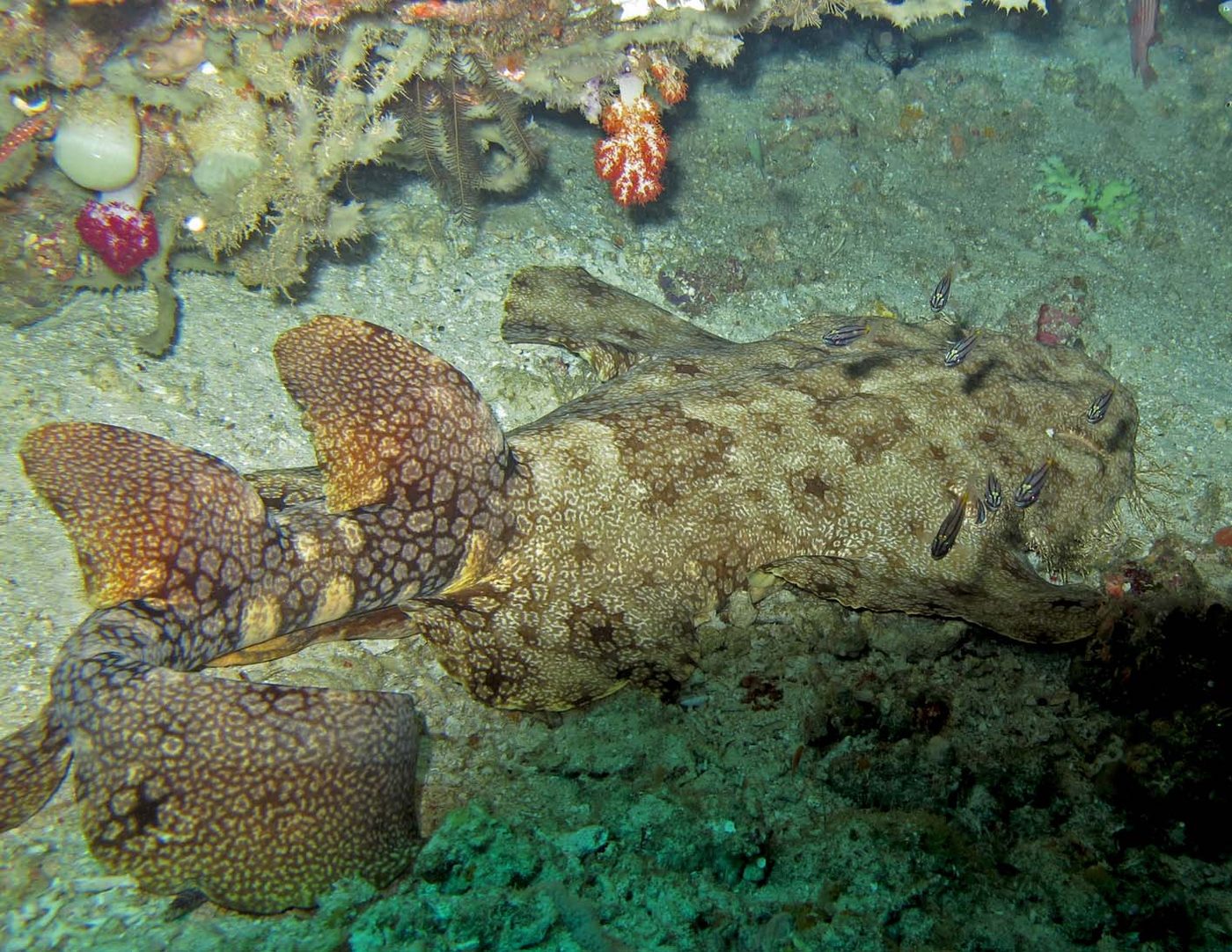
Photo: Lakshmi Sawitri · CC BY 2.0
Tasselled wobbegong
Eucrossorhinus dasypogon
A flat, camouflaged shark of coral reefs, the tasselled wobbegong wears a fringe of branching skin flaps that make it all but invisible on the seabed.
Characteristics
Temperament
Nocturnal, sedentary, ambush predator
Diet
Carnivore: reef fish and crustaceans
A shark disguised as a carpet
The tasselled wobbegong is a carpet shark with a broad, flattened body that presses close to the seabed and can reach about 1.8 metres in length. Its most distinctive feature is a fringe of branching skin flaps that rings its whole head and extends onto its chin, like a ragged beard. Combined with an intricate pattern of blotches and reticulations, these flaps make it almost indistinguishable from the reef it rests on.
Habitat and distribution
It lives on the shallow coral reefs of northern Australia, New Guinea and nearby islands, including the famous Raja Ampat archipelago. It spends the daylight hours motionless, often curled up in caves and beneath coral overhangs.
Behaviour and hunting
It is an ambush predator: it stays perfectly still, blending into its surroundings, and waits for fish and crustaceans to pass within reach, then sucks them in with lightning speed thanks to its wide mouth and sharp, backward-pointing teeth. Some observers believe it may even use the tip of its tail as a lure. It is active mainly at night.
Curiosities
Despite its placid look, this shark can bite if disturbed or trodden on by divers, and its grip is tenacious. Under normal circumstances, however, it is entirely harmless to people and prefers to stay hidden.
Conservation
The IUCN lists the species as Least Concern. As it is tied to coral reefs, it is nonetheless affected by the degradation of these habitats caused by ocean warming and destructive fishing.
Pros
- Extraordinary camouflage with its fringe of skin flaps
- Fascinating ambush predator to observe
- Harmless to people when left undisturbed
Cons
- May bite if trodden on or harassed
- Depends on the health of coral reefs
- Not a home-aquarium animal