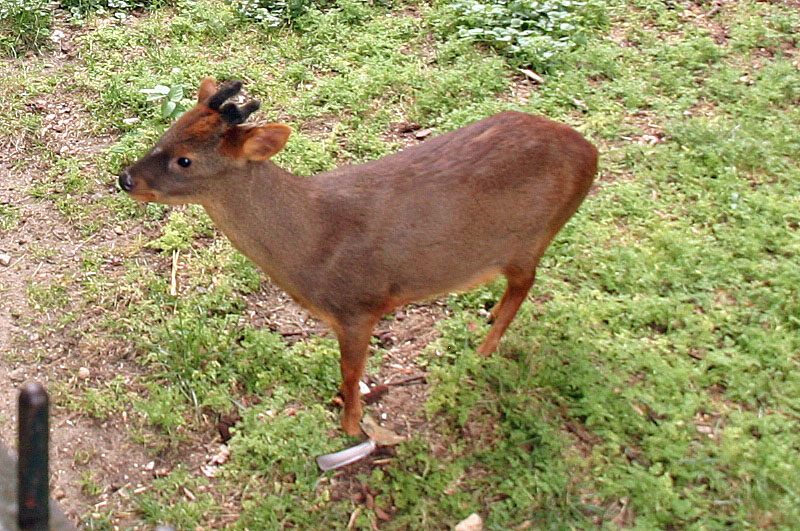
Photo: poudou99 · CC BY-SA 3.0
Southern pudu
Pudu puda
Standing barely forty centimetres tall, the southern pudu is one of the smallest deer in the world, a shy inhabitant of the temperate forests of South America.
Characteristics
Temperament
Shy, solitary, cautious
Diet
Herbivore: leaves, ferns, shoots, bark and fruit
A deer in miniature
The southern pudu is one of the smallest deer on the planet: it reaches barely forty centimetres in height at the shoulder, with a stocky, rounded body and short, slender legs. Its coat is thick and coarse, a reddish-brown that darkens on the back. Its head is small, with large rounded ears and dark, expressive eyes. The males carry tiny, simple antlers, little more than two straight points, lacking the branching typical of larger deer. Its delicate appearance makes it one of the most endearing animals of South American wildlife.
Habitat and distribution
It lives in the Valdivian temperate forests of south-central Chile and the adjacent areas of Argentina, a humid, dense environment rich in undergrowth. It prefers precisely the areas with thick vegetation, where it can move under cover and hide easily thanks to its small size.
Behaviour and feeding
It is an extremely shy, solitary animal, moving cautiously along paths in the undergrowth. It feeds by browsing on leaves, ferns, shoots, bark and fallen fruit, sometimes reaching the higher branches by standing on its hind legs or climbing sloping trunks. When frightened it can flee with short bursts and leaps through the vegetation.
Conservation
The southern pudu is classified as a near-threatened species. The loss and fragmentation of its forests, predation by domestic dogs and the dangers linked to the human presence threaten its populations. The protection of the temperate forests of South America is fundamental for its survival.
Pros
- One of the smallest deer in the world
- Delicate, unmistakable appearance
- Skilful at moving through the dense undergrowth
- Symbol of the Valdivian forests
Cons
- Near-threatened species
- Vulnerable to domestic dogs and predators
- Depends on intact temperate forests