Photo: Vassil · Public domain
South American coati
Nasua nasua
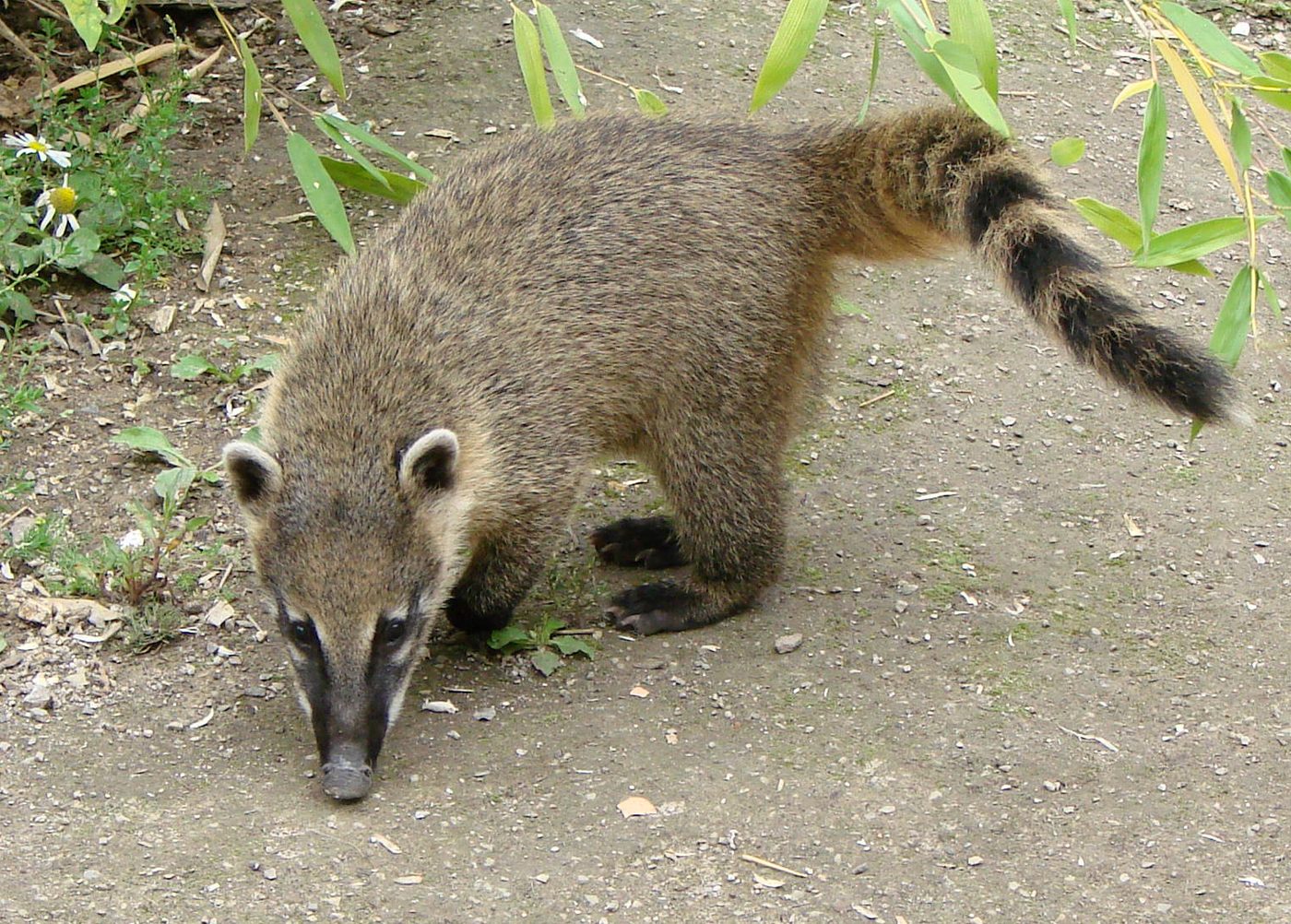
The South American coati is a lively arboreal mammal of South America, a relative of the raccoon, with a pointed snout and a long ringed tail held upright.
Characteristics
Temperament
Lively, curious, gregarious and noisy
Diet
Omnivorous: fruit, invertebrates, small vertebrates and eggs
The raccoon's South American cousin
The South American coati is a carnivorous mammal of the raccoon family, the Procyonidae. It has a slender, cat-sized body, an elongated, flexible snout it uses to root through the ground, and a long ringed tail it often holds upright like an antenna as it moves within the group. Its coat colour varies from reddish-brown to grey. Unlike its white-nosed northern relative, its snout is dark.
Habitat and range
It lives in the tropical and subtropical forests of South America, reaching into the southern part of Central America. It is an agile climber, equally at home in the trees and on the ground. In parts of Europe it is considered an invasive species following introductions.
Behaviour
Females and young live in noisy, close-knit bands that can number dozens of individuals; adult males tend to be solitary. It is omnivorous, feeding on fruit, invertebrates, small vertebrates and eggs, which it finds by rummaging through the leaf litter with its snout and strong-clawed forepaws.
Notable facts
The coati is naturally curious and little afraid of people, and in many tourist areas it approaches visitors in search of food. The upright tail acts as a visual signal to keep the group together in dense vegetation. In Italy and the European Union its keeping is banned precisely because of its invasive nature.
Conservation
The species is listed as Least Concern by the IUCN and is widespread. It benefits from its adaptability and omnivorous diet, though locally it is affected by deforestation and hunting.
Pros
- Social and very active
- Excellent climber and seed disperser
- Adaptable to different forest habitats
Cons
- Invasive outside its range, keeping banned in the EU
- Can become a nuisance in tourist areas