Photo: Charles J. Sharp · CC BY-SA 4.0
Panther chameleon
Furcifer pardalis
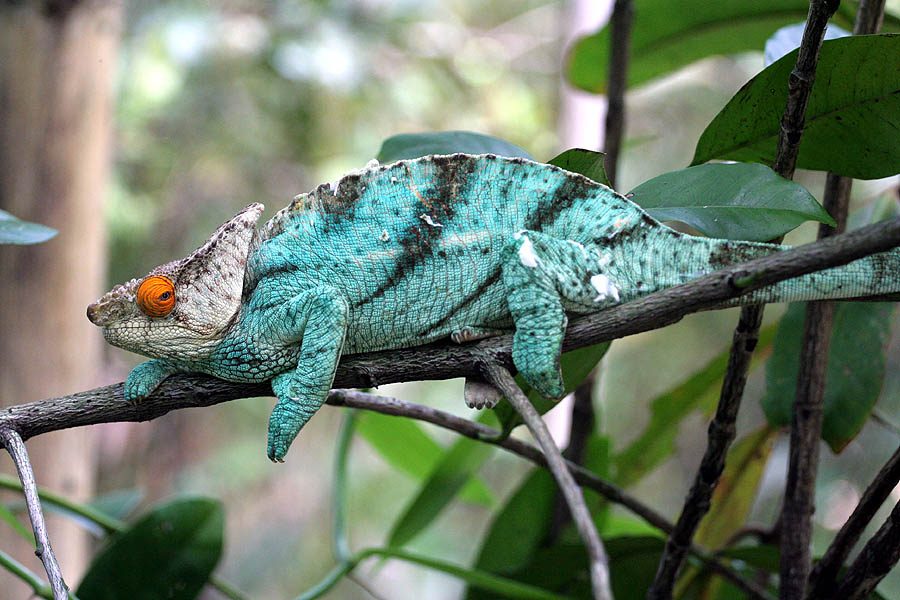
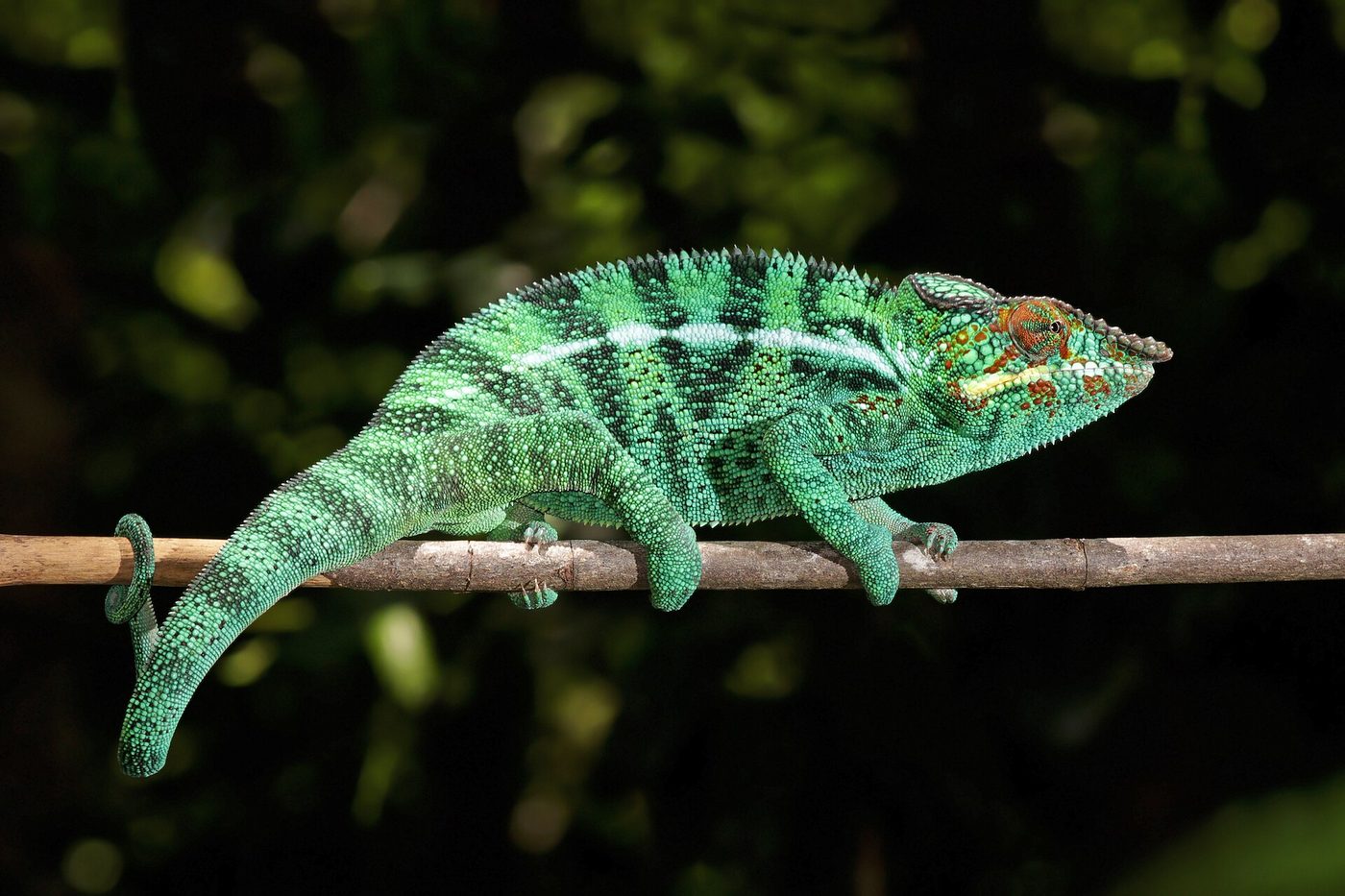
With its blazing colours, eyes that rotate independently and lightning-fast tongue, the panther chameleon is one of the most spectacular reptiles of Madagascar.
Characteristics
Temperament
Solitary, slow and territorial, mostly arboreal. It changes colour to communicate mood and intentions; it hunts with independent eyes and a lightning tongue.
Diet
Insectivore: live insects caught with its long, sticky tongue, which shoots forward in a fraction of a second.
A master of colour
The panther chameleon is one of the largest and most colourful chameleons in the world, native to Madagascar. The males in particular display spectacular liveries that vary enormously according to their region of origin: from red to turquoise, from green to orange, often with contrasting bands and networks. The females are more subdued. It has a laterally compressed body, a crest along the back and a prehensile tail that it uses like a fifth limb to grip branches.
The colour change
Contrary to a widespread belief, the chameleon does not change colour mainly to blend in with the background. The change is above all a means of communication and regulation: it expresses mood, health and intentions, serves in courtship and in disputes between males, and helps regulate body temperature by absorbing or reflecting light. The colours arise from special skin cells that rearrange tiny crystals to reflect different wavelengths.
Extraordinary eyes and tongue
The panther chameleon has two of the most fascinating systems in the animal kingdom. Its bulging eyes can move entirely independently of each other, letting it watch two different points at once and have an almost complete field of vision. When it spots prey, both eyes focus on it and the tongue, very long and sticky, shoots forward in a fraction of a second to catch it.
A reptile for experts
For its beauty the panther chameleon is sought after as a terrarium animal, but it is a species that requires careful attention and is not suited to beginners. It needs vertical spaces rich in vegetation, a precise gradient of temperature and humidity, UV lighting and a diet of live insects. It is also a solitary animal, to be kept singly.
Conservation
The panther chameleon is classified as least concern and its populations are still large in Madagascar. Like many of the island's species, however, it depends on the conservation of forests, threatened by deforestation. The trade in wild specimens can also have a local impact: choosing captive-bred animals is the more responsible choice.