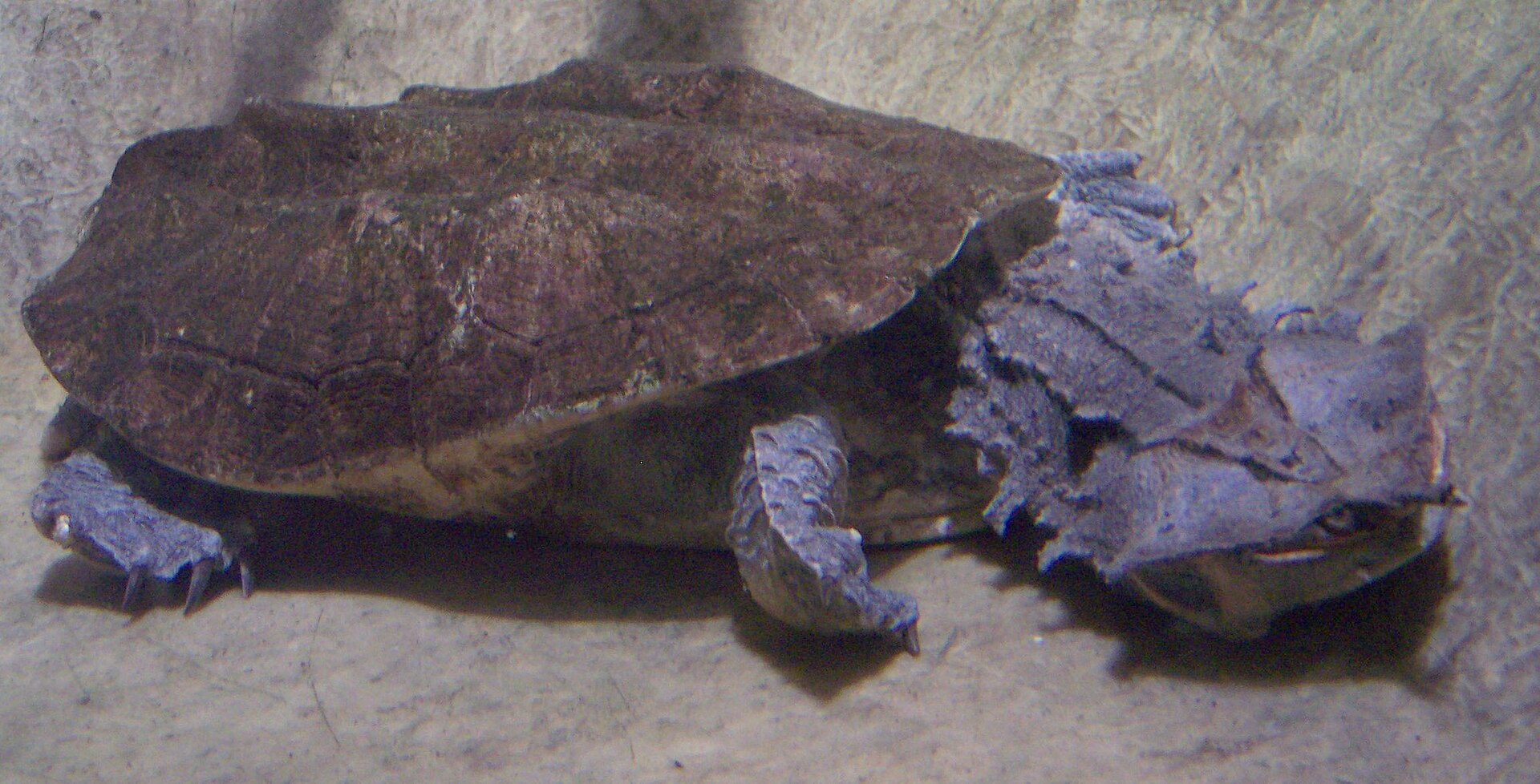
Mata mata Turtle
Chelus fimbriatus
Characteristics
Temperament
Solitary, sedentary, PERMANENTLY AQUATIC. Amazonian "living fossil" with PERFECT camouflage (algal carapace + skin tentacles = looks like dead leaf pile!). UNIQUE SUCTION FEEDING among turtles (opens mouth in 0.01 sec creating -25 kPa vortex sucking whole fish). Tubular snorkel-like nose. LATERAL neck (Pleurodira). NO teeth. 2 recent species (Vargas-Ramirez 2020). IUCN Vulnerable.
Diet
Aquatic ambush predator. Fish 95% diet (characids, catfish, cichlids, small eels), aquatic invertebrates (shrimp, crabs), occasional amphibians. UNIQUE SUCTION FEEDING among turtles: opens enormous mouth in 0.01 seconds creating -25 kPa vortex sucking whole fish from 5-10 cm distance. Skin tentacles attract prey as lure. No teeth — swallows whole. 2-3 fish/week.
The Mata mata Turtle (Chelus fimbriatus) is one of the most BIZARRE animals in the world. Endemic to the Amazon and Orinoco basins, famous for:
- PERFECT CAMOUFLAGE: carapace covered with irregular outgrowths, flat triangular head with fleshy tentacles — looks like a pile of dead leaves on river bottom!
- UNIQUE SUCTION FEEDING: opens enormous mouth in 0.01 seconds creating water vortex that sucks whole fish in — only turtle in world with this mechanism
- "Living fossil": Chelidae family dates to Cretaceous (~75 Mya)
- Snorkel-like nose: long tubular, used as "snorkel" to breathe without surfacing
- Carapace length: 40-45 cm (record 53 cm)
- Weight: 15-18 kg adults
- Very long neck: cannot retract under carapace — folds sideways (Pleurodira "side-necked turtles")
IUCN status: Vulnerable (VU) since 2016 due to intensive pet trade ($200-500+ per specimen).
Classification and category
Order Testudines, suborder Pleurodira, family Chelidae, genus Chelus. Recently divided into 2 species (Vargas-Ramirez et al., 2020): C. fimbriatus (Amazon basin) and C. orinocensis (Orinoco basin) — separated ~7 Mya. Family Chelidae has Gondwanan distribution (S.America, Australia, New Guinea). Etymology: "Chelus" Greek "turtle". "Fimbriatus" Latin "fringed" (skin outgrowths). "Mata mata" from Yanomami/Spanish colonial "kills-kills". Described by Schneider 1783. Parameters: Carapace 40-45 cm (record 53 cm). Weight 15-18 kg (record 25 kg captive). Head 12-15 cm. Neck 30-35 cm (longer than carapace!). Longevity 30-40 years natural, 50+ captive. Sexual maturity 5-8 years. 12-28 eggs/year. Incubation 200-220 days (very long!). Temperature-dependent sex determination.
Habitat and distribution
Endemic to tropical South America. Main populations: Venezuela (Orinoco), Colombia, Brazil (Amazon — main), Guyana, Suriname, French Guyana, Ecuador, Peru, Bolivia. Introduced to Trinidad. Habitats: slow turbid rivers (main — silty/sandy bottom), swamps and flooded areas, varzea floodplain forests, igapó black-water flooded forests, occasional brackish waters. Avoids fast rivers, clear waters, open areas. IUCN: Vulnerable since 2016. Threats: pet trade (main cause), habitat loss, accidental capture in nets, water pollution (pesticides, mercury), nest predation, climate change. CITES: Appendix II.
Diet
Aquatic ambush predator. Diet: fish 95% (characids including piranhas, catfish, cichlids, small eels), aquatic invertebrates (freshwater shrimp, small crabs), occasional amphibians, rare juvenile birds. UNIQUE SUCTION FEEDING: bottom positioning + camouflage + tentacle lure (cutaneous outgrowths oscillate attracting curious fish) + mouth opens in 0.01 SECONDS (faster than blink!) creating -25 kPa negative pressure vortex + 1-2 L water + fish sucked whole + water expelled through nostrils + fish swallowed WHOLE (no teeth — no chewing). Distance: 5-10 cm. Success: 80-90%. 2-3 large fish/week.
Physical features
ABSOLUTELY BIZARRE silhouette. Carapace: oblong, flat, 3 longitudinal keels, brown-chestnut, often covered with filamentous algae and slime (accentuating camouflage), irregular edges. Head: FLAT TRIANGULAR ENORMOUS (leaf-like), FLESHY TENTACLES/OUTGROWTHS on chin/nose/neck (mimic roots/algae, sensory organs detecting vibrations), small black eyes on top, ENORMOUS mouth (wider than head when open), TUBULAR SNORKEL-LIKE NOSTRILS protruding forward (breathing without surfacing). Body: VERY LONG NECK (30-35 cm, longer than carapace!), folds SIDEWAYS (Pleurodira diagnostic — cannot retract under shell), short stout limbs with strong claws, short tail. Speed: very slow swimmer (prefers bottom walking), 0.01 sec strike (explosive!). Excellent chemosensors via tentacles. Hours underwater.
Behaviour and curiosities
Solitary, sedentary, permanently aquatic. No territory, no marking. Polygamous breeding (rainy season variable by region). Underwater mating. Female emerges to lay 12-28 eggs in sandy/dirt bank nest. 200-220 day incubation (very long!). TSD. No parental care. Defence: camouflage + immobility (not aggressive). Bite painful but not serious (no teeth).
Famous: SUCTION FEEDING mechanism (Heiss et al. 2008) — fastest mouth opening among reptiles, -25 kPa negative pressure, unique among turtles. "Perfect camouflage": algal carapace + skin tentacles + leaf shape + immobility — indistinguishable from dead leaf pile. "Snorkel nose": tubular nostrils anatomical snorkel. "Side neck": Pleurodira — folds laterally not retracted. "No teeth": swallows fish whole. 2020 species split: C. fimbriatus (Amazon) + C. orinocensis (Orinoco), 7 Mya separation. Pet trade threat: $200-1,500 per specimen, IUCN VU 2016. Not for pets: requires 1,000+ L acidic tank, live fish. Yanomami name: "kills-kills". 50+ year longevity: San Diego Zoo, Zurich Zoo. Acidic Amazon waters (pH 4-6) adaptation. Convergence with anglerfish: same ambush + lure + suction strategy across 320 My evolution!
Pros
- Camuffamento tra i migliori del regno animale
- Unico meccanismo di suction feeding tra tartarughe
- Fossile vivente di 75 milioni di anni
- Longevità eccezionale (50+ anni in cattività)
Cons
- IUCN Vulnerable per cattura intensiva pet trade
- Riproduzione lenta (maturità 5-8 anni)
- Dipende strettamente da habitat acquatici amazzonici
- Non adatta come pet (richiede setup specifico costoso)