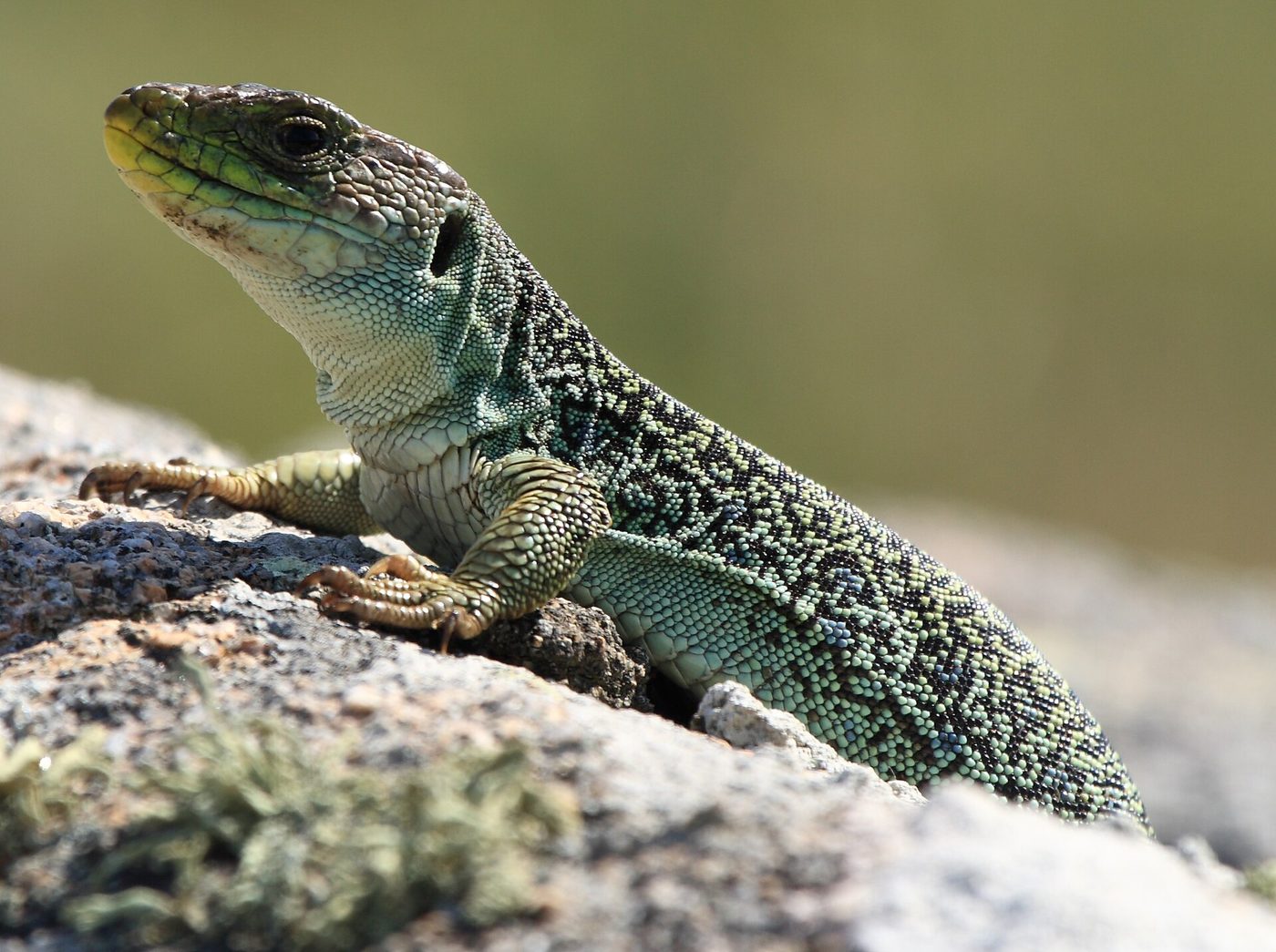
Photo: Arturo Nikolai · CC BY-SA 2.0
Ocellated lizard
Timon lepidus
The ocellated lizard is the largest lizard in Europe, a magnificent reptile of the Mediterranean scrub adorned with striking blue eyespots.
Characteristics
Temperament
Diurnal, heat-loving, wary but pugnacious
Diet
Omnivorous: large insects, invertebrates, small vertebrates and fruit
The jewel of the Mediterranean scrub
The ocellated lizard, also called the jewelled lizard, is the largest lizard in Europe: it can reach 60–70 cm in total length, including the tail. It has a robust body and a large head, especially in adult males. The colour is bright green or brownish, speckled with black, with the feature that gives it its name: two rows of striking, intensely blue eyespots (ocelli) along the flanks, especially vivid in males during the breeding season.
Habitat and range
It is endemic to south-western Europe, particularly the Iberian Peninsula and southern France, with a presence too in north-western Africa. It lives in the warm, sunny habitats of the Mediterranean scrub: garrigue, stony slopes, olive groves, old dry-stone walls and open bushland.
Behaviour and diet
It is a diurnal, heat-loving reptile that likes to bask in the sun. It is a voracious hunter: it feeds mainly on large insects such as beetles and grasshoppers, but also on other invertebrates, small vertebrates, eggs and even fruit and berries. If threatened, it can defend itself with firm bites thanks to its powerful jaws.
Notable facts
It was once classified, like the European green lizard, in the genus Lacerta. The blue ocelli, besides making the animal spectacular, may play a role in recognition between individuals and in courtship. It spends the winter in hibernation, sheltering in burrows or crevices.
Conservation
The species is listed as Near Threatened by the IUCN. It is declining in several areas due to habitat loss, intensive agriculture, road traffic and the disappearance of dry-stone walls and prey.
Pros
- Europe's largest lizard
- Spectacular livery with blue eyespots
- Useful natural control of insects
Cons
- Near Threatened, in decline
- Sensitive to loss of open habitats