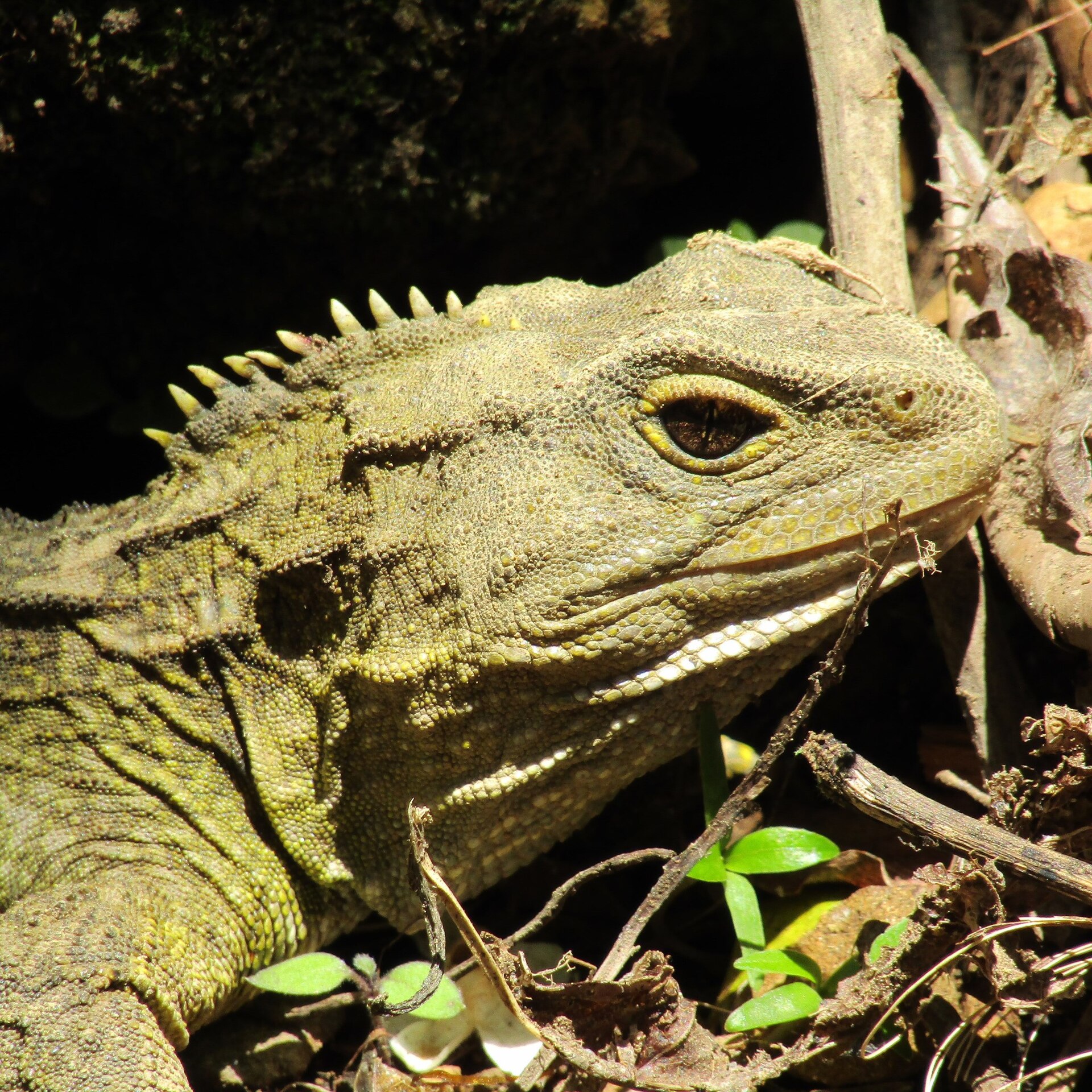
Tuatara
Sphenodon punctatus
Characteristics
Temperament
Solitary, territorial, nocturnal-crepuscular. "Living fossil": sole Rhynchocephalia survivor (250 Mya). Parietal third eye functional until 6 months (regulates circadian rhythm). NO hemipenis (cloacal contact mating). Fixed acrodont teeth, upper double row (unique among vertebrates). Temperature-dependent sex determination.
Diet
Opportunistic carnivore. Insects (endemic weta 60-70%), snails, lizards, small birds, marine eggs. "Sit-and-wait" hunter at burrow entrance. Unique acrodont teeth (upper double row, never replaced). Very slow metabolism: 1 meal/1-3 weeks. Can fast 1 year in captivity!
The Tuatara (Sphenodon punctatus) is a reptile endemic to New Zealand considered one of the most extraordinary "living fossils" on the planet. Although it appears similar to a large lizard, it is NOT a lizard: it is the sole survivor of the order Rhynchocephalia ("beak-heads"), an ancient lineage that separated from the common ancestors of lizards and snakes (Squamata) about 250 million years ago, at the beginning of the Triassic — long before the dinosaurs. It is therefore genetically more distant from a lizard than a human is from a kangaroo. The name "tuatara" comes from the Maori language and means "spiny back", referring to the crest of triangular scales along the spine of males. Measurements: length 50-80 cm (record 1 m), weight 0.5-1.3 kg. The most surprising feature is the parietal "third eye", a photoreceptor on the top of the head visible as a small light spot in the young — functional up to 4-6 months of age to regulate circadian rhythm and thermoregulation, then covered by scales. Longevity is exceptional: 60-100 years in nature, with specimens documented at 130+ years in captivity still fertile. Sexual maturity at 15-20 years. IUCN status: Least Concern (LC) thanks to conservation programmes, but extinct on most of New Zealand; it survives mainly on 32 offshore islets.
Classification and category
The Tuatara belongs to the class Reptilia, order Rhynchocephalia (rhynchocephalians, from the Greek "beak-heads"), family Sphenodontidae, genus Sphenodon. This is a critical point: the tuatara is NOT a lizard! Lizards belong to the order Squamata (together with snakes). The tuatara is the last survivor of an order that flourished during the Mesozoic (250-65 million years ago), diversified into dozens of species, and went almost completely extinct after the K-Pg mass extinction (66 Mya). The Tuatara survived only in New Zealand, isolated from mammalian extermination (NZ never had native mammals except bats).
Internal taxonomy:
- Sphenodon punctatus — Common Tuatara (main species, ~60,000 individuals)
- Sphenodon guntheri — Brothers Tuatara (Brothers Island), recognised as separate species 1989, today considered subspecies of S. punctatus from modern genetic analyses (Hay et al., 2010)
The genetic separation with the closest relative (lizards) is 240-250 million years, equivalent to the separation between mammals and amphibians. Phylogenetically, the Tuatara is older than the dinosaurs themselves.
The morphological parameters: head-body length 50-80 cm (record 100 cm); weight 0.5-1.3 kg (M larger than F, up to 1.5× the weight); tail 25-40 cm (can be autotomised and regenerated). Longevity: 60-100 years in nature, 130+ years in captivity (record "Henry" — Southland Museum, still fertile at 111 years in 2009!). Slow development: sexual maturity at 15-20 years; females reproduce every 2-5 years. Slow growth: continues for 35-50 years (lizards stop growing at 2-5 years).
Habitat and distribution
The Tuatara is endemic to New Zealand. Before human arrival (about 1280 AD with the Maori, and introduced species such as Polynesian rats Rattus exulans), the tuatara inhabited the entire New Zealand archipelago: North Island, South Island, and surrounding islands. Today, due to predation by introduced rats, cats and dogs, it is extinct on the main island (extinct on main island since about 1700-1800); it survives only on 32 offshore islets where predators are absent or have been eradicated. Ideal habitat:
- Maritime temperate forests: coastal humid forests of Pohutukawa, tea-tree trees
- Colonies of seabirds (terns, petrels): the tuatara lives in burrows dug by birds (unique commensalism), warmed by nest heat, fertilised by guano
- Windy grasslands with rocks and crevices
- Temperatures: 5-22°C (the lowest among reptiles — can be active at 6°C, while most lizards die below 10°C)
The main islands with populations:
- Stephens Island (Takapourewa): 30,000-50,000 individuals, maximum density in the world (2,000/hectare)
- Brothers Island: ~400 individuals of "S. guntheri" (critical population)
- Little Barrier Island: 8,000 individuals
- Mokohinau Islands: 8,000 individuals
- Karori Sanctuary (Wellington): reintroduced from 2005, on mainland in fenced reserve
- Maud Island: 30,000
Estimated global population: 55,000-60,000 mature individuals (Wilson et al., 2017). IUCN status: Least Concern (LC), but the species is classified as "Range-restricted endemic" and protected by New Zealand's Wildlife Act 1953. Active conservation programmes: "Tuatara Recovery Programme" (Department of Conservation NZ) — eradicates predators from islands, reintroduces tuatara to protected reserves on the mainland (Zealandia/Karori from 2005). Notable success: at Stephens Island, after cat eradication in 1925, the population has tripled. Modern threats: climate change (tuatara sex determination is temperature-dependent — females are produced at lower temperatures, males at higher; global warming could lead to an imbalanced sex ratio), predation on islands where rats have not been eradicated, habitat loss. The tuatara is also a key species in Maori culture: called "ngārara" or "tuatara", it is considered a spiritual guardian ("kaitiaki") of traditional knowledge.
Diet
The Tuatara is a nocturnal opportunistic carnivorous predator. Diet varies seasonally:
- Insects: weta (large endemic New Zealand crickets), beetles, ants, flies, spiders — constitute 60-70% of the diet
- Snails, worms, annelids in humid areas
- Small birds: taken from nests (terns, young petrels — "rewarded" commensalism)
- Eggs of seabirds
- Smaller lizards (endemic skinks)
- Small mammals (young bats, occasionally)
- Marine crustaceans: in inlets at the tide line
- Amphibians: introduced frogs (eating invasive prey is positive for conservation!)
Hunting technique: the tuatara is a "sit-and-wait" hunter. It waits motionless at the entrance of its burrow for hours, until a prey passes within 10-20 cm. The attack movement is slow for a reptile but effective against slow prey. A unique feature: the teeth of the Tuatara are acrodont, that is, fused directly to the jaw bone (not in sockets as in other reptiles). Furthermore, it possesses a double row of teeth on the upper jaw that closes between the single lower row — a mechanism called "shearing mechanism", unique among living vertebrates. It allows precise cutting of insect shells, bones of small vertebrates. The teeth are never replaced during life (a feature shared only with some mammals); elderly individuals (80+ years) have teeth worn down to the bone level, forcing them to a softer diet.
The tuatara eats little: in cold winter months it can fast for up to 1 year in captivity! In nature, it eats 1-2 prey every 1-3 weeks. Exceptionally slow metabolism: digestion of a meal can require 3-4 weeks. Heart rate: 5-10 beats/minute at rest (vs 80-100 of most lizards).
Physical features
The Tuatara has the appearance of a large robust lizard, but with unique anatomical features. The colour varies from olive green to brown-greyish, with light spots irregularly distributed. Males are slightly larger and more colourful; during the breeding season, some males become darker (almost black). The skin is covered with small, granular scales; on the back, a characteristic crest of triangular spiny scales runs along the spine from the nape to the tail — higher in adult males (10-15 mm), can be raised in display.
The head is large, triangular, with the characteristic "beak" at the tip (hence the name of the order Rhynchocephalia = "head with beak"). The jaws are powerful. The eyes are large, frontal, with vertical slit pupils (adapted to nocturnal vision); brown-green colour. Above the skull, between the normal eyes, the parietal "third eye" is present: a small light spot visible in the young, containing:
- A true lens (analogous to a normal eye)
- A retina with photosensitive cells
- A nerve connected to the epiphysis (pineal gland)
The third eye is fully functional up to 4-6 months of age: it detects light/dark, regulates circadian rhythm, thermoregulation (it tries to expose it to the sun for warming). After 6 months, it is covered by scales and becomes externally invisible, although it remains partially functional as a deep photoreceptor. Many reptiles (lizards, snakes) have a vestigial version of the parietal organ, but the tuatara preserves it in its most developed form — a true "eye".
Unique anatomy:
- Gastralia (gastric ribs): has additional ventral ribs (gastralia), legacy of the primitive Triassic reptiles, lost in modern lizards
- Cranial skeleton: presents two temporal fenestrae (full diapsid), typical of primitive reptiles; lizards have lost one of the temporal bars
- No copulatory organ (hemipenis): the male does NOT have penis/hemipenis like all other male reptiles; mating occurs by "cloacal contact" — males and females press their cloacas together, transferring sperm directly. Primitive feature shared only with birds (in the majority)
- Fixed acrodont teeth: fused to the bone, not replaced during life
- Double row of upper teeth: unique among living vertebrates
- No external ear opening: has only a small eardrum hidden under skin and muscles; hears only low frequencies (40-800 Hz)
The legs are short but powerful, with 5 fingers equipped with claws. The tuatara is capable of caudal autotomy (loses the tail to escape predators) — but unlike lizards, the tail grows back very slowly (1-2 years vs 1-3 months for most lizards) and is structurally different.
Behaviour and curiosities
The Tuatara is a nocturnal-crepuscular animal, territorial in males. During the day it sleeps in burrows dug by seabirds (commensal, rarely digs itself); at night it emerges to hunt, with much reduced activity in the coldest hours. It is an ectotherm extremely "cold-tolerant": optimal body temperature 16-21°C (vs 30-35°C for most reptiles). It can be active at only 6°C — record for reptiles. For thermoregulation, during the day it warms at the entrance of the burrow (exposing the "third eye" to the sun). The extreme metabolic slowdown allows it to live long: it breathes only 1 time every 7 seconds, can hold its breath for over 1 hour underwater.
The territorial behaviour: adult males defend territories of 20-50 m². Male fights are spectacular: two males face each other, raise the crest of scales, open their mouths in display, can bite on the nape causing wounds. Visual communication (postural displays, raising the crest) — the tuatara is almost mute, emitting only an occasional hoarse croak.
Reproduction is one of the slowest processes among vertebrates. Mating season: austral winter (February-March). Without hemipenis, mating lasts 30 minutes to 1 hour (vs a few seconds in lizards). The female lays eggs only 9-10 months later (longest gestation among reptiles). Lays 6-10 eggs in burrows dug in the ground. Natural incubation lasts 11-16 months — it is the longest reptile incubation in the world! The cubs weigh 4-5 g at hatching.
Extraordinary feature: tuatara sex determination is temperature-dependent:
- Eggs incubated below 21°C → produce females
- Eggs incubated above 22°C → produce males
- 21.5°C is the "pivotal temperature" point: 50% M, 50% F
This means that climate change directly threatens the tuatara: even a 1°C increase in nesting islands could lead to almost male-only populations → functional extinction within 50-100 years. It is one of the most vulnerable species to global warming.
Famous curiosities: the "living fossil". The term was coined by Charles Darwin in The Origin of Species (1859) but applied to the tuatara by the New Zealand palaeontologist Sir William Dallinger (1907). The tuatara is morphologically almost identical to its fossils from 200 million years ago (Homoeosaurus, Jurassic). This makes it the "oldest morphological type of living terrestrial vertebrate". Henry curiosity: the most famous tuatara in the world is Henry, resident at the Southland Museum (Invercargill, NZ). Captured adult in 1970 (probably born ~1900), he is 130+ years old. He became a father for the first time at 111 years (2009), with female Mildred (80 years), 11 cubs. He is the oldest documented reptile in the world. Maori culture curiosity: the Maori call the tuatara "ngārara" or "tuatara"; in their cosmology, it is the kaitiaki (spiritual guardian) of wisdom. Never hunted (tapu sacred). Traditional tattoos ("ta moko") include tuatara motifs. "Third eye" curiosity: the parietal eye of the tuatara has been studied as a model of the evolution of the pineal gland in mammals. In mammals (and humans), the pineal gland regulates circadian rhythm and melatonin production — it is the evolutionary homologue of the tuatara's parietal eye! Size curiosity: the largest tuatara ever weighed was 1.5 kg (Stephens Island, 1994). Males can weigh 2× females. Longevity curiosity: the tuatara is one of the few animals that continues to grow throughout life, although very slowly after 50 years. Maximum length is reached at 40-50 years. Growth curiosity: young tuatara grow 0.5-1 cm/year; at 5 years they measure 10 cm, at 15 years 30 cm, at 30 years 50 cm. DNA curiosity: the genetic analysis of the tuatara (2008) revealed that it has a molecular evolution rate higher than any other vertebrate studied — paradoxically, while morphological evolution is "slow" (morphological stasis), the DNA changes rapidly. NZ curiosity: the tuatara is the symbol of the New Zealand Department of Conservation. It appeared on the 5 cent NZ coin (1967-2006). "Tuatara" name curiosity: in Maori it means "spiny on the back", referring to the dorsal crest. The name "Sphenodon" also derives from the Greek "sphēnos" (wedge) + "odōn" (tooth), referring to the wedge-shaped tooth shape. Cinema curiosity: the tuatara appears in the film "Lord of the Rings" (special effects, 2001) as inspiration for small creatures, in BBC Planet Earth documentaries, and in games like "Animal Crossing". Heart curiosity: during nocturnal activity, the tuatara has a heart rate of 30-50 BPM; in winter stasis (brumation), it can drop to 1-3 BPM — one of the lowest heart rates in living vertebrates. Sphenodon guntheri vs punctatus curiosity: genetic analyses of 2010 have shown that the separation between the "two species" is very recent (10-20,000 years) and does not justify the taxonomic separation. Today it is considered a single species with two distinct geographical populations.
Pros
- Vero 'fossile vivente' (lignaggio di 250 milioni di anni)
- Longevità eccezionale (60-100 anni, record 130+)
- Terzo occhio parietale funzionale (unicum tra vertebrati)
- Denti acrodonti fissi a doppia fila superiore (unicum)
Cons
- Critica vulnerabilità al cambiamento climatico (sex ratio T-dipendente)
- Endemico solo a 32 isolotti NZ (estinto su isola principale)
- Crescita lentissima (35-50 anni), maturità sex. 15-20 anni
- Incubazione natural 11-16 mesi: una delle più lunghe al mondo