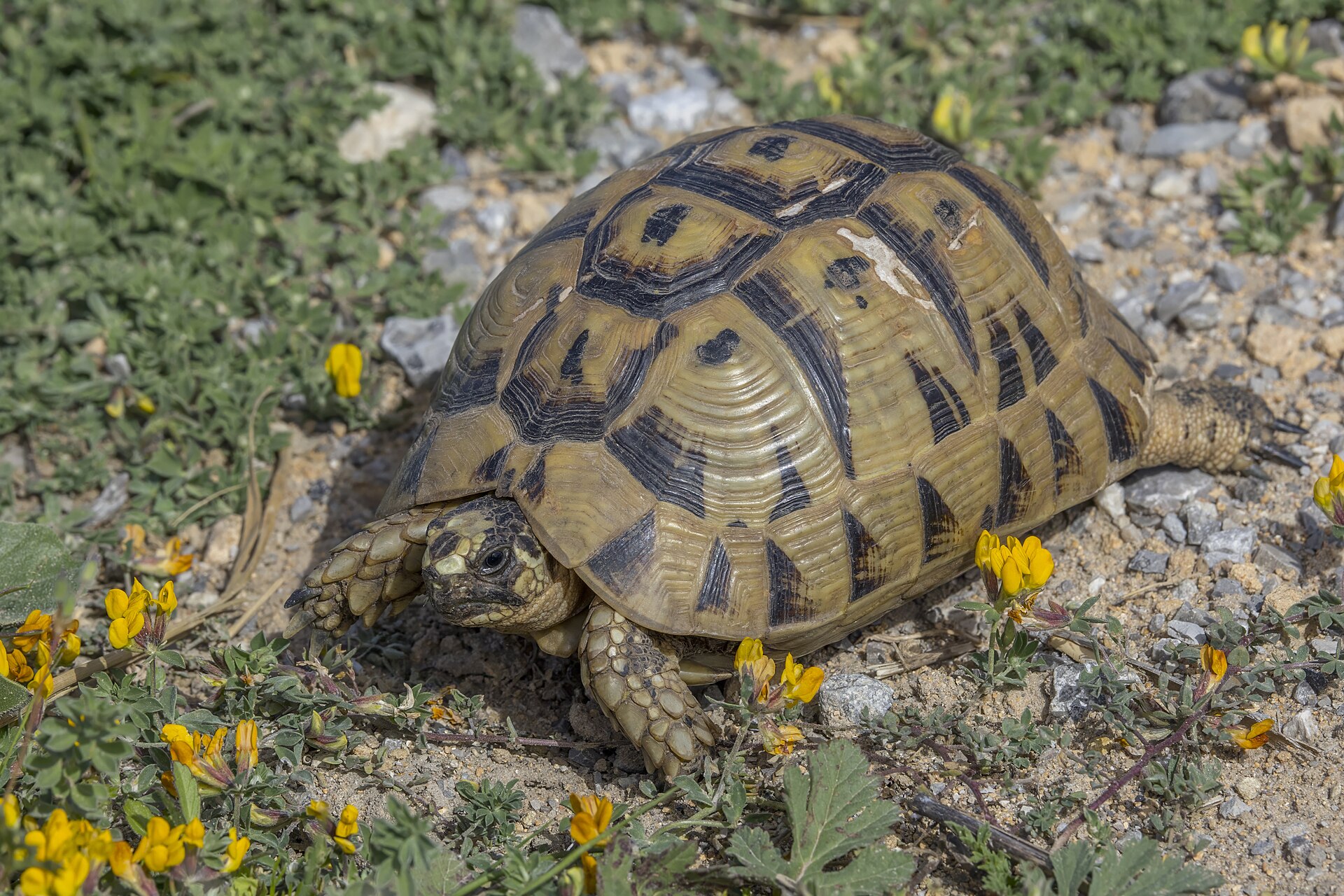
Spur-thighed Tortoise
Testudo graeca
Characteristics
Temperament
A slow, calm, diurnal, heliothermic land tortoise: it warms up in the sun to be active and takes shelter in the hottest hours. It is a long-lived animal (over 50 years), shy but adaptable, a symbol of calm and patience. It is NOT an "easy" animal to take lightly: it requires outdoor space, sun, a correct diet of wild plants and calcium, and careful hibernation management. It is also a threatened and protected species (CITES/EU): it must be kept only with proper documentation and NEVER taken from the wild.
Diet
A herbivore adapted to a poor, fibrous diet: it feeds mainly on wild grasses, leaves and flowers (dandelion, clover, plantain, chicory, mallow) and scrub shoots, with only occasional, limited small fruits. In captivity it needs plenty of fibre and little protein, an adequate calcium supply (e.g. cuttlebone), and the exclusion of animal foods and excess fruit or rich vegetables, which cause abnormal shell growth ("pyramiding") and health problems. Reproducing the natural wild-plant diet is essential for its welfare.
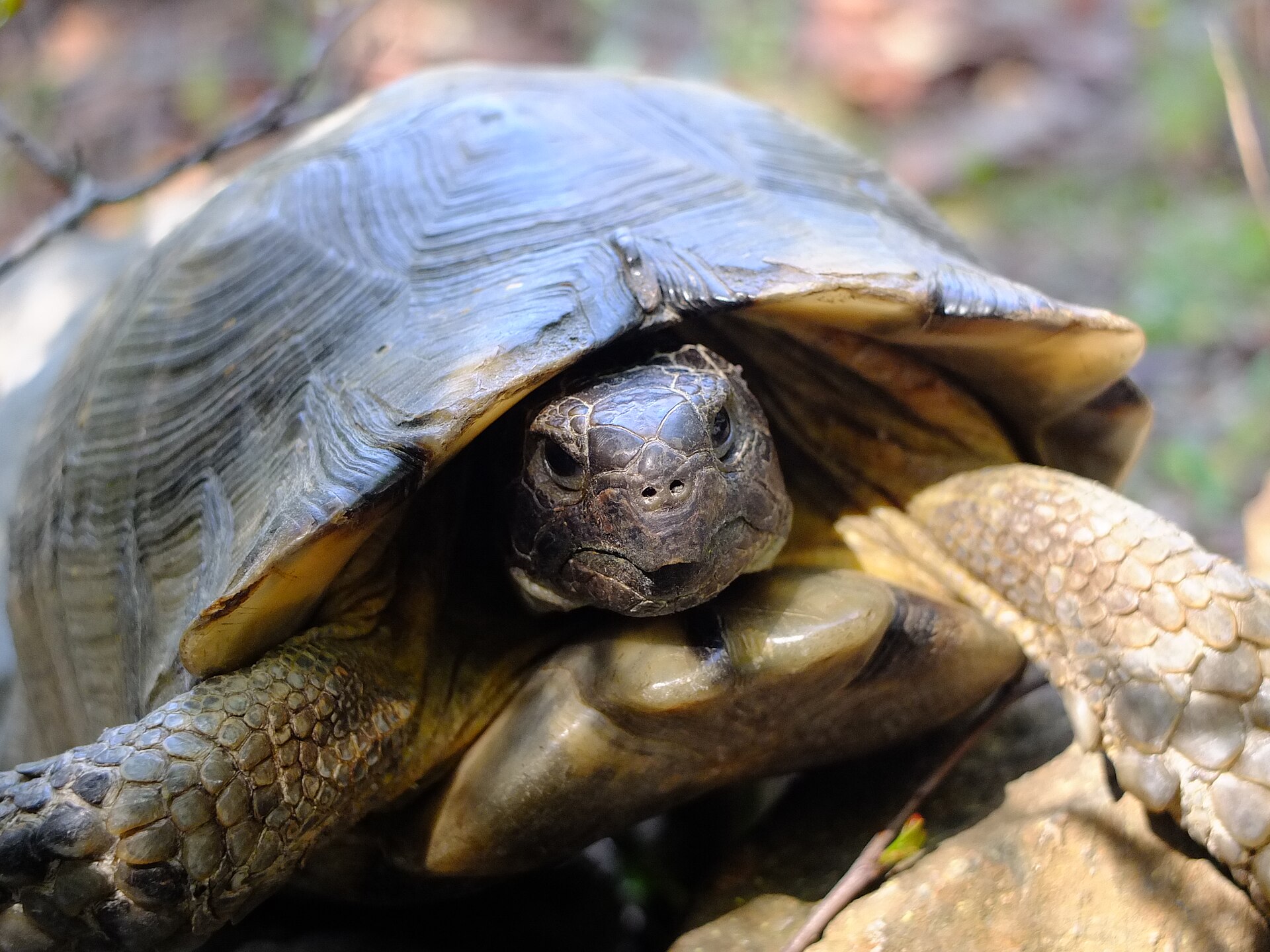
The Spur-thighed Tortoise (Testudo graeca), also known as the Greek or Moorish tortoise, is one of the best-known and most loved land tortoises of the Mediterranean basin. Famous for:
- The spurs on the thighs: two horny tubercles on the back of the hind thighs, which give it its English name
- The "mosaic" shell: the domed carapace, yellow-brown with dark blotches, hence the name "Greek" (Greek-key pattern)
- The extraordinary longevity: it can live well over 50 years
- The wide distribution: from North Africa to Spain, from the Balkans to the Middle East
- The resemblance to Hermann's: the Mediterranean "cousin" with which it is often confused
- The (problematic) bond with humans: much loved as a pet, and threatened because of it
IUCN status: Vulnerable (VU). It enters the portal among the land tortoises, alongside the giant Galápagos tortoise: two tortoises from different worlds, one colossal and insular, the other small and Mediterranean, but both examples of the slowness and longevity that make tortoises so special.
Classification and category
Order Testudines, family Testudinidae (the true land tortoises), genus Testudo — that of the Mediterranean tortoises. The species is Testudo graeca, divided into numerous subspecies. In the portal it is placed among the land tortoises. It is useful to tell it apart from related species, above all from Hermann's: Hermann's tortoise (Testudo hermanni), the better-known "cousin", differs in having the scute above the tail divided in two and a small horny tip (claw) on the end of the tail, but no spurs on the thighs; the spur-thighed, by contrast, has spurs on the thighs and usually an undivided tail scute; the marginated tortoise (Testudo marginata) is larger, with the rear edge of the carapace flared like a bell; other Testudo such as the Russian (T. horsfieldii) and the Egyptian (T. kleinmanni) differ in size, shape and range. Etymology: the name "Greek" does not indicate an origin from Greece, but derives from the carapace pattern, recalling the decorative "Greek key" motif; "Moorish" refers instead to the North African range; the English "spur-thighed" describes the most reliable distinguishing trait. Parameters: Carapace length typically 15-25 cm, with strong differences between subspecies (some larger). Weight variable, roughly up to 1-2 kg and more in the larger forms. Dimorphism: females tend to be larger than males. Longevity: remarkable — commonly over 50 years, and not rarely much more: an animal that can accompany several generations of a family. Reproduction: it lays eggs in holes dug in the ground; the hatchlings' sex depends on the incubation temperature.
Habitat and distribution
The spur-thighed tortoise has one of the widest ranges among the Mediterranean tortoises: its range covers North Africa (from Morocco to Libya and Egypt), southern Spain, the Balkans and southeastern Europe, the Middle East and southwestern Asia up to the Caucasus and the Black Sea. Preferred habitats — warm, arid, sunny environments: Mediterranean scrub, garrigue and bushland; arid grasslands, steppes and dunes; and stony slopes and semi-desert terrain, with low vegetation. It is a terrestrial, diurnal, heliothermic animal: it regulates its body temperature by warming up in the sun, and is therefore particularly active in the mild hours, taking shelter in the hottest ones. In the colder parts of its range it hibernates in winter, while in very hot areas it may go through a period of summer inactivity (aestivation). IUCN status: Vulnerable (VU). The species is threatened by the destruction and fragmentation of habitats and, historically, by massive collection for the pet trade. For this it is protected internationally: it is included in CITES (Appendix II) and in European protected-species legislation, and keeping it requires proper documentation.
Diet
The spur-thighed tortoise is herbivorous, with a diet based on fibrous, low-protein wild plants. It feeds on: wild grasses, leaves and flowers (dandelion, clover, plantain, chicory, mallow and many others); shoots and wild herbs of the scrub; and occasionally small fruits, but to a very limited extent. Guidelines for a correct diet (in captivity): plenty of fibre, little protein (the basis must be wild grasses and weeds; excesses of fruit, "rich" vegetables and above all animal foods must be avoided); the right calcium supply (essential for shell and bone health, often supplemented with cuttlebone); and mistakes to avoid (a too rich and protein-heavy diet causes abnormal shell growth — "pyramiding" carapace — and serious health problems). Crucially, this tortoise is adapted to a poor, fibrous diet, typical of arid Mediterranean environments. Reproducing this diet — made up above all of wild plants and fibre — is one of the most important aspects of its welfare in captivity.
Physical features
A medium-small land tortoise, with a sturdy, domed shell. The spurs and legs — the distinguishing trait: two horny spurs on the back of the hind thighs (the most reliable mark of recognition versus Hermann's); sturdy legs covered in scales, the front ones suited to digging; and the absence of the horny claw on the tail tip (present instead in Hermann's). The shell: a domed carapace, yellow-brown with variable dark blotches; the scute above the tail generally undivided; and a pale plastron with dark markings. The head and look: a sturdy head with a horny, toothless beak; a stocky, compact appearance, typical of land tortoises; and a remarkable variability of size and colour among the numerous subspecies.
Curiosities, care and protection
The spur-thighed tortoise is a slow, calm, diurnal animal, the very symbol of calm and longevity. Known for millennia in Mediterranean countries, it has entered popular imagination as the "land tortoise" par excellence, but its relationship with humans also hides a problematic side.
The misleading name: the "Greek" does not necessarily come from Greece; the name derives from the carapace pattern, recalling the classic "Greek key" decorative motif, the broken-line one that runs along many ancient friezes; its range, in fact, is very wide and includes above all North Africa, hence the other name "Moorish tortoise". The telltale spurs: the surest way to tell the spur-thighed tortoise from the similar Hermann's tortoise is to look at the hind thighs and the tail; the spur-thighed has two horny spurs on the thighs and usually an undivided scute above the tail; Hermann's has no thigh spurs, but a divided tail scute and a pointed horny tip on the tail; small details, but decisive for recognition. The record longevity: like many tortoises, the spur-thighed is extraordinarily long-lived and can live well over 50 years; this means that adopting one of these tortoises is a commitment potentially as long as a human life: an animal that can pass from generation to generation, and must never be taken lightly or as a "disposable" pet. Hibernation: in the temperate parts of its range, the spur-thighed tortoise spends the cold months in hibernation, burying itself or hiding in sheltered refuges and slowing its metabolism greatly; the correct management of hibernation (or its controlled suspension) is one of the most delicate aspects for keepers, and must be approached with great competence. Protection and responsible keeping: the spur-thighed tortoise is a threatened and protected species; it is forbidden to take it from the wild, and specimens kept as pets must come from breeders and possess the documentation required by CITES and European regulations; it is an animal that needs space, sun, a correct diet of wild plants, calcium and careful hibernation management: those who wish to care for it must inform themselves thoroughly and turn to legal, responsible sources, thereby also contributing to the conservation of the species.
Pros
- Testuggine terrestre tranquilla, longeva e affascinante, simbolo di calma
- Molto longeva: può vivere oltre 50 anni
- Erbivora e relativamente semplice nelle esigenze alimentari (erbe selvatiche)
- Icona della fauna mediterranea, utile per sensibilizzare sulla tutela dei rettili
Cons
- Specie minacciata e protetta (IUCN Vulnerabile, CITES/UE): solo con documenti regolari
- MAI prelevarla in natura: il prelievo è illegale e dannoso
- Impegno lunghissimo (oltre 50 anni) e gestione delicata del letargo
- Dieta scorretta (troppe proteine/frutta) causa gravi danni al guscio