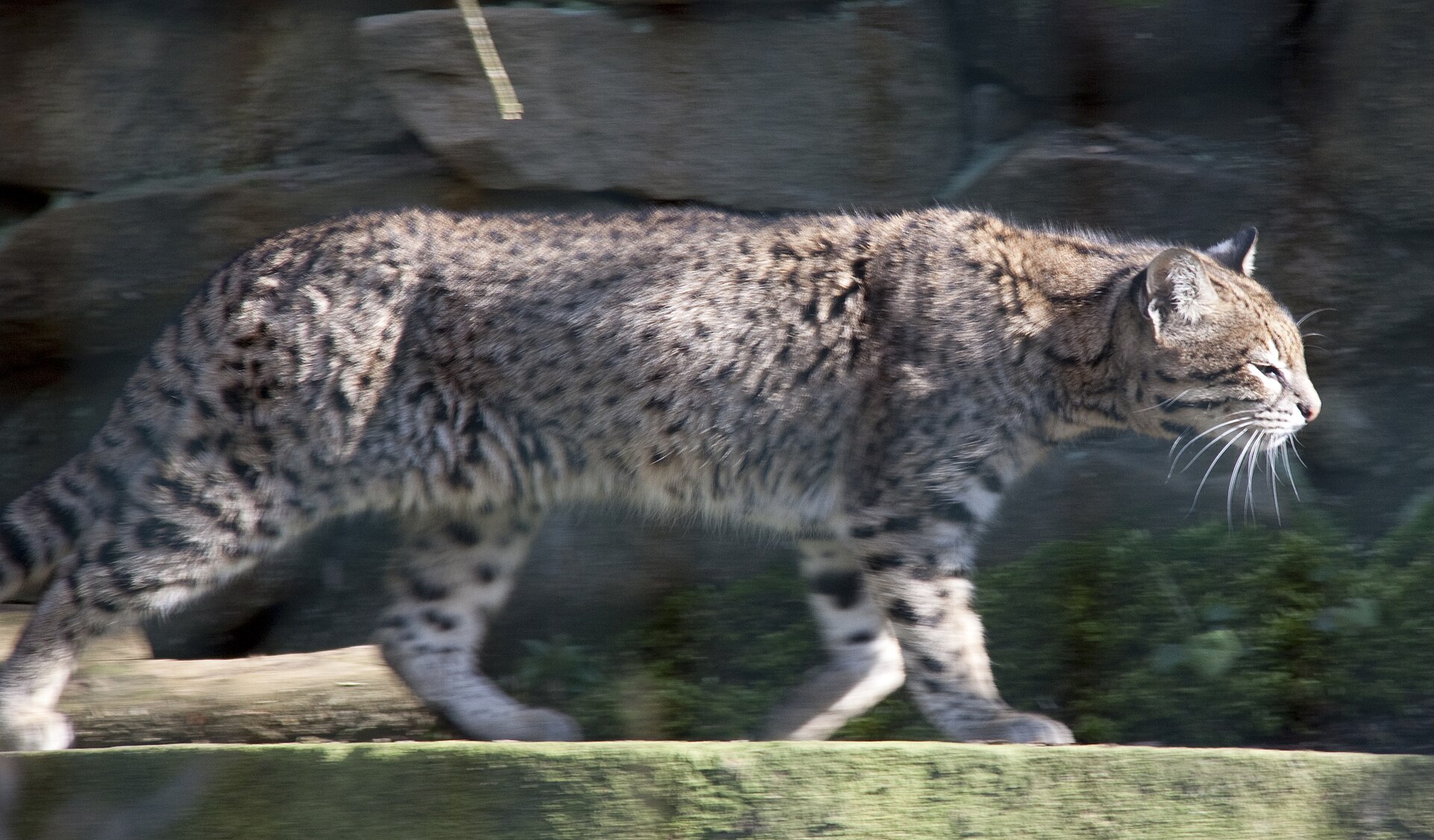
Geoffroy's Cat
Leopardus geoffroyi
Characteristics
Temperament
A small, solitary, nocturnal, shy wild feline, agile and adaptable. A versatile hunter, it is a good climber and, unusually for a cat, also a fair swimmer; it often rears up on its hind legs, using its tail as a tripod, to scan the environment. It defends a territory and avoids humans. It is NOT a pet: it is a protected wild cat, to be observed and safeguarded in nature. Although it has been used to create the domestic "Safari" hybrid, Geoffroy's cat remains a wild predator with needs impossible to meet at home.
Diet
An agile, opportunistic predatory carnivore. It feeds mainly on small mammals (especially rodents), as well as birds, lizards, amphibians and fish, and insects. It hunts at night patrolling the ground, but also uses tree-climbing and — unusual for a cat — swimming to reach different prey, showing great versatility. It often rears up on its hind legs, using its tail as a "tripod", to locate prey or danger above the vegetation. Its rodent-based diet makes it a useful regulator of small mammals in South America's open environments.
Geoffroy's Cat (Leopardus geoffroyi) is one of the most widespread and fascinating small wild cats of South America: a hunter in miniature with a densely spotted coat. Famous for:
- The polka-dot coat: grey-ochre scattered with numerous small, round black spots, dense and regular
- Domestic-cat size: roughly the size of a common house cat, or a little smaller
- Agility: an excellent climber and also a good swimmer, unlike many cats
- The "tripod pose": it often rears up on its hind legs using its tail as a third support to look around
- Its abundance: one of the most common small wild cats of southern South America
- Its kinship: it belongs to the genus Leopardus, like the ocelot and the margay
IUCN status: Least Concern (LC). It joins the many wild felines of the portal and, with the ocelot and the margay, completes the picture of the small spotted cats of the New World: three South American hunters, from the large ocelot to the arboreal margay to the agile, adaptable Geoffroy's cat.
Classification and category
Order Carnivora, family Felidae (the felines), genus Leopardus — the same as the ocelot (Leopardus pardalis) and the margay (Leopardus wiedii), both in the portal, as well as the oncilla and other small South American cats. In the portal it is placed among the Wild felines. It is useful to place it relative to its New World relatives: the ocelot is larger and patterned with rosettes and bands; the margay is the arboreal one par excellence, with large eyes and a very long tail; Geoffroy's cat is smaller, patterned with small solid spots (not rosettes), very adaptable and often ground-dwelling. Etymology: the species is dedicated to the French naturalist Étienne Geoffroy Saint-Hilaire, who studied South American fauna in the early 19th century; the genus Leopardus recalls the "leopard-like" coat pattern. Parameters: Head-body length about 45-60 cm, plus a tail of 25-35 cm. Weight about 2-5 kg (on average similar to or slightly less than a domestic cat). Appearance small, slim and muscular. Longevity: not fully known in the wild, but in captivity it can reach 14 years and more. Reproduction: the female usually gives birth to 1-3 kittens, raised in a hidden shelter.
Habitat and distribution
Geoffroy's Cat is an exclusively South American feline, typical of the central-southern part of the continent: Argentina, Bolivia, southern Brazil, Chile, Paraguay and Uruguay, as far as Patagonia. Preferred habitats — it is a very adaptable species: pampas, grasslands and steppes, including the Patagonian steppe; scrub, brush and open forests; and wetlands and areas along watercourses, where it hunts and swims. It is a nocturnal and crepuscular animal, solitary and territorial. Although a good climber, it often hunts on the ground, and does not shun water: it is one of the felines most willing to swim. Its great adaptability to different climates and environments — from warm zones to the cold Patagonian plains — is one of the reasons for its success and relative abundance. IUCN: Least Concern. The species is still relatively common, but in the past it suffered very intense hunting for its fur: in the 20th century millions of skins were traded, putting pressure on the populations. Today it is protected by international conventions (CITES); current threats are mainly habitat loss, road collisions and conflicts with humans.
Diet
Geoffroy's Cat is an agile, opportunistic predatory carnivore. It eats: small mammals (especially rodents, the basis of its diet); birds; lizards, amphibians and fish, the latter also caught in the water; and insects and other small invertebrates. Hunting strategies: nocturnal ground hunting (it patrols the ground in search of rodents, its main prey); climbing and swimming (it uses trees and water to reach different prey, showing an uncommon versatility among cats); and the "tripod" pose (it rears up on its hind legs, leaning on its tail, to scan the environment and locate prey or danger). Crucially, Geoffroy's Cat's diet, based largely on rodents, makes it a useful regulator of small-mammal populations in the open environments of South America. Its dietary adaptability, combined with its environmental adaptability, explains why it is one of the most widespread small cats on the continent.
Physical features
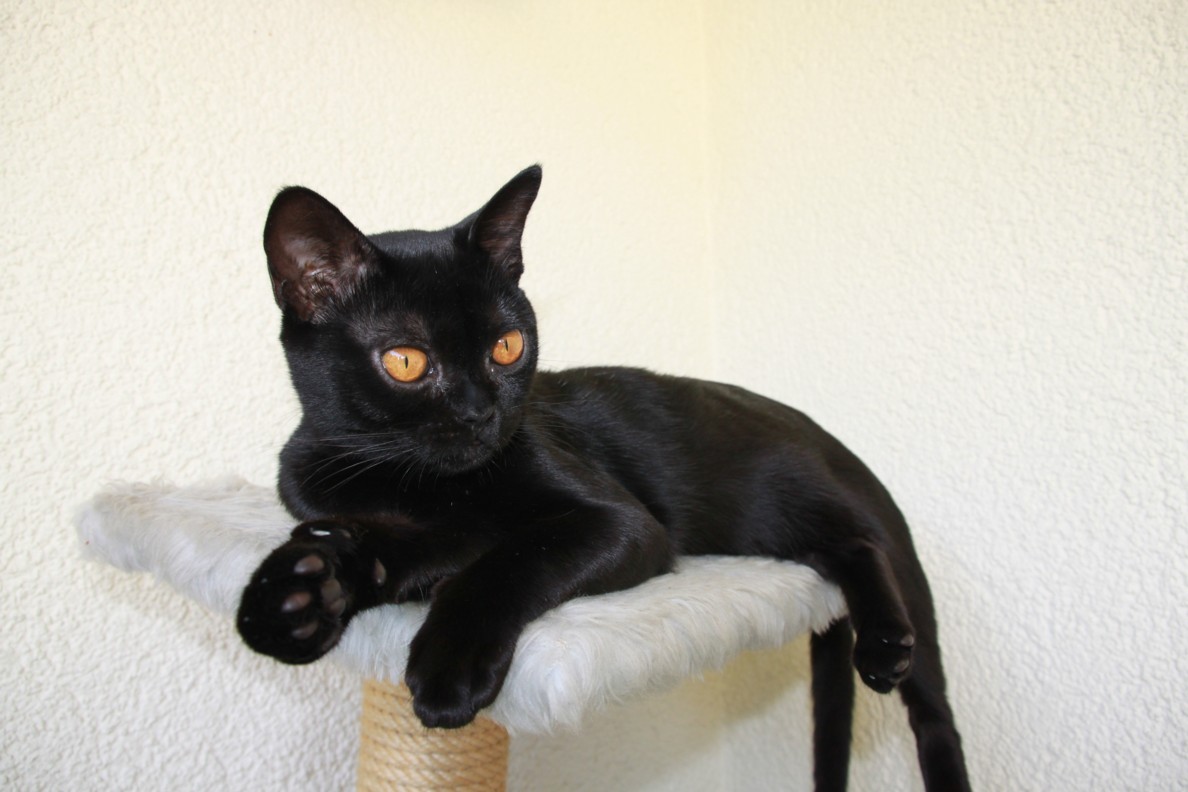
A small feline of elegant, compact appearance with an unmistakable coat. Coat and colouring: a background from grey to yellowish-ochre, varying by region; numerous small black spots, round and solid (not rosettes), densely and regularly distributed over the whole body; dark bars on the head, cheeks and legs, and a ringed tail; melanistic (entirely black) individuals are frequent, especially in some areas. The body: a small, slim, muscular build; a relatively small, rounded head; sturdy legs, suited both to climbing and to moving on the ground. Performance: agility and climbing (it moves with ease among the branches); the ability to swim, unusual for a feline; and keen senses and a cautious, shy nature.
Behaviour and curiosities
Geoffroy's Cat is a solitary, nocturnal, shy animal. It defends its own territory and meets conspecifics mainly in the breeding season. Although relatively common, it is hard to observe because of its nocturnal habits and cautious nature. Within its range it is a feline familiar to country dwellers, sometimes in conflict with humans over poultry predation.
The "tripod" cat: a curious, typical behaviour of Geoffroy's Cat is rearing up on its hind legs, using its tail as a third point of support, to form a kind of "tripod"; in this upright position it can look around above the tall grass of the pampas, spotting prey, rivals or danger; it is a posture that reveals its life in open environments. The cat that swims: contrary to the reputation of cats as animals that hate water, Geoffroy's Cat is a fair swimmer and does not hesitate to enter watercourses to hunt or move; this aptitude, shared with few other felines, is tied to its presence in wetlands and along rivers, where it also catches fish and amphibians. The fur tragedy: Geoffroy's Cat has a history marked by the fur trade; over the 20th century, and particularly in some decades, millions of skins of this small cat were hunted and traded for the fashion industry, making it one of the most exploited cat species in the world for its fur; only thanks to international protection conventions (CITES) and the fall in demand did this mass hunting decline, allowing the populations to hold. The miniature "black panthers": in some areas of its range, a substantial proportion of Geoffroy's cats are melanistic, that is entirely black; these dark individuals, in which the spots remain visible only in raking light, are little "panther cats" and show how widespread melanism (black colouring) is in the world of cats, from the great leopards and jaguars to small cats like this. The cat named after a naturalist: the name of this species honours Étienne Geoffroy Saint-Hilaire, an important French naturalist of the 19th century; many animals carry in their scientific or common name a tribute to the scholars who first described them or studied their fauna: Geoffroy's Cat is one of these, a small "living monument" to the history of natural science. The Safari's relative: Geoffroy's Cat has been used, in modern times, to create a rare hybrid breed of domestic cat called the "Safari", obtained by crossing it with the house cat; it is a case analogous to that of the leopard cat behind the Bengal or the serval behind the Savannah: small and medium wild cats used to give rise to domestic cats with a "wild" look; Geoffroy's Cat itself, however, remains a wild animal in every respect.
Pros
- Affascinante piccolo gatto maculato, completa il quadro dei felini sudamericani (con ocelot e margay)
- Molto adattabile e versatile: arrampicatore e perfino nuotatore
- Utile predatore di roditori negli ambienti aperti del Sud America
- IUCN Least Concern: ancora relativamente comune nel suo areale
Cons
- NON è un animale domestico: è un piccolo felino selvatico protetto
- In passato cacciato in massa per la pelliccia (milioni di pelli commerciate)
- Minacciato da perdita di habitat, investimenti stradali e conflitti con l'uomo
- L'uso per ibridi domestici ("Safari") può alimentare un dannoso interesse a tenerlo come esotico