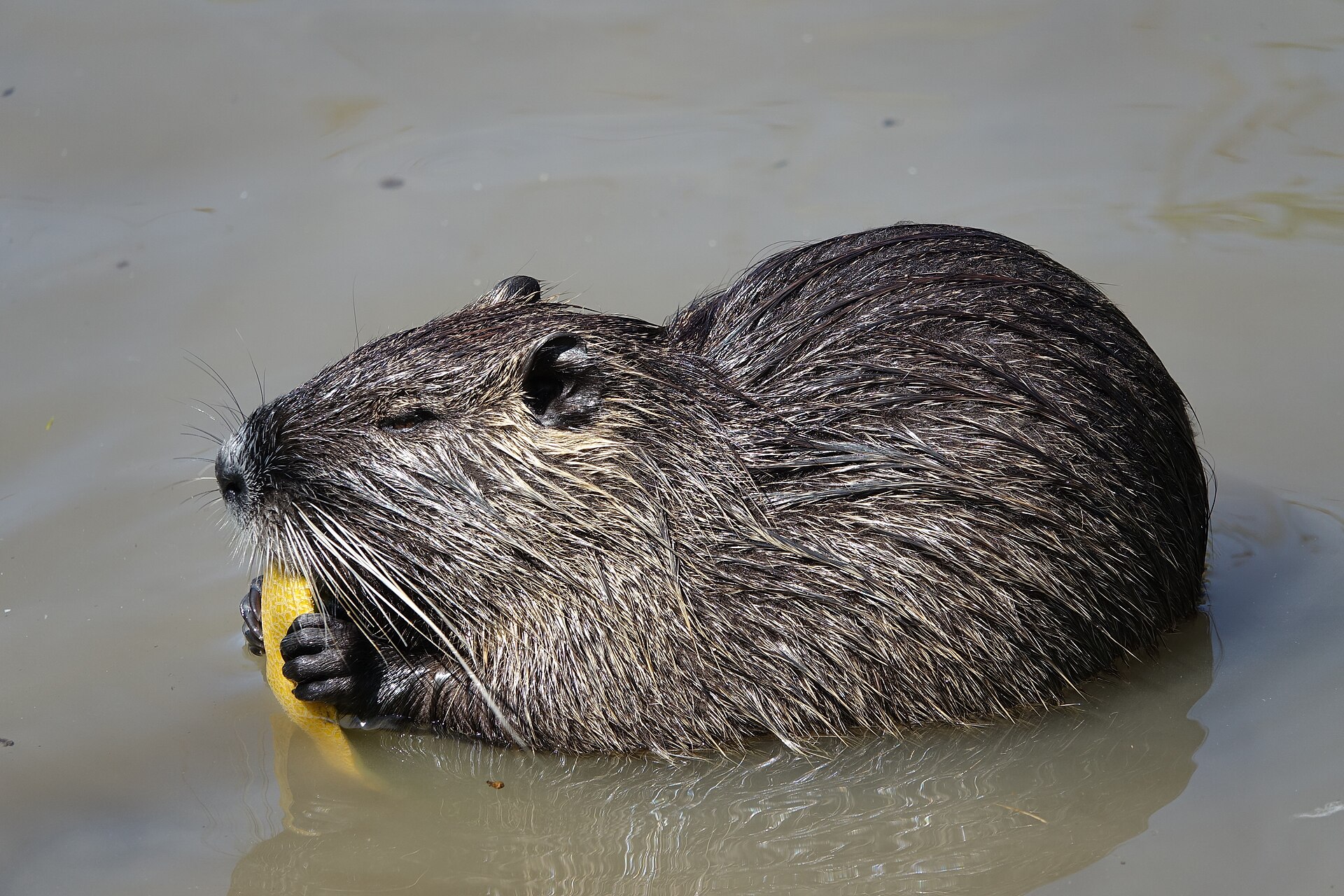
Nutria (Coypu)
Myocastor coypus
Characteristics
Temperament
Social, crepuscular-nocturnal, semi-aquatic. Lives in family groups of 5-15 individuals in burrows dug in the banks. Excellent swimmer (7 km/h, 5-10 min diving). Reproduces 2-3 litters/year (5-10 cubs each). Invasive species among the "100 worst in the world" IUCN.
Diet
Strict herbivore: aquatic plants (roots, stems, leaves of reeds, water lilies, cattails) + agricultural crops (corn, rice, wheat, vegetables). Consumes 25% of body weight/day (1.5-2.5 kg vegetation). "Eat-out" behaviour: destroys 95% of marsh vegetation.
The Nutria (Myocastor coypus), also known as Coypu, is a large semi-aquatic rodent native to South America. It weighs 5-10 kg (record 17 kg) and is 40-65 cm long in body + 30-45 cm of tail, representing the second largest rodent after the capybara in South America. It is recognisable for the characteristic orange teeth (iron deposits in the enamel), the rounded rat-like tail (not flat like the beaver's), and the waterproof double coat. Native to the rivers and swamps of South America (Argentina, Chile, Bolivia, southern Brazil, Uruguay, Paraguay), it was introduced to Europe, North America, Asia and Africa in the 19th-20th centuries for fur farming. When the fur market collapsed (1940s-70s), many specimens escaped or were released, creating feral populations. It is now classified among the "100 most damaging invasive species in the world" by IUCN (2008). In Italy, where it arrived in 1928, it now counts over 2 million specimens and causes damage to river embankments and agriculture worth 5-15 million euros per year. The global conservation status is Least Concern (LC).
Classification and category
The Nutria belongs to the order Rodentia, suborder Hystricomorpha, family Echimyidae (historically classified as unique of the Myocastoridae family, now reclassified). It is the only species of the genus Myocastor. Modern systematics recognises 4 subspecies:
- M. c. coypus — central Argentina (nominal)
- M. c. bonariensis — southern Brazil, north-eastern Argentina
- M. c. melanops — Chile
- M. c. santacruzae — southern Argentina
The species was scientifically described by Juan Ignacio Molina in 1782 with the name "Mus coypus" and subsequently reclassified into its own genus. The scientific name "Myocastor" derives from Greek "mys" (mouse) + "kastor" (beaver) — "mouse-beaver". "Coypus" derives from the Mapuche name "coypu" used by indigenous people of South America.
Adult dimensions are: body length 40-65 cm, tail 30-45 cm, weight 5-10 kg (females 4-7 kg, males 7-10 kg, record 17 kg in captivity). Sexual dimorphism is moderate (males 25-30% heavier). Longevity is 5-8 years in nature (high mortality from predation and climate), up to 12-15 years in captivity. Important taxonomic difference: the nutria is NOT a beaver! They are very distant relatives (beavers are Castoridae, sciuromorphs; nutrias are Echimyidae/Myocastoridae, hystricomorphs). The similar form is an example of evolutionary convergence: both are semi-aquatic and have evolved similar adaptations independently.
Habitat and distribution
The natural habitat of the Nutria consists of slow-flowing rivers, swamps, ponds, lakes, artificial canals, marshlands, rice fields. It prefers fresh water; tolerates moderate salinity (typical in deltas and river mouths). It always lives near water: it digs burrows in the banks of watercourses, consisting of tunnels 3-15 m long, up to 2 m deep, with entrances below the water level for protection. The burrows are typically in clayey slopes. It is found up to 1,000 m of altitude.
The native distribution includes: temperate and subtropical South America — Argentina, Chile (centre-south), Bolivia, southern Brazil, Uruguay, Paraguay. The global IUCN conservation status is Least Concern (LC) for the species in its native range.
The introduced distribution is much wider. Between 1882 and 1970, the nutria was introduced into:
- Europe: Italy (from 1928, current population 2+ million), France, Spain, Netherlands, Germany, United Kingdom (eradicated in 1989), Russia, Ukraine
- North America: USA (Louisiana, Oregon, Maryland — massive invasion), Canada
- Asia: Japan (introduced, today population 250,000+), eastern Russia
- Africa: Kenya, South Africa (minor populations)
Cause of introduction: fur farming. The "castorino" fur was very requested in the late 1800s-early 1900s as an economic imitation of beaver fur. When the fur market collapsed (1940s-70s), many farms closed and the specimens were released or escaped, establishing feral populations. In Italy, the first documented introduction was in 1928 in Lombardy for commercial breeding; today it is present throughout the Po Valley, Tuscany, Lazio, Campania, up to Sicily. Considered among the "100 most damaging invasive species in the world" by IUCN (Global Invasive Species Database). The damage caused in Italy (ISPRA 2020 estimates): 5-15 million euros/year for damage to river and canal embankments (the digging of burrows weakens the embankments, contributing to floods — episode of the Po river in 2000), damage to crops (corn, rice, vegetables, alfalfa), expenses for control and removal. Complete eradication is practically impossible: the species has settled too deeply.
Diet
The Nutria is a strict herbivore: it feeds almost exclusively on aquatic and marsh plants. The diet includes: roots and rhizomes (reeds, phragmites, water lilies, cattails), aquatic stems (rushes, sedges), leaves, sprouts, bark, seasonal fruits and seeds. From invasive populations: agricultural crops like corn (preferred), rice, wheat, alfalfa, vegetables (carrots, potatoes, beets), fallen fruit. Occasionally supplemented with freshwater molluscs (snails, clams) for calcium during pregnancy.
The food requirement is considerable: an adult consumes about 25% of its body weight per day in fresh vegetation, that is 1.5-2.5 kg/day. It is an enormous consumption for a single animal, and explains the devastating ecological impact of the species when invasive: a colony of 100 nutrias can consume 200 kg of vegetation per day, uprooting the aquatic plants of an entire canal. The nutria is also a negative "engineer species": in addition to eating the vegetation, it destroys entire marsh areas with an "eat-out" behaviour: in densely populated areas, it destroys 95% of the original marsh vegetation, leaving the muddy bottom stripped. This causes: loss of habitat for water birds, erosion of banks, alteration of the food chain. The feeding technique: the nutria enters the water, cuts the vegetation with its incisor teeth (powerful, 5-7 cm long), brings the food to land or to a floating platform to eat, and then returns to the water to cool off. It is very wasteful in use: it wastes a lot of food, throwing it away after eating only the most tender parts — further damage to local vegetation. It also practises coprophagy (eats its own soft faeces) to recover nutrients — common in herbivorous rodents.
Physical features
The Nutria has a stocky, robust, fusiform body, well adapted to semi-aquatic life. The body length is 40-65 cm + tail 30-45 cm (total up to 1 m). The weight of adults is 5-10 kg (females), up to 17 kg in obese captivity. The head is large, broad, triangular-shaped, with a rounded muzzle. The eyes are small, black, positioned laterally; vision is moderate. The ears are small, rounded, covered with fur, positioned high on the head — adaptation to swim with the head just out of the water.
The most iconic feature are the incisor teeth: 5-7 cm long (above the lip), of brilliant intense orange colour (iron deposits in the enamel that strengthen them). The teeth are visible even with the mouth closed, protruding, creating the characteristic "fool grin" appearance. They grow continuously; to control the length, the nutria must constantly gnaw vegetation and wood. The bite force is 200-300 psi, sufficient to cut cane stems 5 cm wide.
The coat is double: outer hair long, rough, water-repellent; undercoat dense, woolly, very insulating. It is precisely the undercoat that was commercially desired (called "castorino" or "nutria fur") in the 1920s-40s. The colours are variable: dark brown to almost black in nature, but in captivity white, gold, silver, black, pearl variants have been selected for the fur market. The cubs are born brown-grey in colour. The legs: front short with 5 free toes, robust, with strong claws for digging and manipulating food; hind longer, with 5 toes of which 4 connected by a swimming membrane (the 5th toe is free) — adaptation to swimming. The tail is the most important diagnostic feature: long, robust, covered with scales and few scattered hairs, of round section (not flat like the beaver!) — this is the main visual difference that allows distinguishing nutria and beaver. The tail acts as a rudder during swimming and as a balance during terrestrial activity. The mammary glands of females are positioned very high on the sides of the body (not on the belly like common rodents) — unique adaptation: the female can nurse the young while swimming.
Behaviour and curiosities
The Nutria is a social, mainly crepuscular-nocturnal, semi-aquatic animal. It lives in family groups of 5-15 individuals composed of 1 dominant male (alpha), 2-5 adult females, and pups of various ages. The territories of the groups partially overlap; they are not strongly territorial. During the day they hide in burrows (systems of tunnels dug in the banks, up to 2 m deep, 3-15 m long), going out for activity at dusk and at night. They are excellent swimmers: they can swim at 7 km/h, dive for 5-10 minutes at a time, descend to 2-3 m depth. The tail acts as a rudder, the membranes of the rear legs as fins, and the position of the nose/eyes/ears allows swimming with almost the entire head submerged (adaptation similar to that of the hippopotamus).
Reproduction is very prolific — one of the main reasons for its success as an invasive species: the female reaches sexual maturity at 4-5 months, has 2-3 litters per year, each litter of 5-10 cubs (record 13). Gestation is 130 days; the cubs are born already completely developed: open eyes, teeth already visible, complete fur, able to swim and eat vegetation within 24 hours of birth. Lactation lasts only 2 months (while swimming in the rivers thanks to the high mammary glands). The cubs are autonomous at 2-3 months. This "r-selected" strategy (many cubs, fast development, short longevity) is ideal for colonising new environments. In Italy, a single pair of nutrias can generate up to 200 descendants in 3 years in favourable conditions.
Famous curiosities: the nutria was introduced to many countries in the world for fur but trade collapsed in the 1970s when animal rights movements put pressure on the fashion industry. Nutria fur is today considered a symbol of cruelty and almost unsaleable on the market; in Italy, breeding for fur was banned in 2022 (last active farm in Turin closed). Ethological curiosity: the nutria is famous for the "side-step jump" — when threatened in water, it makes a very fast lateral jump of 1-2 metres to disorient the predator (foxes, wolves, dogs). Invasive curiosity: in Louisiana (USA) nutrias were introduced in the 1930s for fur. When the market collapsed, populations exploded into millions, destroying the swamps of the Mississippi Delta (huge habitat loss). The State of Louisiana now pays $6 per nutria tail to hunters to control the population (Coastal Wetlands Conservation Bounty programme); since 2002 over 5 million nutrias have been caught. Etymological curiosity: the name "nutria" derives from Spanish "otter" — a historical linguistic misunderstanding, since the nutria is not an otter (15th-century Spanish sailors confused the South American nutria with a European otter). The correct term is "coypu" (from Mapuche), but "nutria" is the most used name in Italy and Europe. Medical curiosity: the nutria is a carrier of leptospirosis, tularaemia, echinococcosis, toxoplasmosis — zoonoses transmissible to humans mainly through water contaminated by urine. For this reason, it is not advisable to swim in waters where nutrias are present. Cultural curiosity: in Latin America, the nutria is considered traditional food in some areas (Argentina, Paraguay): the meat is lean, similar to rabbit, rich in protein. In Italy nutria hunting is practised by some hunters for control, but the meat is considered "strange" and little appreciated. Management curiosity: Italy eradicated the nutria from Sardinia in 2018 thanks to an intensive programme of traps and culling. The Po Valley, however, is now irreversibly colonised.
Pros
- Secondo roditore più grande del Sud America (dopo il capibara)
- Ottimo nuotatore: 7 km/h, immersioni 5-10 minuti
- Unica con mammelle ai lati: allatta i piccoli nuotando
- Longevità eccellente in cattività (12-15 anni)
Cons
- Specie invasiva tra le '100 peggiori al mondo' IUCN
- Danni in Italia: 5-15 milioni euro/anno per dighe e agricoltura
- Porta zoonosi (leptospirosi, tularemia, echinococcosi)
- In Italia divieto allevamento (2022) e caccia per controllo popolazione