Norwegian Lemming
Lemmus lemmus
Characteristics
Temperament
Solitary, active day and night, surprisingly AGGRESSIVE. Cyclical demographic explosions every 3-5 years (hundreds/thousands individuals/hectare). Sexual maturity at 3-4 weeks (record). False legend of "mass suicide" scientifically debunked.
Diet
Strict herbivore: mosses (Sphagnum, Hylocomium), lichens, low tundra grasses. Consumes 50% body weight/day. Survives under snow in winter (does not hibernate). Coprophagy to recover B vitamins. Keystone species in arctic ecosystem.
The Norwegian Lemming (Lemmus lemmus) is a small Arctic rodent endemic to Scandinavia (Norway, Sweden, Finland, north-western Russia), famous for two exceptional characteristics: the explosive demographic cycles (the population grows and decreases by hundreds of times every 3-5 years in a predictable way) and the famous legend of "mass suicide", completely false but still widely spread in popular culture. It is the most symbolic rodent of European Arctic, fundamental in the tundra ecosystem as keystone species: during demographic peaks, lemmings are the main food of arctic foxes, snowy owls, ermines, and their abundance determines the reproductive success of all predators. Made popular by the famous video game series "Lemmings" (1991), it has conquered global pop culture as a symbol of blind group behaviour.
Classification and category
The Norwegian Lemming belongs to the order Rodentia, family Cricetidae, subfamily Arvicolinae (voles and lemmings), genus Lemmus. The genus comprises 7 species of lemmings distributed between Eurasia and North America; L. lemmus is the European species, the most characteristic and studied. Body length is 13-15 cm, plus a very short tail of only 1-2 cm (diagnostic characteristic of lemmings, distinct from voles with longer tails). Average adult weight is 70-130 g (males slightly larger than females). The scientific name Lemmus derives from Norwegian "lemende", which means "the rodent". The species was scientifically described by Carl Linnaeus in 1758. There are other lemming species in the world: Dicrostonyx torquatus (Variable Lemming, Eurasian arctic, changes fur from summer to winter), L. trimucronatus (Brown Lemming, North America), L. sibiricus (Siberian Lemming).
Habitat and distribution
The habitat of the Norwegian Lemming consists of alpine and arctic tundra, altitude moorland, subarctic birch forest, wet meadows with mosses and lichens. It lives at altitude on Scandinavian mountains (above 600-800 m above sea level) and at lower altitudes in northern latitudes. It prefers cold and wet areas with winter snow cover: snow is essential for winter survival, acting as thermal insulator (the temperature under snow is -2 to +2 °C even if outside air is -20 to -40 °C). It digs a complex network of galleries under the snow, where it remains active all winter (does not hibernate).
The natural distribution covers Scandinavia: Norway (from the southern coastal area to North Cape), Sweden northern, Finland northern, Russia north-western (Kola Peninsula). Conservation status is listed as Least Concern (LC) by IUCN, but with concern for climate change: global warming is reducing stable winter snow cover, essential for lemming survival. Recent studies (University of Helsinki, 2021) show that traditional explosive demographic cycles are altering: the last peaks (2010, 2015, 2020) have been much less intense than the past (1970-1990), probably due to reduced snow cover. This alteration has cascading consequences on the entire arctic ecosystem (Arctic Foxes, Snowy Owls, Tundra Owls, Ermines depend on lemmings as main food source).
Diet
The Norwegian Lemming is a strict herbivore with diet specialised in vegetation typical of the tundra. It feeds almost exclusively on: mosses (main prey: Sphagnum, Hylocomium splendens, Polytrichum), lichens, low grasses (Carex, Eriophorum), leaves, shoots of dwarf birch and willow, occasionally blueberry fruits. In winter it feeds mainly on mosses protected under the snow, where the temperature is stable.
The food requirement is high: a lemming consumes up to 50% of its body weight every day in vegetation (a 100 g adult eats 50 g of mosses/day). It is voracious: during summer it accumulates fat reserves for winter. The digestive system is optimised for digesting fibrous plant material poor in nutrients: long intestine with enormous caecum and rich symbiotic bacterial flora. It practises coprophagy (ingests its own primary faeces rich in B vitamins produced by bacterial flora). During demographic explosions, the herbivory pressure on tundra mosses is enormous: a lemming population at peak can consume 50-80% of herbaceous biomass of an entire area in one season, causing temporary desertification and contributing to vegetation succession.
Physical features
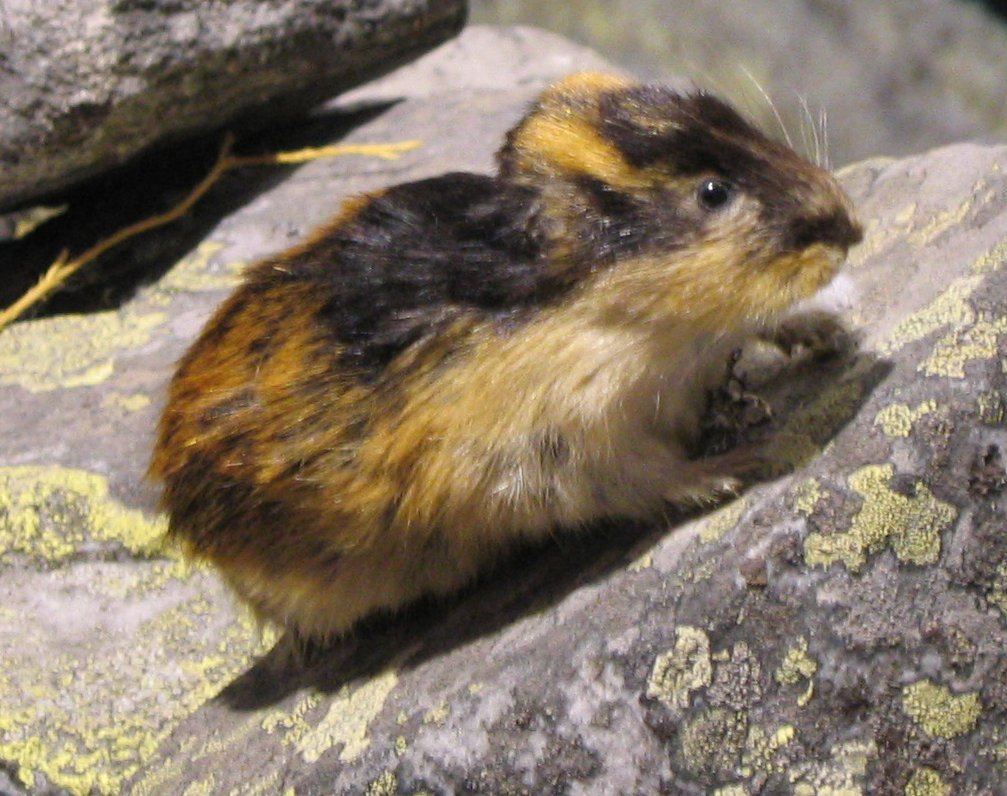
The Norwegian Lemming has a stocky, compact, robust body, perfectly adapted to the arctic climate. The coat is characteristic: brilliant multicoloured (yellow, black, brown, white distributed in irregular patches on the body), very thick and with dense insulating undercoat. The head, back and legs are predominantly black; the cheeks, chest and flanks are bright yellow-orange; the belly is cream-white. This aposematic (warning) colouration signals the aggressive nature of the lemming to predators: it is a surprisingly aggressive species for its size, with fierce bites and threatening attitudes.
The head is large in proportion to the body, with short rounded muzzle. The eyes are small, black, not protruding. The ears are very small, almost hidden in the fur (thermal reduction for the arctic climate). The tail is particularly short (only 1-2 cm, one of the shortest among rodents), also haired for thermal protection. The legs are short, robust, with particularly piloferous plantar pads and strong claws for digging in snow and frozen ground. The forelegs have five fingers with well-developed claws, the hindlegs are slightly longer. Very thick coat, some specimens develop a small darker "hood" on the head that distinguishes them from other arctic rodents. The species slightly changes its coat between summer (darker) and winter (slightly lighter), but unlike the variable lemming (Dicrostonyx) does not become completely white.
Behaviour and curiosities
The Norwegian Lemming is a solitary, active day and night, surprisingly aggressive animal. It fiercely defends its territory (3,000-30,000 m²) against other lemmings, although during periods of hyperdemography density becomes such that interconjugal aggressiveness increases dramatically. The most famous characteristic of the species is the "cyclical demographic explosion": every 3-5 years the population undergoes an exponential explosion, passing from a few units per hectare to hundreds or thousands per hectare in a single season, followed by an equally rapid collapse. These cycles have been intensively studied: the causes are complex and still debated, probably involving interactions between food availability, predation, winter weather conditions (snow cover) and endocrinology (hormonal changes from crowding stress).
During demographic peaks, lemmings actively disperse, migrating in mass to new areas in search of food. This mass dispersion gave rise to the famous but FALSE LEGEND of "collective suicide": the myth that lemmings throw themselves en masse into rivers or from cliffs to "regulate their own population". This idea was popularised in the 1950s by the Disney documentary "White Wilderness" (1958), which won the Oscar but scientifically falsified the scenes: the filmmakers artificially pushed lemmings off a cliff in Alberta (Canada, where Norwegian lemmings don't even live). The legend was definitively debunked by a CBC inquiry in 1982. The truth: during mass migrations, some lemmings accidentally drown in rivers or lakes while trying to cross them (they are good swimmers but cannot survive long in cold water). There is no intentional suicidal behaviour.
Reproduction is explosive: the female can give birth to up to 4-7 litters per year, with 4-8 young per litter, even in winter under the snow! Sexual maturity is reached at only 3-4 weeks (the fastest among mammals). A pair of lemmings in ideal conditions can generate over 1,000 descendants in a year through multiple generations. Longevity is short: 1-2 years in nature, with very high mortality (90% in the first year). Cultural curiosity: the famous video game "Lemmings" (1991, DMA Design) has sold over 15 million copies and is considered one of the most influential video games in history. It is based on the (wrong) belief of "blind group behaviour": the player must guide lemmings through obstacles to prevent them from accidentally throwing themselves into chasms. The video game has generated an entire series of sequels and a global iconography. In physics and complex systems theory, lemming demographic cycles are the classic case study for predator-prey oscillations (Lotka-Volterra models), and for chaotic dynamics in ecology.
Pros
- Specie iconica dell'Artico europeo, simbolo della tundra
- Fenomeni di esplosione demografica spettacolari (ogni 3-5 anni)
- Maturità sessuale a 3-4 settimane (record nei mammiferi)
- Mascotte del famoso videogioco 'Lemmings' (15+ milioni copie)
Cons
- Vita brevissima (1-2 anni, mortalità 90% primo anno)
- Minacciato dal cambiamento climatico (perdita copertura nevosa)
- Falsa leggenda del 'suicidio di massa' ancora diffusa nella cultura pop
- Non è specie da pet (selvatica, aggressiva)