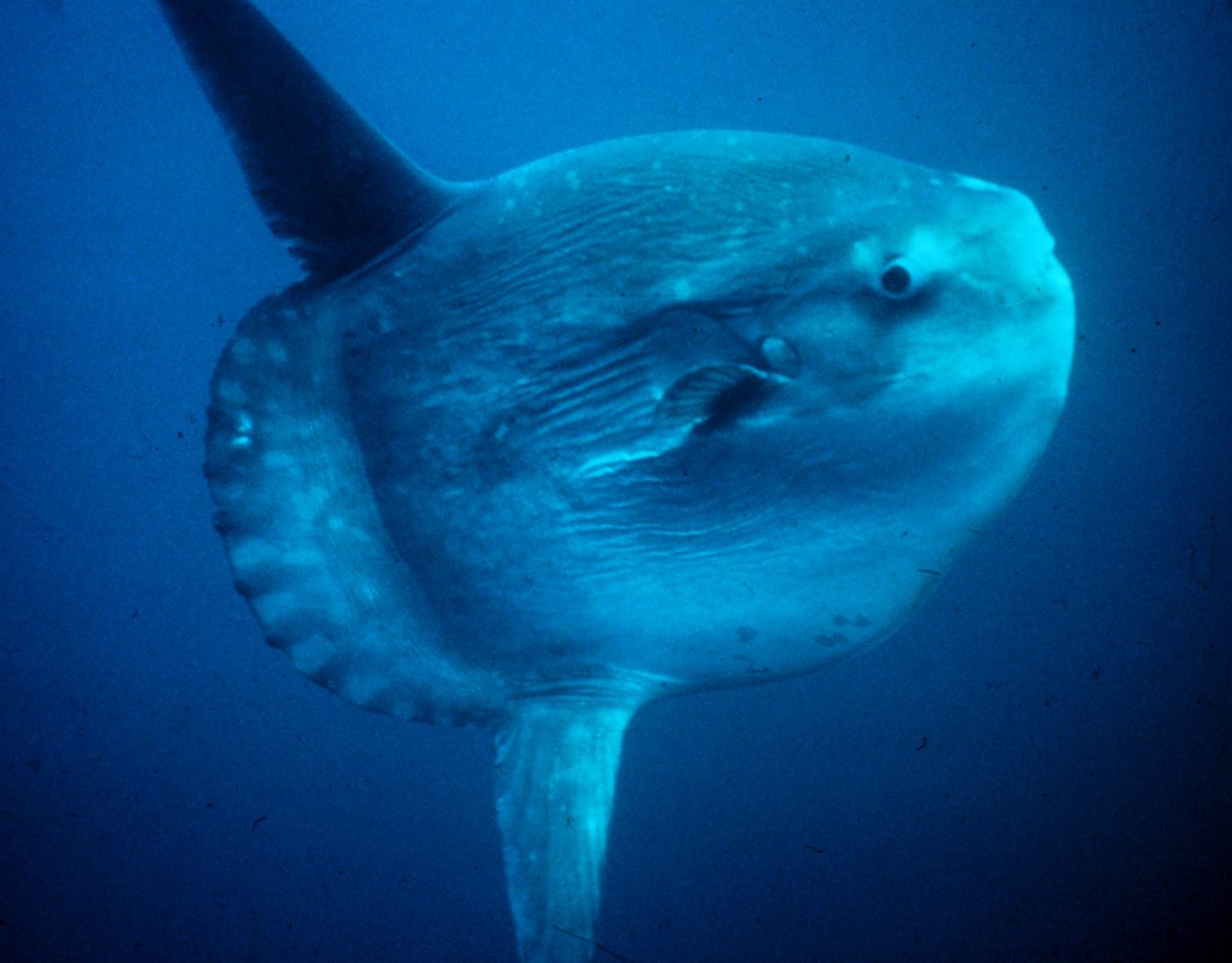
Photo: U.S. National Oceanic and Atmospheric Administration · Public domain
Ocean sunfish
Mola mola
Enormous and extravagantly shaped, like a truncated disc that swims on its side, the ocean sunfish is the heaviest bony fish in the world.
Characteristics
Temperament
Placid, a slow open-ocean swimmer
Diet
Carnivore: mainly jellyfish and gelatinous organisms
The giant of unusual shape
The ocean sunfish is one of the most bizarre and fascinating marine animals: it is the heaviest bony fish in the world, able to reach and exceed a tonne in weight. Its shape is unmistakable: a very tall body, flattened at the sides, which seems almost 'truncated' at the back, as if it lacked a tail. In its place it has a wavy, rounded structure. Above and below open two large fins, dorsal and anal, which the animal moves together to swim. From afar, this rounded silhouette recalls a great silver moon, hence its Italian name.
Habitat and distribution
It lives in the temperate and tropical seas all over the world, swimming in the open ocean. It is often seen 'sunbathing', floating on one side near the surface: a behaviour that has earned it, in many languages, the name 'sunfish'. It is thought that in this way the animal can warm up after dives into the cold deep waters, where it goes to find food.
Behaviour and diet
Despite its imposing bulk, the ocean sunfish is a rather slow and placid swimmer. It feeds largely on jellyfish and other gelatinous organisms, poor in nutrients, which explains why it must eat them in large quantities. It undertakes considerable migrations and dives in search of food. Its body often carries numerous small parasites, and to rid itself of them it relies on other fish and birds that remove them.
Curiosities
The ocean sunfish is also famous for its extraordinary fecundity: females can produce an enormous number of eggs, among the highest known among vertebrates. Its unique shape, lacking the classic tail of fish, makes it immediately recognisable and one of the most curious subjects in the oceans.
Conservation
The ocean sunfish is classified as a vulnerable species. Among the threats are accidental capture in fishing nets and marine pollution, in particular plastic, which can be mistaken for jellyfish and ingested. Protecting the health of the oceans is essential for the survival of this gentle and unusual giant.
Pros
- The heaviest bony fish in the world
- Unique, unmistakable shape
- Extraordinary fecundity
- Fascinating inhabitant of the open ocean
Cons
- Vulnerable species
- Victim of accidental capture and pollution
- Risks ingesting plastic mistaken for jellyfish