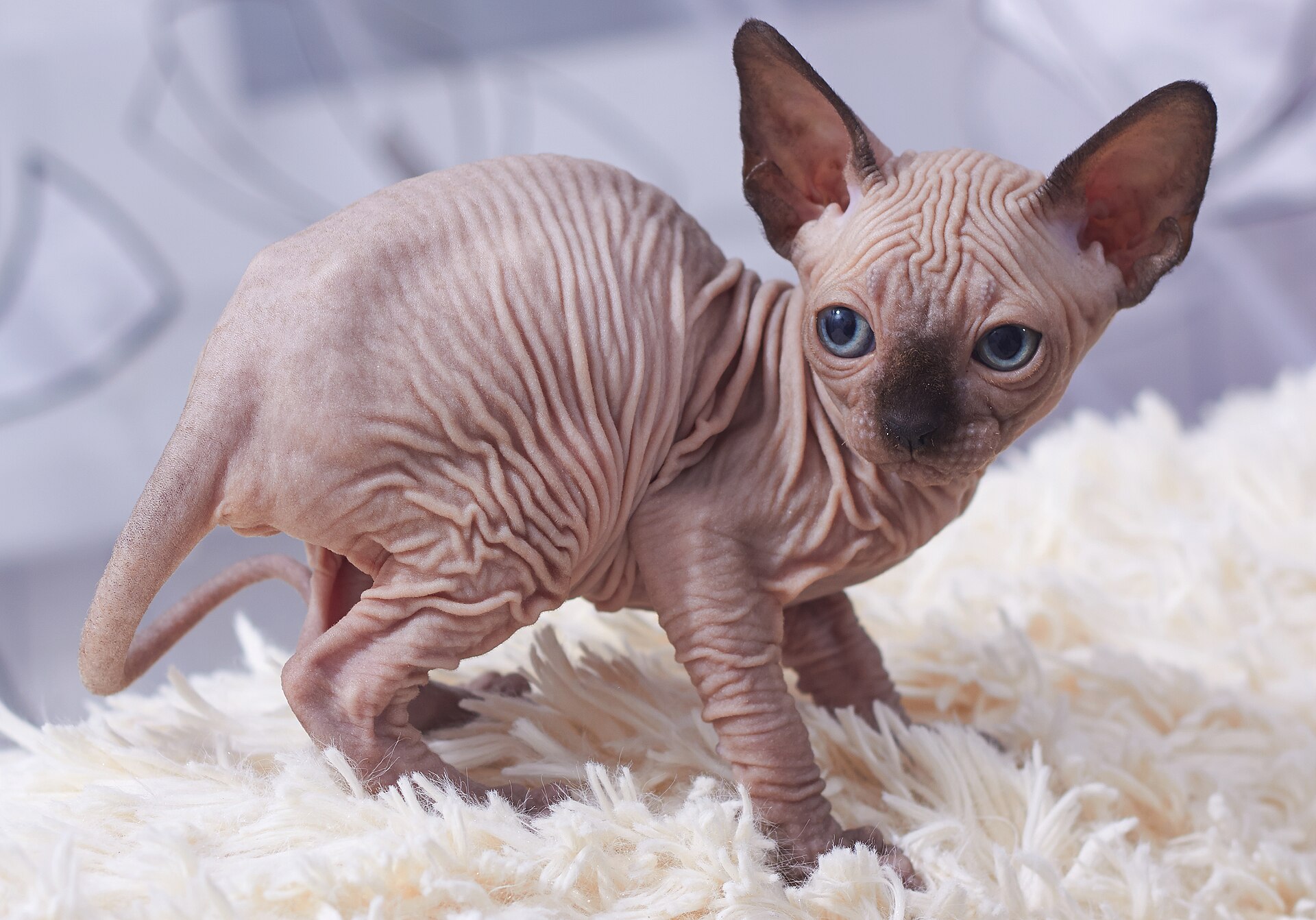
Sphynx Cat
Characteristics
Temperament
Extremely affectionate, attached to its owner like a dog. Seeks warmth (sleeps under covers). Suffers from solitude. Learns clicker training.
Diet
Obligate carnivore. Accelerated metabolism: 20-30% larger portions than furred cats. 3-4 small meals a day. Omega-3/6 for the skin.
The Sphynx is a Canadian cat breed famous worldwide for its most unmistakable feature: the almost total absence of fur. Far from being a "bald-by-design" cat, it is actually covered by a very fine velvet-like down, perceived to the touch like the skin of a peach. Its name evokes the great Egyptian statue for its hieratic posture and piercing gaze, but its origins are much more recent and Canadian.
Classification and category
The Sphynx is a domestic breed of the species Felis catus (Mammalia, order Carnivora, family Felidae). The modern breed was born in 1966 in Toronto (Canada), when a domestic cat called Elizabeth gave birth to a hairless kitten due to a spontaneous mutation of the KRT71 gene. From that single specimen and other similar mutations registered in the 1970s in Minnesota and Toronto, breeders developed the race by crossing it with Devon Rex and American Shorthair to broaden the genetic pool. It was officially recognised by TICA in 1979 and by FIFe in 2002. It is a medium-sized cat: males weigh 4-7 kg, females 3-5 kg, with a body length of 35-45 cm.
Habitat and distribution
Being a domestic breed, the Sphynx is today found worldwide thanks to specialised breeders, with the highest concentrations in North America, Russia (where it is very popular) and western Europe. Its natural "habitat" is exclusively the heated home environment: the absence of fur makes the Sphynx extremely sensitive to temperatures.
It does not tolerate temperatures below 20 °C without the help of cat sweaters or covers; on the other hand, in summer or under direct sunlight it risks skin burns. It is a breed that cannot be left outside and that needs a stable home environment, ideally with soft surfaces and controlled sunny areas. It should never be exposed to the sun for more than half an hour at a time, and at the beach (if transported) it requires specific hypoallergenic sunscreen.
Diet
Like all cats, the Sphynx is an obligate carnivore: the diet must be rich in animal protein (at least 35%), high-quality fats, taurine and arachidonic acid. Because of the absence of fur, the Sphynx has an accelerated metabolism: it burns far more calories than a long-haired cat to maintain body temperature (38-39 °C). Portions must therefore be increased by 20-30% compared to a same-sized cat, with rations divided into 3-4 small daily meals.
A mix of high-quality wet food (to ensure hydration) and kibble specifically formulated for active cats is recommended. Bare skin also involves more visible sebaceous secretion on the body: a diet rich in Omega-3 and Omega-6 fatty acids helps keep skin healthy and less greasy.
Physical features
The Sphynx has a muscular, athletic body, with a broad chest, pronounced "pot belly" and medium-long legs. The head is wedge-shaped with high cheekbones, large ears wide at the base (reminiscent of bat wings) and large lemon-shaped eyes in all recognised colours.
The skin is the true distinguishing feature: it is not really naked, but covered by a very fine layer of down less than 2 mm long, comparable to that of a peach or premium velvet. To the touch it is warm (1-2 °C above human skin) and soft. Skin pigmentation follows the same patterns as traditional cats: there are tabby, tortoiseshell, colourpoint, blue, black, white Sphynx and so on, but the "colour" is expressed directly by the skin and not by fur. Typical features include pronounced wrinkles on the muzzle, legs and neck (especially in kittens and older males), and either absence of whiskers or very short, curly whiskers.
Behaviour and curiosities
The Sphynx is famous for its extremely affectionate, sociable, active and curious character. Often described as "half cat, half dog, half child", it follows its owner around the house, loves being held, sleeps under the covers to warm up and cannot stand loneliness. It is a breed that suffers from separation and tends to be much happier with another cat (Sphynx or otherwise) for company.
The most demanding aspect is skin care: without fur to absorb sebum, the Sphynx requires a weekly bath with neutral or emollient shampoo to avoid greasy build-up. Ears and between the toes require regular cleaning for the same reason. The skin can develop feline acne, eczema and infections if not well cared for. Lifespan is 12-15 years, in line with the feline average; genetic predispositions include hypertrophic cardiomyopathy (HCM), a serious heart disease today controllable through annual echocardiography and responsible genetic selection. Contrary to common belief, the Sphynx is not hypoallergenic: cat allergy is caused by the Fel d 1 protein present in saliva and sebaceous secretions, not by fur — although the reduced dispersion of allergens in the environment can effectively reduce symptoms in mildly allergic subjects.
Pros
- Carattere unico, molto affettuoso
- Non perde pelo (pochi allergeni dispersi)
- Intelligente, addestrabile
- Esemplari ricchi di interazione con la famiglia
Cons
- Bagno settimanale obbligatorio
- Sensibile a freddo/caldo: non vive all'esterno
- Predisposto a HCM (cardiomiopatia)
- Costi di acquisto e gestione elevati