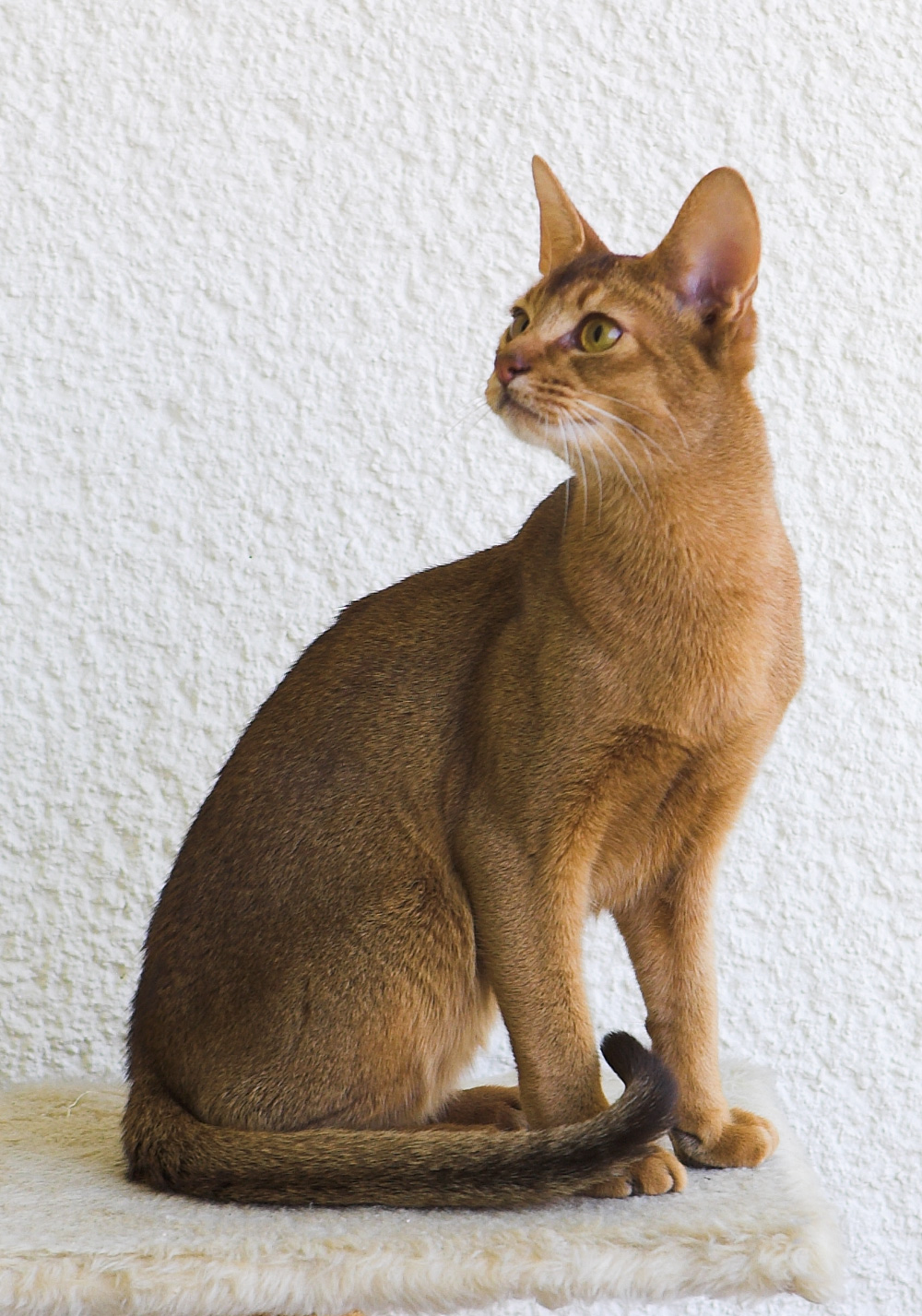
Abyssinian
Felis catus
Characteristics
Temperament
Extremely lively, very intelligent, curious, social ("clown cat"). Hyperactive, explores everywhere, loves height. Canine behaviours: fetch, follows, greets guests. NOT suitable for sedentary families. Ideal in pairs.
Diet
Obligate carnivore, very active metabolism. 280-350 kcal/day in 2-3 meals. High-quality kibble (40% protein min) or wet/BARF. Tends to stay lean due to intense activity. DNA tests for renal amyloidosis and PKDef.
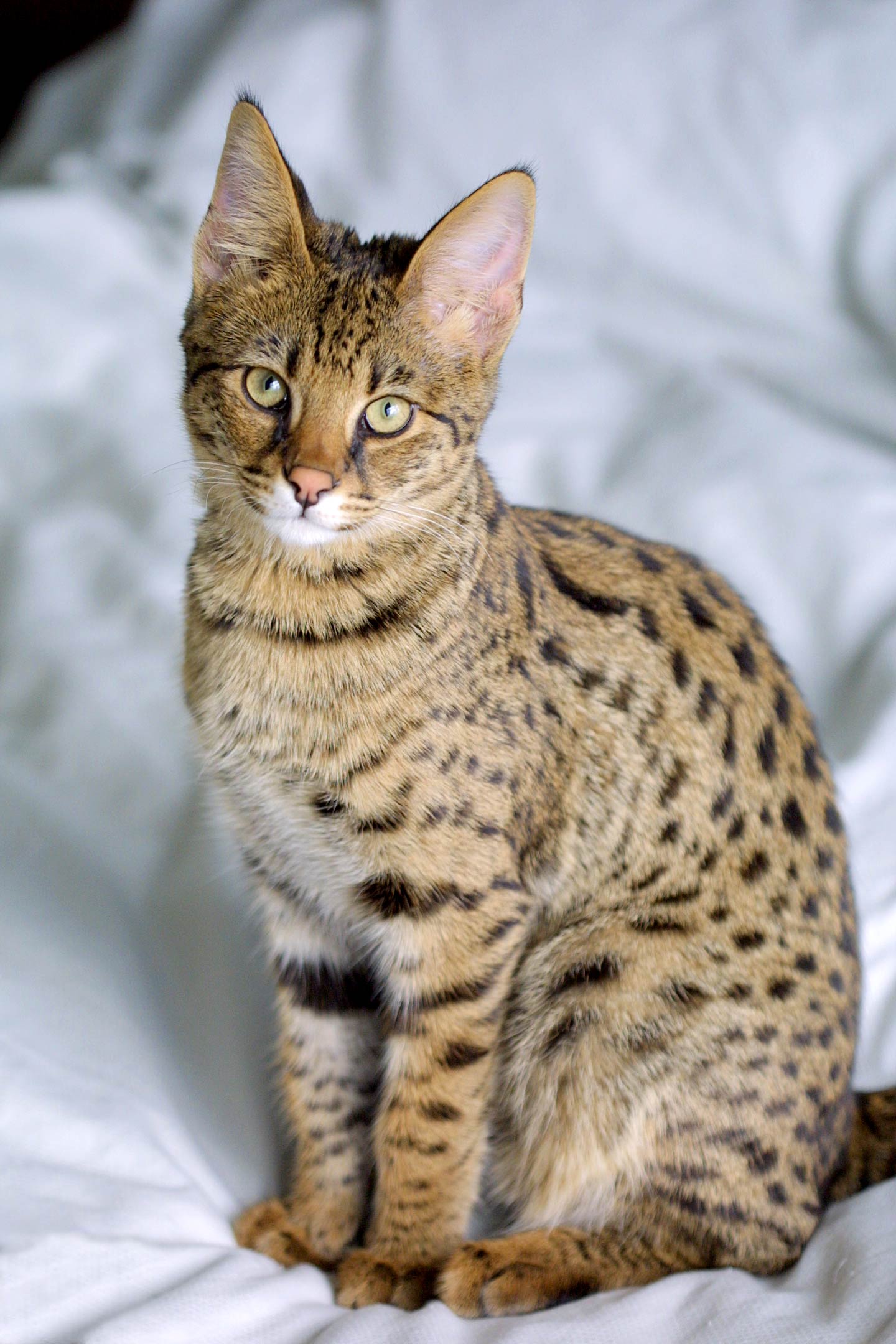
The Abyssinian (Felis catus) is one of the oldest and most fascinating cat breeds in the world. Wrapped in a legend that wants it descendant of the sacred cats of ancient Egypt depicted in the paintings of the temples (the "cat Bastet"), it is characterised by a coat unique in the world: the "ticked" (agouti-coloured hairs with alternating light and dark bands, which give the cat a colouration similar to that of the lynx or miniature lion). Nicknamed the "clown cat" for its incredible liveliness, intelligence and curiosity, it is an extremely active and social breed, perfect for dynamic families who can dedicate time and attention to it. Among its most admired characteristics: the intense almond-shaped eyes (green, yellow or copper), the elegant "feline-oriental" bearing, and the propensity for typically canine behaviours such as retrieving toys, following the owner, actively exploring.
Classification and category
The Abyssinian belongs to the species Felis catus, the domestic subspecies derived from the African wildcat (Felis silvestris lybica). It is classified by FIFe in Category III — Shorthair (code ABY), by CFA as a distinct breed, by British GCCF as Foreign Group 4. The standard provides for a medium size: weight 3-4 kg for females, 4-5 kg for males, withers height 25-30 cm. The structure is slim, elegant, muscular, "foreign body type" (elongated and elegant body similar to the Siamese but more robust). Full physical maturity is reached at 1.5-2 years. The breed was officially recognised by the British GCCF in 1929, by FIFe in 1949, by the American CFA in 1949. There are 4 standard recognised colours: Ruddy (Usual in the UK: red-brown with black ticking), Sorrel (copper-red with dark brown ticking), Blue (grey-blue with darker blue ticking), Fawn (pink-beige with darker beige ticking). All variants have the characteristic "ticked" coat (also called "agouti pattern"). There is also the long-haired variant (Somali), recognised as a distinct breed since 1978.
Habitat and distribution
The Abyssinian is a completely domestic breed, perfectly adapted to apartment life provided it is dynamic. Its lively, social, intelligent and independent nature makes it ideal for active families (not sedentary), even with children of compatible age and other animals (if well socialised). It is NOT a breed for quiet or sedentary people: it gets bored quickly and can develop destructive behaviours (scratching, unwanted climbing, continuous vocalisations). It needs vertical spaces (cat trees, high shelves, safe outdoor access): the need to climb and explore is very strong, inheritance of ancestral origins.
The historical origins of the breed are shrouded in mystery and legend. The classic narration tells that it was the sacred cat of the ancient Egyptian civilisation: temple paintings depict cats with ticked coats, similar to the modern Abyssinian, identified with the goddess Bastet. However, modern genetic studies (2008) have shown that the modern breed has roots in Southeast Asia (Thailand, Bengal) and the Indian Ocean, and was probably introduced to Europe in the 19th century. The first known Abyssinian was brought to England in 1868 by a British military returning from the war in Abyssinia (today Ethiopia), from which it takes its name. The cat, called "Zula", was exhibited at the Crystal Palace in London in 1871 in the "British or Foreign Fancy" category, causing a sensation for its unique coat. In the 1920s the breed was brought close to extinction by the First World War (about ten specimens remained in England); the reconstruction programme used crossings with Burmese and Asian leopard cat. Today it is widespread globally, with concentrations in North America, Europe (Great Britain, Italy, France, Germany), Russia. In Italy it is a relatively rare but very appreciated breed, with about 500-700 specimens registered with ENCI. The average price of a pedigree FIFe kitten is 1,000-2,000 euros; show line specimens 2,500-4,000 euros.
Diet
The Abyssinian is an obligate carnivore with very active metabolism (the most "caloric" breed among pedigree cats): the daily caloric requirement of a 4 kg adult is about 280-350 kcal, distributed in 2-3 small meals (some owners prefer free feeding with food always available). The ideal diet consists of high-quality kibble rich in animal protein (minimum 40%), or wet feeding (cans) or BARF under veterinary supervision. The Abyssinian tends to stay lean thanks to intense physical activity: obesity is rare compared to other breeds.
The breed is generally robust, with few specific genetic predispositions. Pathologies to monitor: renal amyloidosis (amyloid deposit in the kidneys, hereditary disease lethal in 5-7 years, DNA test available for breeders), pyruvate kinase deficiency (PKDef) (hereditary anaemia, DNA test), hypertrophic cardiomyopathy (HCM) (annual cardio screening from 3 years), progressive retinal atrophy (PRA-rdAc, DNA test). A complete genetic panel is recommended in breeders before mating. The care of the coat is easy: self-cleaning short hair, just weekly brushing. Water always available, fresh. The Abyssinian is moderately hydrophilic: some specimens love to play with water, cat fountains recommended. Portions must be controlled after sterilisation (25% metabolism drop).
Physical features
The Abyssinian has an elegant, slim, muscular, medium-sized body, defined by the standard as "foreign body type" intermediate between the Siamese (slimmer) and the British Shorthair (stockier). The head has a modified triangular shape (rounded wedge), with well-proportioned muzzle, slightly rounded forehead, strong chin. The ears are the most distinctive trait after the coat: large, wide at the base, well spaced, carried erect in "alert" position (it is a breed with "lynx-like" characteristic — resemblance to the lynx — with ear tufts often present). The eyes are large, almond-shaped, well spaced, of intense emerald green, gold or copper colour (the standard requires bright and deep colour).
The coat is the world's unique feature: short hair (1-2 cm), fine, dense, shiny, with ticking (hairs that have light base, darker centre, and light tip again). Each individual hair has 2-4 bands of alternating colour ("agouti" effect, similar to that of the wild hare or wild rabbit). This unique characteristic gives the Abyssinian a shaded appearance with reflections that change according to the observation angle. The four standard colours are: Ruddy/Usual/Hare (reddish-brown base with black ticking), Sorrel (copper base with dark brown ticking), Blue (grey-blue base with darker blue ticking), Fawn (pink-beige base with darker beige ticking). The dorsal line and tail tip are slightly darker (ticking characteristic). The belly, chest and inner part of the legs are of base colour without ticking. The legs are long and slender, with small oval feet. The tail is long, thin, slightly sharp. The bearing is most elegant, "very feline": the Abyssinian moves with "Egyptian" grace, often described as "a small miniature lynx".
Behaviour and curiosities
The Abyssinian has an extremely lively, intelligent, curious, social temperament. It is often defined "the clown cat" for its incredible activity and funny expressions. It is hyperactive: climbs everywhere, explores every corner, manipulates objects with dexterous paws, plays with everything. Its intelligence is considered among the highest in the feline world (top 5 most intelligent breeds): it easily learns complex tricks (sit, give paw, come, fetch, jump hoops), recognises its own name, understands dozens of human words, solves complex spatial problems.
It shows many typically canine behaviours: fetching toys (plays bringing them to the owner to repeat the throw), following everywhere, greets guests at the door, can be trained on a leash for outdoor walks. It is sociable with children (of appropriate age, it is too active for very small ones), other cats (preferably Abyssinians or equally active cats), dogs and even rabbits/birds if well socialised. It is NOT suitable for sedentary families: it gets bored in 1-2 days and becomes destructive. It is relatively vocal: melodic meowing, frequent "chirps" and "trills" to communicate. It loves height: always finds the highest point in the house (above bookshelves, wardrobes, shelves) to observe the world. It gets along in pairs (recommended two Abyssinians together): they keep each other company and multiply their activity.
The cultural history is rich: in addition to the famous legend of the "cats of ancient Egypt", the Abyssinian has been the protagonist of numerous publications and shows. The famous "Friendly" was the first Abyssinian in the world to win the "Cat of the Year" title of the CFA (1972). In modern times, the cat character in "The Cat from Outer Space" (1978, Disney) is played by Abyssinians for their "alien" expressiveness. Various famous owners: Stephen King, Bill Clinton (the family owned one at the White House), Steven Spielberg. Longevity is excellent: 12-17 years on average, with well-cared specimens reaching 18-20 years. Scientific curiosity: the long-haired variant of the Abyssinian is the Somali, distinct breed recognised since 1978: occasionally born in Abyssinian litters (recessive gene for long hair introduced by the 1920s crosses).
Pros
- Mantello ticked unico al mondo, eleganza 'felino-egiziana'
- Top 5 razze più intelligenti, addestrabile come un cane
- Longevità eccellente (12-17 anni, fino 20)
- Carattere vivace e socievole, ideale per famiglie attive
Cons
- NON adatto a famiglie sedentarie (si annoia, distrugge)
- Necessita compagnia (consigliato in coppia)
- Predisposto a amilodosi renale (test DNA obbligatorio)
- Raro in Italia, prezzi elevati (1.000-4.000 €)