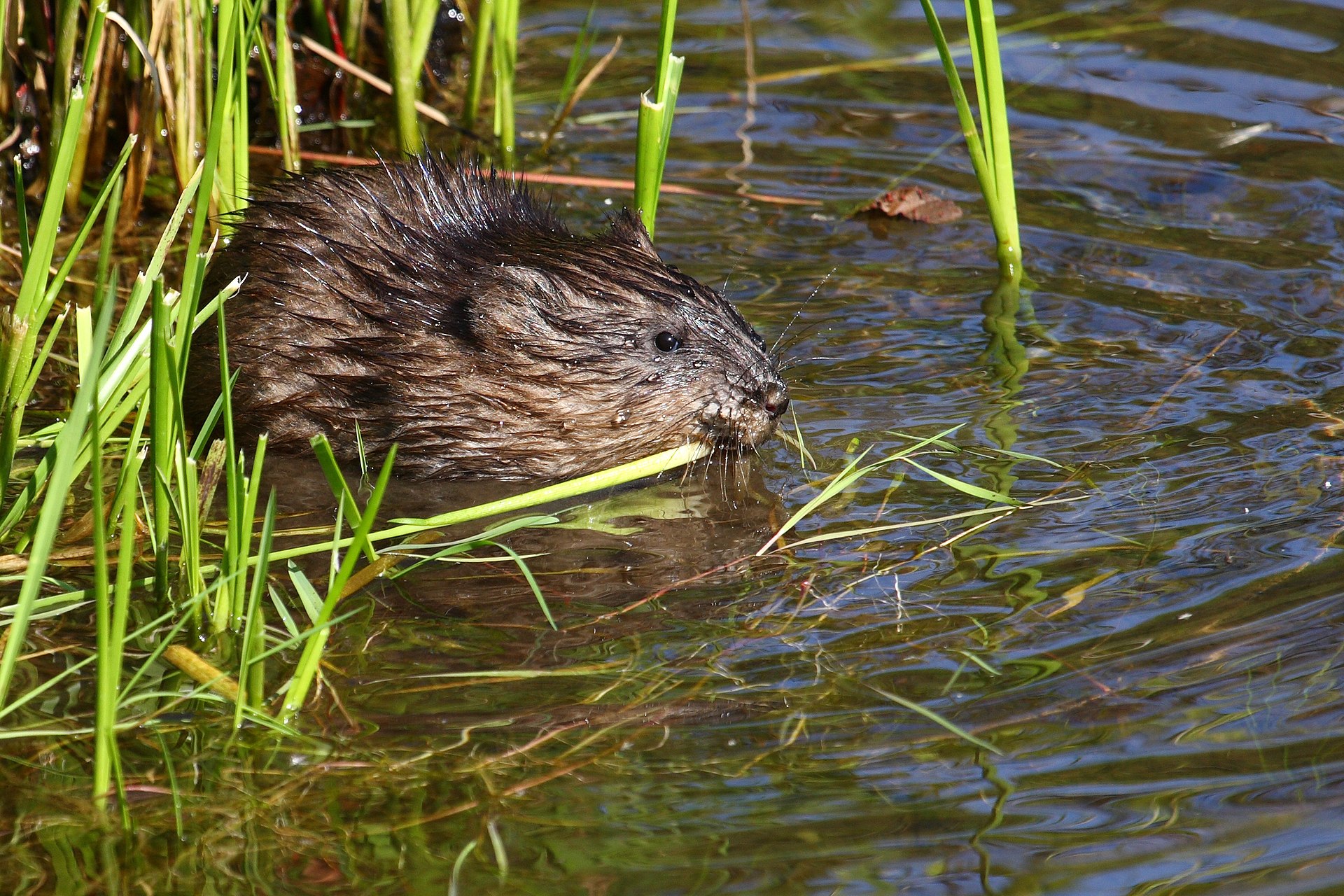
Muskrat
Ondatra zibethicus
Characteristics
Temperament
A semi-aquatic wild rodent, active mainly at dusk and at night, shy and tied to the water. It lives in family groups and can be territorial in the breeding season. An excellent swimmer and tireless builder (of reed lodges or burrows dug into banks), it is very prolific and adaptable. It is NOT a pet: it is wildlife, and in the territories where it has been introduced it is considered invasive, partly for the damage its digging can cause to banks and dikes.
Diet
Mainly herbivorous, with a clear preference for aquatic plants. It feeds above all on cattails, reeds, rushes, water lilies and other marsh vegetation (green parts and roots), as well as bankside plants and crops near the water; to a lesser extent it eats mussels, snails, crayfish, frogs and small fish, especially when plant food is scarce. It gathers plants by swimming and diving, uses floating platforms as "dining tables", and in autumn stores reserves of vegetation near the burrow.
The Muskrat (Ondatra zibethicus) is a semi-aquatic wetland rodent, and the largest member of the vole family. Famous for:
- Life in the water: an excellent swimmer, perfectly adapted to ponds, marshes and canals
- The rudder-tail: long, flattened sideways and nearly hairless, it serves as an oar and a rudder
- Reed lodges: it builds characteristic dome-shaped shelters from marsh vegetation
- Waterproof fur: dense and warm, once highly sought after by the fur industry ("musquash")
- The "musk" of the name: it secretes a scented substance with which it marks its territory
- Its ecological role: through its activity it keeps stretches of open water in the marshes
IUCN status: Least Concern (LC), common and widespread. In the portal it joins the Coypu (Nutria) in the group of semi-aquatic rodents: together — with the beavers — they illustrate the different ways rodents have conquered fresh water, from the giant engineer (the beaver) to the medium builder (the coypu) to the smaller, agile muskrat.
Classification and category
Order Rodentia (the rodents), family Cricetidae, subfamily Arvicolinae — that of the voles, lemmings and water voles. Among all these, the Muskrat is by far the largest: it is the biggest "vole" in the world. In the portal it is placed among the semi-aquatic rodents. It is important not to confuse it with the other water rodents, also in the portal: the beaver is much larger (20-30 kg) and has a flat, horizontal, paddle-shaped tail; the coypu (nutria) is medium-sized (5-9 kg), with large white whiskers, orange incisors and a round, rat-like tail; the Muskrat is the smallest of the three (about 1 kg), with a tail flattened sideways (vertically), nearly bare. Etymology: the genus name "Ondatra" comes from a Native American word (Huron/Wyandot); "zibethicus" refers to the civet, for the musky smell of its secretions; the English name "muskrat" means just that, "musk rat". Parameters: Body length about 25-35 cm. Tail about 20-27 cm. Weight about 0.6-2 kg. Longevity short in the wild, generally 3-4 years (up to about 10 in captivity). Reproduction: very prolific — it can have several litters a year, each of several young, which explains how quickly it colonizes new environments.
Habitat and distribution
The Muskrat is a freshwater rodent with a now vast range: its original range covers much of North America; its current range, after humans introduced it in the early 20th century, spreads across much of Europe and Asia, where it is now a common (and often invasive) species. Preferred habitats — always near water: marshes, swamps and reedbeds, its ideal environments; ponds, lakes, slow rivers, canals and ditches; and anywhere with still or slow water and abundant vegetation. The Muskrat builds two types of shelter: in areas with lots of vegetation it erects dome-shaped lodges of reeds, cattails and mud, like small versions of beaver dams; along firmer banks, instead, it digs burrows and tunnels with underwater entrances. This very digging makes it, in Europe, a problematic species, because it can damage banks and dikes. Introduced into Bohemia in the early 20th century for fur, it then spread overwhelmingly. IUCN: Least Concern. It is abundant across much of its range; in the territories where it has been introduced it is considered invasive, for the damage to banks and competition with local wildlife.
Diet
The Muskrat is mainly herbivorous, with a clear preference for aquatic plants. It eats: aquatic vegetation (cattails, reeds, rushes, water lilies and other marsh plants, both the green parts and the roots); bankside plants and crops near the water; and, to a lesser extent, animal matter (mussels, snails, crayfish, frogs and small fish, especially when plant food is scarce). Feeding habits: foraging in the water (it gathers plants by swimming and diving, able to stay underwater for a long time); "dining tables" (it uses floating platforms or emerging logs as feeding stations); and stores (in autumn it accumulates vegetation near the burrow for lean periods). Crucially, by feeding heavily on reeds and cattails, the Muskrat actively shapes marsh vegetation, creating patches of open water amid the reedbeds. This "thinning" can favour other aquatic species, but in excess it can also impoverish the reedbeds.
Physical features
A stocky, hydrodynamic rodent, perfectly equipped for aquatic life. Fur and body: dense, soft, waterproof fur, dark brown on the back and paler on the belly, which traps air and keeps it warm and dry; a compact, rounded body, a little "ball-like". The aquatic adaptations: a long tail, flattened sideways and nearly bare, used as a rudder and for propulsion in swimming; large hind feet, partially webbed and fringed with stiff hairs, acting as flippers; the ability to close its ears and dive for a long time holding its breath; and protruding incisors that let it gnaw plants even underwater, with its mouth closed. The head: a broad head with a short muzzle, with small eyes and ears. Performance: excellent swimming and prolonged dives; building shelters (lodges of vegetation or burrows dug into banks); and great prolificacy (it reproduces very quickly).
Behaviour and curiosities
The Muskrat is an animal active mainly at dusk and at night, though it is not unusual to see it swimming by day. It lives in family groups and can be territorial, especially in the breeding season. Although it spends much of its time in the water, it comes out on land to feed and move between one pool and another.
The rat that smells of musk: the name "muskrat" comes from the characteristic scent this animal produces — the Muskrat has glands that secrete a musky-smelling substance, which it uses to mark its territory and communicate with others, especially in the mating season; hence also the scientific name zibethicus, recalling the civet. The "little marsh architect": like the beavers, the Muskrat is a builder, though on a more modest scale — in reed-rich areas it erects dome-shaped lodges of vegetation and mud, with a dry inner chamber and underwater entrances that protect it from predators; these lodges, besides housing the Muskrat, often become resting and nesting platforms for waterbirds and other animals. The rudder-tail: the Muskrat's tail is a specialized swimming tool, different from that of the other water rodents — while the beaver has a horizontally flat (paddle) tail and the coypu a round one, the Muskrat's is flattened sideways, that is vertically flat, and is moved laterally to push and steer the body through the water, a little like a boat's rudder or a fish's fin. The "musquash" fur: for the quality of its warm, waterproof coat, the Muskrat was long one of the most important species for the fur industry, under the trade name "musquash"; it was precisely to farm it for fur that, in the early 20th century, it was introduced into Europe, from where it then escaped and spread in the wild across half the continent. The tireless colonizer: thanks to its extraordinary prolificacy — several litters a year, each of several young — and its great adaptability, the Muskrat can rapidly colonize new wetland environments; this is why, starting from a few introduced animals, it became within a few decades a common presence across much of Europe and Asia, where it is now considered an invasive species. The water-rodent trio: in the portal the Muskrat completes, with the beaver and the coypu, the picture of the large semi-aquatic rodents; it is interesting to note how these three animals, although belonging to different families, have developed similar adaptations — waterproof fur, swimming feet, modified tails — to exploit the same kind of environment: a classic example of "convergence", in which different species arrive at analogous solutions.
Pros
- Affascinante roditore acquatico: nuotatore eccellente e costruttore di capanne
- Ruolo ecologico utile: mantiene specchi d'acqua aperti e nutre molti predatori
- Comune e adattabile; IUCN Least Concern, nessun rischio di conservazione
- Completa, con castoro e nutria, il "terzetto" dei roditori semi-acquatici
Cons
- NON è un animale da compagnia: è fauna selvatica
- Dove introdotta è invasiva: danneggia argini e dighe con gli scavi
- Può competere con la fauna acquatica autoctona
- Molto prolifica: difficile da contenere una volta insediata