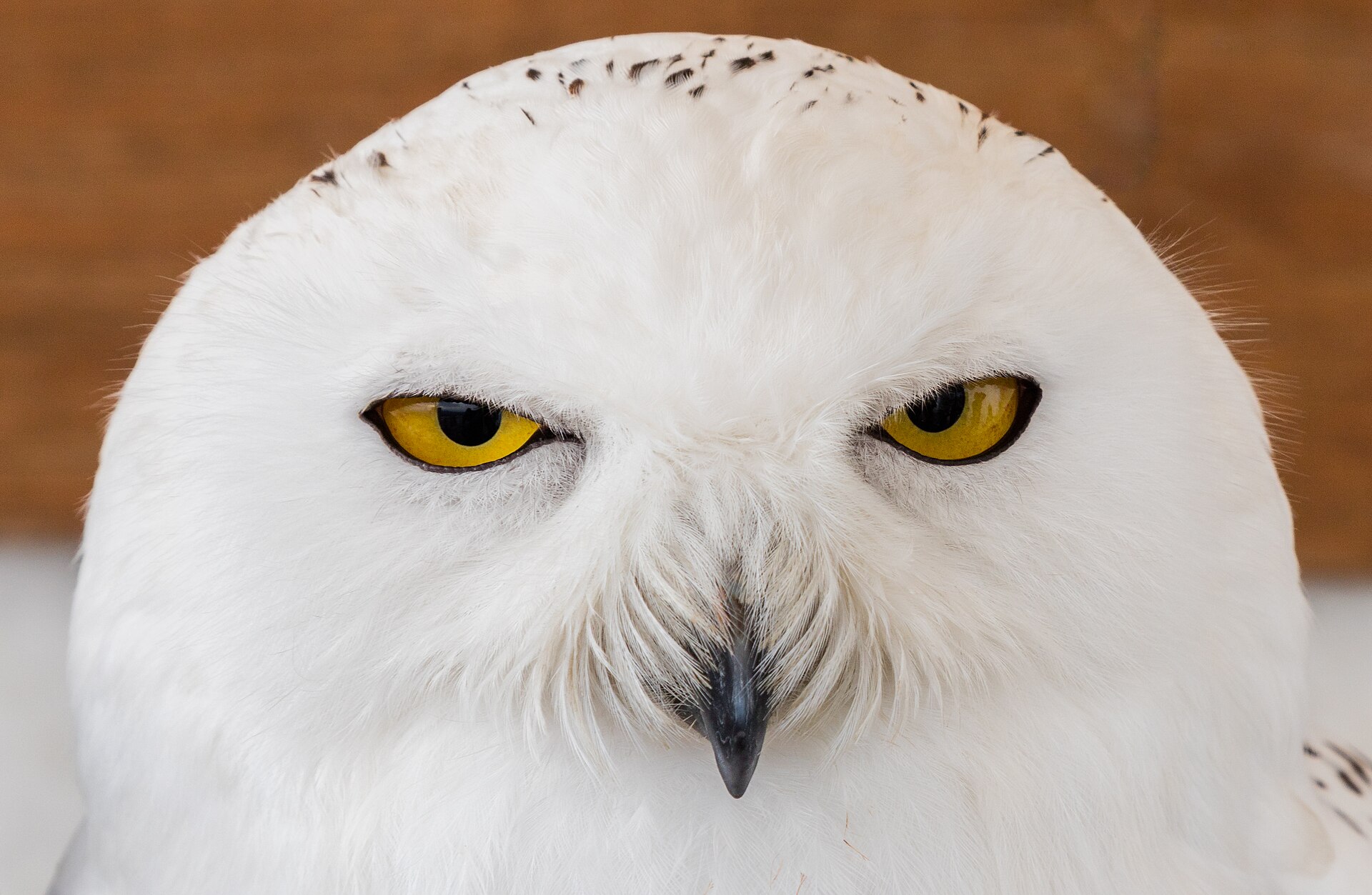
Snowy Owl
Bubo scandiacus
Characteristics
Temperament
Solitary, territorial and adapted to the extreme: it lives on the Arctic tundra amid intense cold, winter darkness and perpetual summer sun. Unlike almost all owls it is often diurnal. An ambush predator with very keen sight and hearing and silent flight. It defends its ground nest very aggressively, diving even at large predators and people. Its breeding follows lemming cycles. Not a pet: a large wild raptor of the Arctic.
Diet
A powerful predator, in the breeding season strongly specialized on lemmings, small Arctic rodents it can catch in large numbers. It also eats voles and other rodents, hares (Arctic and otherwise) and rabbits, and birds such as ptarmigan, ducks and seabirds (especially in winter). It hunts by ambush from a perch or the ground, scanning the open tundra with very keen sight and hearing, and with silent flight. It can hunt by day too. Its breeding (egg number) closely follows lemming abundance cycles.
The Snowy Owl (Bubo scandiacus) is the large white owl of the Arctic tundra and one of the world's most recognizable and beloved owls. Famous for:
- Its white plumage: adult males are almost pure white, females and juveniles white with dense dark barring — perfect camouflage on snow and tundra
- The owl of the Arctic: it lives in the cold lands of the north, where few other raptors dare to nest
- Daytime activity: unlike most owls, it also hunts by day, an adaptation to the midnight sun of the Arctic summer
- Yellow eyes and a round head with no "tufts": no false ears like the Eurasian eagle-owl
- Specialization on lemmings: small Arctic rodents that form the basis of its diet
- Pop fame: it is "Hedwig", the snowy owl of Harry Potter, among the best-known birds in the world
IUCN status: Vulnerable: once thought common, it has been listed among threatened species because of population declines and uncertainty about real numbers. It belongs to the same cold "world" as other snow dwellers in this portal, such as the Canada lynx and the Snowshoe hare: like them, it "wears" white to survive in the realm of snow.
Classification and category
Order Strigiformes (the owls), family Strigidae (the "true" owls), genus Bubo — the same as the Eurasian eagle-owl (Bubo bubo), the largest owl of the Old World. It is therefore a close relative of the eagle-owl, from which it differs sharply: the snowy owl is white and lacks ear tufts (the feather "ears"), while the eagle-owl is brown-fulvous with conspicuous tufts; the snowy owl is tied to the open Arctic tundra, the eagle-owl to woods, cliffs and varied habitats; and the snowy owl is often diurnal, while the eagle-owl is mostly nocturnal. It was once placed in its own genus (Nyctea), but genetic analyses moved it close to Bubo. Despite the name, it should not be confused with the small "owlets": it is a large owl. Etymology: "Bubo" is the Latin name for the owl; "scandiacus" refers to Scandinavia, part of its northern range; the common name simply describes its link to snow. Parameters: Length 52-71 cm. Wingspan 125-150 cm. Weight 1.6-2.9 kg (females, larger than males, are among the heaviest owls in the world). Longevity about 9-10 years in the wild, up to nearly 30 in captivity. It nests on the ground on the tundra; the number of eggs depends strongly on lemming abundance — from 3-5 up to 11 or more eggs in "lemming years", very few or none in lean years.
Habitat and distribution
The Snowy Owl is a circumpolar Arctic species: its breeding range is the Arctic tundra around the North Pole — northern Canada, Alaska, Greenland, Scandinavia and northern Russia. In winter it moves further south, reaching southern Canada, the northern USA and parts of Europe and Asia; in some years it makes true "irruptions" southward, linked to lemming cycles. Preferred habitats — open, cold environments: Arctic tundra (its realm, a treeless open expanse); and in winter open fields, grasslands, dunes, coasts, airports and other spacious areas that recall the tundra. It is a bird of open spaces, where its very sharp sight and silent flight let it spot prey from afar. It often perches on the ground or on small rises (boulders, hummocks, posts) to scan its surroundings. It is territorial in the breeding season and defends the nest very aggressively, attacking even much larger predators (Arctic foxes, wolves) and even people who come too close. IUCN: Vulnerable. Threats include climate change (which alters the tundra and lemming cycles), collisions (with vehicles, power lines, aircraft) and other factors. Arctic warming is a particular concern for a species so adapted to the cold.
Diet
The Snowy Owl is a powerful predator with a strong specialization, in the breeding season, on small Arctic rodents: lemmings (the key prey, especially while nesting; a single owl can catch a great many in a year); voles and other small rodents; hares (including Arctic and snowshoe hares, and leverets), rabbits and other larger mammals; and birds (ptarmigan, ducks, waterbirds and seabirds, especially in winter and along coasts). Hunting strategies: perch-and-wait (it sits motionless on a high point, or on the ground, scanning the open terrain with very keen sight and hearing, then drops on the prey); daytime hunting (able to hunt in full daylight, it exploits the long daylight hours of the Arctic summer, when night and day barely exist); and silent flight (like all owls, it has soft-edged feathers that muffle the sound of flight, letting it approach prey unheard). Crucially, the dependence on lemmings ties the snowy owl's breeding to their abundance cycles: in lemming-rich years owls lay many eggs and raise many young; in lean years they may not breed at all or move elsewhere seeking food — a mechanism essentially similar to the lynx-hare cycle.
Physical features
A large, massive, splendidly white owl, built for the cold. Plumage: males almost pure white, increasing with age; females and juveniles white with dense dark barring and spots (females on average more "marked" than males); dense, insulating plumage that even covers the legs and toes like feather "boots", against the Arctic cold. Head and body: a large, round head with no ear tufts (unlike the eagle-owl); big, piercing yellow eyes; a robust, powerful build, with strong talons hidden among the leg feathers; and a dark bill, largely concealed by the facial feathers. Performance: exceptional sight and hearing, to spot prey on open snowy expanses; silent flight thanks to soft-edged feathers; resistance to extreme cold thanks to the dense plumage; and aggressive nest defence, diving at any threat.
Behaviour and curiosities
A solitary, territorial animal adapted to one of the planet's most extreme environments. On the tundra it must face intense cold, long months of darkness in winter and continuous light in summer, and a food supply that changes enormously from year to year. Its biology is shaped by these challenges.
The "owl that lives by day": almost all owls are nocturnal, but the snowy owl is an exception — living in the Arctic, where in summer the sun does not set for weeks (the "midnight sun"), it has had to adapt to hunting in full light too, so it is one of the few owls that can be seen active by day, a rarity among owls. White "for the snow": the snowy owl's white plumage is not only beautiful but perfect camouflage for the snowy tundra, where the bird almost vanishes — the same "trick" used by other snow dwellers in this portal, like the Snowshoe hare (which turns white in winter) and the Canada lynx (with its silvery-grey coat): in the realm of snow, dressing in white is a winning strategy, to hide from both prey and predators. Lemmings and "elastic" broods: the snowy owl is famous for tuning its breeding to lemming availability — in years when these rodents abound a pair may lay an extraordinary number of eggs (even over ten) and raise many young; in years when lemmings are scarce it may lay few eggs or not nest at all, and move in search of richer areas, so its populations "follow" prey cycles, just as the Canada lynx does with the hare. Winter "irruptions": in certain winters many snowy owls appear far further south than usual, reaching regions where they are not normally seen; these events, called "irruptions", are linked to lemming cycles and the high number of young produced in good years — the surplus owls disperse southward seeking food, giving birdwatchers exceptional sightings. "Hedwig" and culture: few bird species have entered popular culture like the snowy owl, made famous worldwide by Hedwig, the faithful snowy owl of the young wizard Harry Potter; it is also the official bird of Quebec, Canada, and its image even appears in prehistoric cave paintings, a sign of an ancient fascination. The relentless defender: despite its peaceful look, the snowy owl is a fierce defender of its nest, which is on the ground and thus exposed — it dives at any intruder, from Arctic foxes to wolves to humans, striking with talons and wings; other birds often nest near its nests precisely to benefit from this "free" protection.
Pros
- Rapace iconico e inconfondibile, simbolo dell'Artico (l'Edvige di Harry Potter)
- Grande predatore: controlla lemming e roditori della tundra
- Adattamenti straordinari al freddo e alla luce continua artica
- Grande valore culturale e di richiamo per il birdwatching
Cons
- IUCN Vulnerabile: cali di popolazione e Artico in riscaldamento
- Non è un animale da compagnia (grande rapace selvatico protetto)
- Nidifica a terra: nidi e pulli esposti ai predatori
- Dipende dai cicli dei lemming: riproduzione instabile di anno in anno