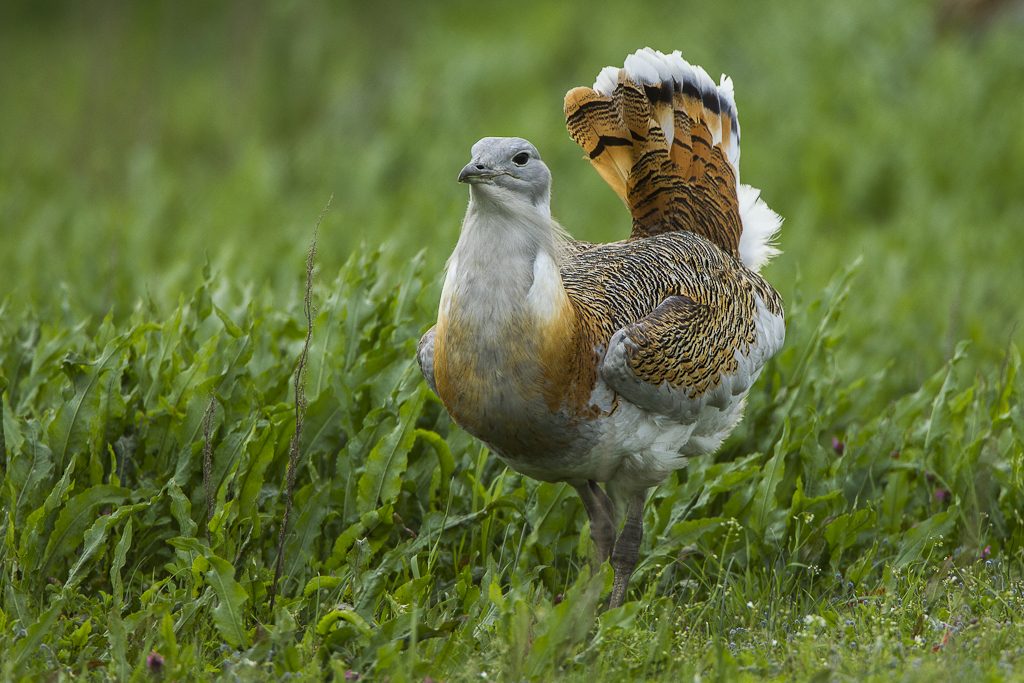
Great bustard
Otis tarda
The great bustard is one of the heaviest flying birds in the world, a giant of Eurasian steppes and grasslands with a spectacular courtship display.
Characteristics
Temperament
Gregarious, wary, tends to run
Diet
Omnivorous: shoots, seeds, insects and invertebrates
A giant of the grasslands
The great bustard is one of the heaviest birds still capable of flight: males can reach sixteen kilograms, while females are much smaller — a case of marked sexual dimorphism. The plumage is buff-brown barred with black on the back, with grey neck and head and a white belly. Adult males sport long "whiskers" of bristle-like feathers at the sides of the bill. (Note: the mass value reported by Wikidata, 143 kg, is clearly erroneous: no bustard reaches such weights; males reach about 16 kg.)
Habitat and range
It breeds in open grasslands, steppes and farmland across southern and central Europe and temperate Asia, from Morocco and Spain to China. European populations are largely resident, while Asian ones migrate farther south in winter. It is a gregarious bird, especially in the cold season.
Behaviour and courtship display
It is mainly omnivorous: it feeds on shoots, seeds, insects and small invertebrates. When disturbed it tends to run rather than fly. The males' display is spectacular: in spring they inflate the neck and raise and turn out the white feathers of the undertail and wings until they become a conspicuous white puffball, to impress the females gathered at the display arenas (lek).
Notable facts
Despite its bulk, the bustard is capable of powerful, sustained flight. In many European countries it has become rare or extinct through intensive agriculture; in some regions, such as Britain, reintroduction programmes have been launched.
Conservation
The species is listed as Endangered by the IUCN. The main threats are the transformation of open habitats, farm mechanisation, collisions with power lines and disturbance at nesting sites.
Pros
- One of the heaviest flying birds in the world
- Spectacular male courtship display
- Symbol of steppes and grasslands
Cons
- Endangered, with steeply declining populations
- Very sensitive to disturbance and intensive farming