Barn Owl
Tyto alba
Characteristics
Temperament
A nocturnal, solitary, shy, silent wild raptor, active mainly at dusk and at night; by day it rests hidden. Although it readily nests in human buildings, it is a reserved animal, perceived more by its screeching call than by sight. It forms stable pairs and defends its hunting territory. A patient, prodigious hunter, it locates prey by hearing alone and flies in total silence. It is NOT a pet: it is protected, highly useful wildlife, to be safeguarded by conserving old buildings, nest boxes and prey-rich countryside, and by avoiding rodent poisons.
Diet
A nocturnal predator specialized in small mammals. It feeds above all on rodents (voles, mice, rats), as well as shrews and, occasionally, small birds, amphibians and large insects. It hunts in slow, very silent flight at low altitude over the fields, locating prey thanks to a prodigious hearing that lets it catch them even in total darkness, based only on sound. It swallows prey whole and regurgitates the indigestible parts (bones, fur) as compact "pellets". By feeding on huge quantities of mice and rats, it is an irreplaceable natural ally of the farmer.
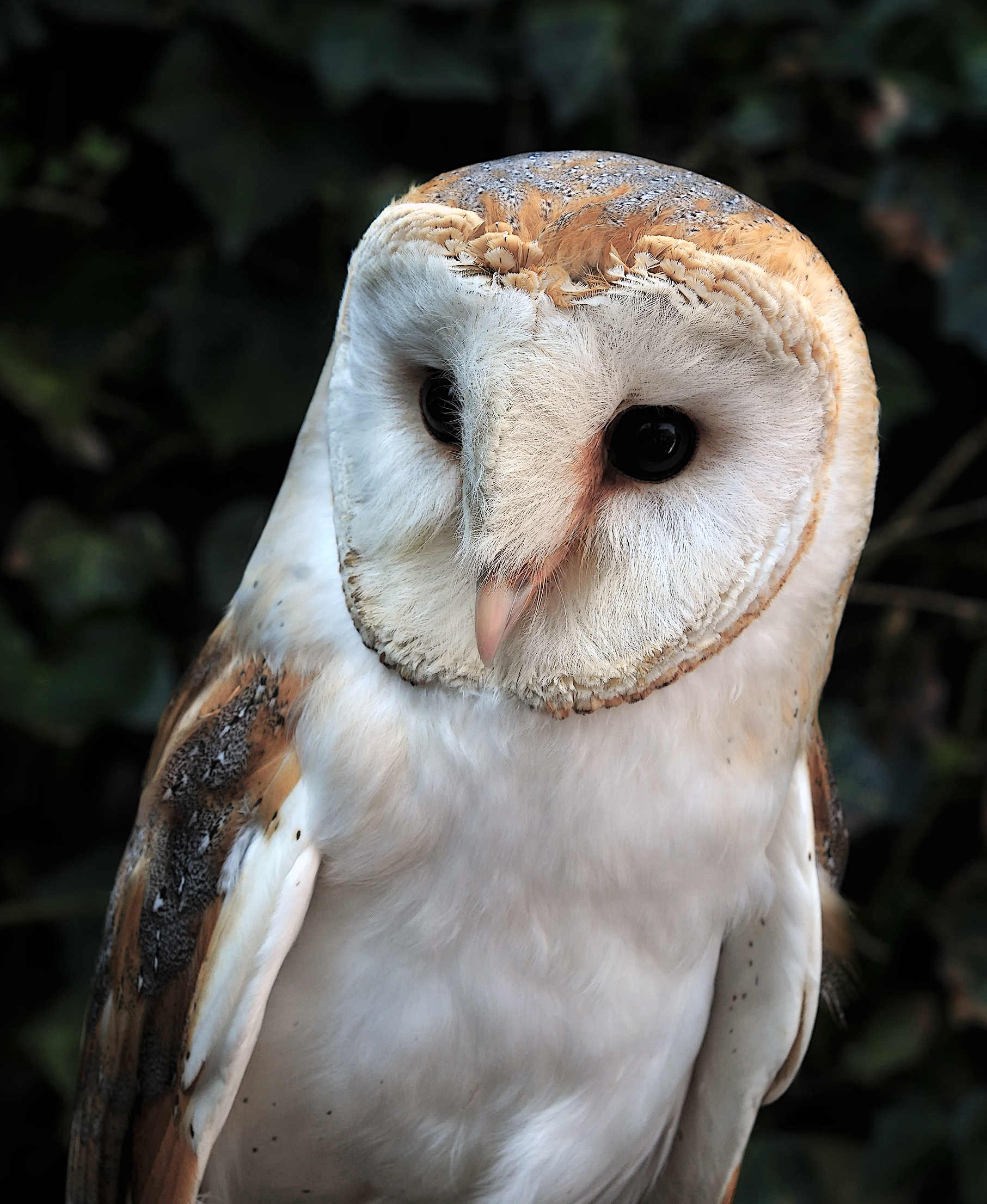
The Barn Owl (Tyto alba) is one of the most beautiful, mysterious and widespread nocturnal birds of prey on the planet: the owl with the pure white heart-shaped face that moves through the night like a silent ghost. Famous for:
- The heart-shaped face: a white, sharp, heart-shaped facial disc that makes it unmistakable
- Silent flight: special feathers let it fly without any noise, surprising its prey
- Prodigious hearing: it can locate and catch mice in total darkness, guided by sound alone
- Pale plumage: golden and grey above, white below, hence its ghostly look in nocturnal flight
- The bond with humans: it nests in barns, bell towers and old buildings, hence the name "barn owl"
- The eerie call: it does not "hoot" but gives a hissing screech that has fuelled its mysterious reputation
IUCN status: Least Concern (LC), and it is one of the most widely distributed birds in the world. It enters the portal among the nocturnal raptors, alongside the Little Owl, Eurasian Eagle-Owl and Snowy Owl: among them it is the only one not belonging to the "typical owls" family, forming a group of its own, and it stands out for its famous heart-shaped face and black eyes.
Classification and category
Order Strigiformes (the nocturnal birds of prey), but a particular family, the Tytonidae (the barn owls), distinct from that of all the other owls and owlets, the Strigidae. In the portal it is placed among the nocturnal raptors. Some traits help tell it apart from the other nocturnal raptors in the portal: the Barn Owl has a white heart-shaped facial disc, black eyes, no "tufts" on the head and very pale plumage; the Eagle-Owl and the other owls often have ear tufts and large orange or yellow eyes; the Little Owl is small and stocky, with yellow eyes. Etymology: the scientific name "Tyto" comes from Greek and means "owl", while "alba" means "white", referring to the pale plumage; the Italian name "barbagianni" is an old popular term, perhaps linked to the "bearded" look of the face or to a jokey personal name. Parameters: Length about 33-39 cm. Wingspan about 80-95 cm. Weight about 250-480 g (the female usually larger than the male). Longevity: in the wild on average short (often a few years, due to high juvenile mortality and harsh winters), but it can reach and exceed 15 years. Reproduction: it usually lays 4-7 eggs (even more in vole-rich years), in cavities of buildings, ruins or trees, or in special nest boxes.
Habitat and distribution
The Barn Owl is one of the most widely distributed birds in the world: it is present on almost every continent (except Antarctica) and across much of the temperate and tropical areas, including Italy and Europe. Preferred habitats — open environments tied to humans: open countryside, meadows, pastures, cropland and fallow land, where it hunts rodents; barns, farmhouses, bell towers, ruins and old buildings, where it nests and shelters; and roadsides and rural areas with grass and prey-rich hedges. It is a nocturnal, sedentary raptor closely tied to traditional farming environments. The availability of nest sites (old buildings, cavities) and of mouse-rich countryside is essential for its presence. This is why it is greatly affected by changes in agriculture: the renovation of barns and bell towers, the use of rodent poisons (rodenticides) and road collisions have reduced the species in many areas. Nest boxes installed by humans help a great deal to support its populations. IUCN: Least Concern globally, thanks to its enormous range; however, in several European regions it is in decline and is a protected species, the subject of conservation programmes and the placing of artificial nests.
Diet
The Barn Owl is a nocturnal predator specialized in small mammals. It eats: rodents (especially voles, mice and rats, the absolute basis of its diet); shrews and other small mammals; and occasionally small birds, amphibians and large insects. Hunting techniques: low quartering flight (it slowly patrols the fields at low altitude, in very silent flight, listening for the movements of prey); locating by sound (thanks to its exceptional hearing it can find and catch a mouse in complete darkness, based only on the noise it makes); and the "whole mouthful" (it swallows prey whole and then regurgitates the indigestible parts (bones, fur) in compact "pellets", very useful to scientists for discovering what it eats). Crucially, by feeding almost exclusively on mice, voles and rats, the Barn Owl is one of the most effective and welcome natural "pest controllers". A single barn owl family can catch thousands of rodents in a year, which is why farmers have always welcomed it into their barns.
Physical features
A raptor of pale, elegant, "ghostly" appearance. The face and head — the distinguishing trait: a white heart-shaped facial disc, which frames the face and works like a "radar" to channel sounds towards the ears; black eyes, relatively small and deep (unlike the large yellow or orange eyes of many owls); the absence of ear "tufts" on the head. The plumage and body: golden and grey upperparts, finely speckled; very pale underparts, from white to pale buff; long feathered legs with sharp talons; feathers with "fringed" edges that muffle the noise of flight. Performance: very silent, almost imperceptible flight; extraordinary hearing, with asymmetrical ears that allow it to locate prey in three dimensions; and sight adapted to dim light and great agility in slow flight.
Behaviour and curiosities
The Barn Owl is a nocturnal, solitary, shy raptor, active mainly at dusk and at night. By day it rests hidden in its shelters. Although tied to human buildings, it is a reserved animal, which most people hear (its call) more than they see. It forms stable pairs and defends its hunting territory.
The heart-shaped face: the Barn Owl's pure white heart-shaped facial disc is not just an unmistakable aesthetic trait but a hunting tool; it works like a "dish" that gathers and channels sounds towards the ears, amplifying them; together with the ears set in asymmetrical positions (one higher than the other), this lets the barn owl locate prey with three-dimensional precision, even in total darkness. The "blind" hunter: the Barn Owl is one of the very few predators able to catch prey in absolute darkness based on hearing alone; in experiments carried out in completely dark rooms, it has been shown to swoop accurately onto a mouse guided only by the noise of its movements; its hearing is among the finest in the whole animal kingdom. The ghost's flight: unlike most birds, the Barn Owl flies almost completely silently; its feathers have soft, "fringed" edges and a velvety surface that dampen the rustle of the air; this silence serves two purposes: not to be heard by prey, and not to drown out, with the noise of its own wings, the sounds it needs to locate them; combined with its pale plumage, the silent flight gives it a ghostly look that has fuelled many legends. The owl that doesn't hoot: contrary to what people think, the Barn Owl does not give the classic "hoot" of owls; its call is instead a hissing, rasping screech, sometimes eerie, that echoes in the night; this very call, combined with the ghostly white face and silent flight, has meant that in many cultures the barn owl was surrounded by superstition and considered, unjustly, a bird of ill omen. The revealing pellets: like many raptors, the Barn Owl swallows prey whole and then regurgitates the indigestible parts (bones, fur, teeth) as small compact "packages" called pellets; these pellets, which accumulate under perches, are a real mine of information for scientists: by analysing them one can discover exactly which rodents and small mammals it feeds on, and therefore which species live in an area. The farmer's friend: by feeding in huge quantities on mice, voles and rats, the Barn Owl has always been a valuable ally of humans in the countryside; in many rural traditions it was — and is — welcome precisely for this, and today there are widespread programmes that install nest boxes in barns and farmhouses to encourage its presence: a natural, ecological way of keeping rodents in check, as an alternative to poisons.
Pros
- Affascinante e inconfondibile: il rapace dal volto a cuore e dal volo silenzioso
- Alleato insostituibile dell'agricoltore: divora enormi quantità di topi e ratti
- Tra gli uccelli più diffusi al mondo; IUCN Least Concern
- Facile da aiutare con le cassette nido: ottimo simbolo di convivenza uomo-natura
Cons
- NON è un animale da compagnia: è fauna selvatica protetta
- In declino in Europa per perdita di siti di nido, rodenticidi e investimenti stradali
- Dipende da vecchi edifici e campagne ricche di prede: soffre l'agricoltura intensiva
- Vittima di superstizioni infondate (verso e aspetto "spettrale")