Prairie Dog
Cynomys ludovicianus
Characteristics
Temperament
Diurnal, hyper-social, gregarious, underground. Lives in "towns" of millions of individuals in underground colonies up to 30 m of tunnels. Animal language among the most complex (50-100 specific "words" for predators/objects). Characteristic "jump-yip".
Diet
Herbivore: grasses, seeds, roots, bulbs, flowers. 50-90 g/day. Does not drink: gets water from fresh vegetation. Modifies prairie by cutting tall grass. Does NOT enter true hibernation (only of genus): lives on winter stores.
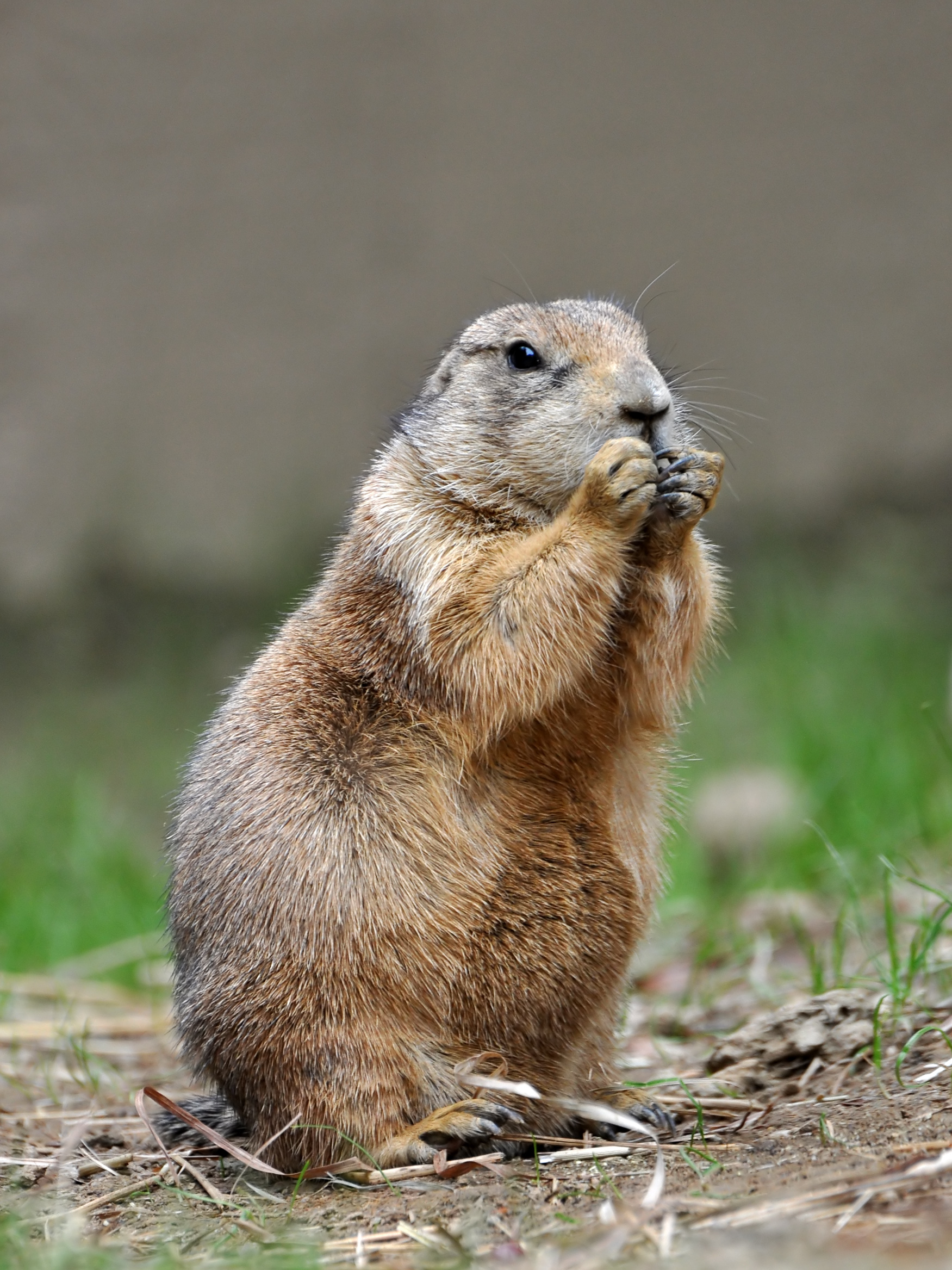
The Black-tailed Prairie Dog (Cynomys ludovicianus) is a medium-small rodent of the Sciuridae (squirrel) family, endemic to the Great Plains of North America. Its name derives from its alarm call, reminiscent of a dog's bark, and is a literal translation of the Lakota ("píŋspíŋza"), Cheyenne and Crow indigenous names for the species. It is obviously not a canid: it is a rodent closely related to marmots and squirrels. It is famous for being one of the most social animals in the world: it lives in underground colonies called "towns" or "coteries" (family clans), which can contain up to millions of individuals distributed over dozens of km² of prairie. A historical colony in western Texas, recorded in 1900, covered 65,000 km² (larger than Ireland) and hosted about 400 million prairie dogs. The species is also famous for its incredibly sophisticated vocal language: studies by Professor Constantine Slobodchikoff (Northern Arizona University) have shown that the prairie dog possesses one of the most complex animal communication systems ever documented, with specific "words" to describe predators (fox, wolf, hawk, human), colours, sizes, even the shirt a person is wearing.
Classification and category
The Prairie Dog belongs to the order Rodentia, family Sciuridae (squirrels and marmots), tribe Marmotini, genus Cynomys. The genus comprises 5 all-North American species: C. ludovicianus (Black-tailed, the most common and widespread), C. gunnisoni (Gunnison's), C. leucurus (White-tailed), C. mexicanus (Mexican, critically endangered), C. parvidens (Utah, threatened). The genus name derives from the Greek "kynos" (dog) and "mys" (mouse). The species C. ludovicianus was scientifically described by George Ord in 1815, based on specimens collected by the Lewis and Clark expedition that crossed the Great Plains between 1804 and 1806. Adult dimensions: length 28-40 cm (of which tail 3-12 cm), weight 700-1,500 g in males, 600-1,000 g in females. Longevity is 3-5 years in the wild (high predation mortality) and up to 8-9 years in captivity.
Habitat and distribution
The habitat of the Prairie Dog is the shortgrass prairie and mixed-grass of the North American Great Plains. It prefers flat or slightly undulating terrain, with low grass (for ample visibility of predators), compact or clayey soils easy to dig, drained. It lives in very elaborate underground colonies (see behaviour section). Historical distribution covered 518,000 km² of prairies in central USA, from Canada to Mexico (today the states of Montana, Wyoming, South Dakota, Nebraska, Colorado, Kansas, Oklahoma, Texas, New Mexico). Today the distribution is reduced by 98% compared to the past due to the conversion of prairies into agricultural land and systematic extermination promoted by the American and Canadian governments between 1900 and 1970 (poisoning campaigns, considered harmful to livestock).
The current population is estimated at 10-20 million specimens (vs 5 billion in 1900), distributed in isolated colonies. IUCN conservation status is Least Concern (LC) globally for the still high presence, but with declining trends in many regions. The species is considered a "keystone species" of the prairie ecosystem: its burrows are used by burrowing owls (Athene cunicularia), snakes, black-footed ferrets (Mustela nigripes — specialised predator, now critically endangered due to the decline of prairie dogs), American badgers, wild rabbits. The destruction of colonies has caused the collapse of the entire prairie ecosystem. Reintroduction and protection programmes are active (American Prairie Foundation, World Wildlife Fund, Defenders of Wildlife). The "black-footed ferret" — North America's rarest mammal — exists only thanks to prairie dog conservation.
Diet
The Prairie Dog is a herbivore, mainly granivorous and foliivorous. The diet includes grasses (prairie grasses: Bouteloua, Buchloe, Stipa), seeds of various plants, roots, bulbs, tubers, flowers, green leaves. It occasionally supplements with insects (grasshoppers, ants), but it is a marginal behaviour (perhaps to integrate protein). Prairie dogs actively modify the vegetation around the colonies: they cut the tall grass to improve visibility (reduce predation) and this favours the growth of grasses and plants of superior nutritional value (effect called "pastoralism by prairie dogs"). A colony has measurable effects on the landscape for hundreds of meters around.
Food requirements are 50-90 g of vegetation per day for an adult. They do not drink directly: they get all the water from food (fresh plants contain 80% water), an adaptation to prairies where water sources are rare. In winter, when snow covers the vegetation, the Black-tailed Prairie Dog does not enter true hibernation (unlike the other species of the genus that hibernate): it goes out only on warm days, lives mainly on the food deposits accumulated in underground burrows in autumn, and plugs with earth the burrows to conserve heat. This is one of their most important adaptations: the only species of the genus that does not hibernate completely. Food supplies are hidden in specific chambers of the burrow ("pantry chambers"), separate from the resting chambers and latrines — prairie dogs maintain rigorous underground hygiene.
Physical features
The Black-tailed Prairie Dog has a stocky, robust body, well adapted to underground life. The total length is 28-40 cm, of which the short tail 3-12 cm — diagnostic feature of the species: tip black at the end (hence the name), which distinguishes this species from others of the genus (the White-tailed has a white tip). The weight of adult males is 700-1,500 g (record 1.5 kg in autumn), of females 600-1,000 g — modest sexual dimorphism. The body is spindle-shaped, with robust thorax, slightly arched back, flat belly. The front legs are equipped with 4 long fingers with strong, curved claws, suitable for digging; the rear legs have 5 toes.
The coat is fulvous-brown uniformly on the back, with red-cinnamon reflections in summer (due to the sun) and more grey-brown in winter. The belly is lighter, yellowish-white. The ears are small, rounded, sparsely furred. The eyes are large, dark, positioned laterally for ample panoramic vision (180° per eye, total vision ~360°) — vital adaptation to detect predators. Vision is excellent: they distinguish colours (trichromatic vision, rare in non-primate mammals), shapes, movements at 1 km away. The head is wide, with incisor teeth typical of rodents: 4 large incisors (2 upper, 2 lower) of orange colour due to iron deposit that reinforces them, with continuous growth. They must be worn by gnawing roots and hard seeds. The nose is black and moist, with well-developed sense of smell to recognise conspecifics (each individual has a distinctive smell). The anal glands produce secretions for territorial marking.
Behaviour and curiosities
The Prairie Dog is a diurnal, strongly social, gregarious, underground animal. Its society is organised in "coteries" (family clans) of 2-30 individuals, composed of: 1 dominant adult male (alpha), 2-4 related adult females, 4-12 young (pups and sub-adults). Coteries occupy territories of 0.1-1 ha within a larger colony ("town"), which can contain hundreds of coteries. Prairie dog cities are real "underground apartment buildings": the tunnel system can be up to 30 m long, 3-5 m deep, with multiple specialised chambers (nursery, dormitory, pantry, latrines, sentinel chamber). Each entrance is surrounded by a cone of excavated earth 30-50 cm high (to prevent flooding during rain and improve ventilation).
Social relationships are complex: coterie members recognise each other with the characteristic "kissing" (they touch teeth and sniff each other's mouth to identify themselves through the unique oral microflora). They practise social grooming, sleep in piles (sleep piles), and cooperate in defence. Communication is the most surprising feature: according to research by Constantine N. Slobodchikoff and collaborators (Northern Arizona University), prairie dogs have one of the most complex animal communication systems documented. They possess specific "words" (different calls) for: different predators (fox vs wolf vs hawk vs snake vs human vs dog); predator characteristics (fur colour, size, shape, speed); objects (the human with red shirt vs blue shirt — experimentally recorded); direction and distance. Their vocabulary is estimated at 50-100 distinguishable "words", a rudimentary syntax, and an incredible ability to create new words for objects never seen. When a prairie dog spots a predator, it emits a specific call (at 2-30 kHz, audible by humans as "yip-yap"), and all conspecifics in the vicinity: rise on their hind legs, check the indicated direction, hide in tunnels if necessary. All this in 1-2 seconds.
Ethological curiosities: the "jump-yip" is a spectacular behaviour unique to prairie dogs — an individual jumps on hind legs with the head facing upwards and the forelegs pushed towards the sky, while emitting a characteristic "yip!". When an individual does the jump-yip, conspecifics in the vicinity do the same, creating a wave of jumps that propagates in the colony (wave effect). It was thought to be an "all-clear" call (safety signal), but recent studies classify it as a vigilance test: the individual checks if its neighbours are attentive — if they are not, it is a signal to be on guard. Reproductive curiosity: the breeding season is short, in March-April. The female is in oestrus only 1 day a year and only 1 hour of that day. Gestation lasts 33-38 days; the female gives birth to 1 litter per year of 3-8 pups, in spring. The pups are born naked, blind, and completely dependent. They are raised in the tunnel nursery, going out for the first time at 6 weeks. The dominant female of the coterie practises infanticide: sometimes it kills and eats the pups of other females during rearing (5-10% of litters are destroyed this way). Adopted or surviving pups have a 50% mortality in the first year (predators, hunger, social conflicts). Health curiosity: prairie dogs are the main natural reservoir of wild bubonic plague in the USA. Plague outbreaks in colonies can kill 95-99% of individuals in a few weeks. Plague arrived in the USA from Asia in 1900 and from 1947 spread west of America. It is an important factor in the species' decline.
Pros
- Ipersociale: vive in colonie di milioni (record 400 milioni!)
- Linguaggio animale tra i più complessi al mondo (50-100 'parole')
- Specie chiave dell'ecosistema prateria americana
- Unica del genere a non andare in vero letargo
Cons
- Specie selvatica: detenzione vietata in EU e in molti stati USA
- Portatore di peste bubbonica (focolai del 95-99% mortalità)
- In declino: 98% di habitat perduto (1900-oggi)
- Furettario per zoonosi: rabbia, tularemia, monkeypox umano (2003)