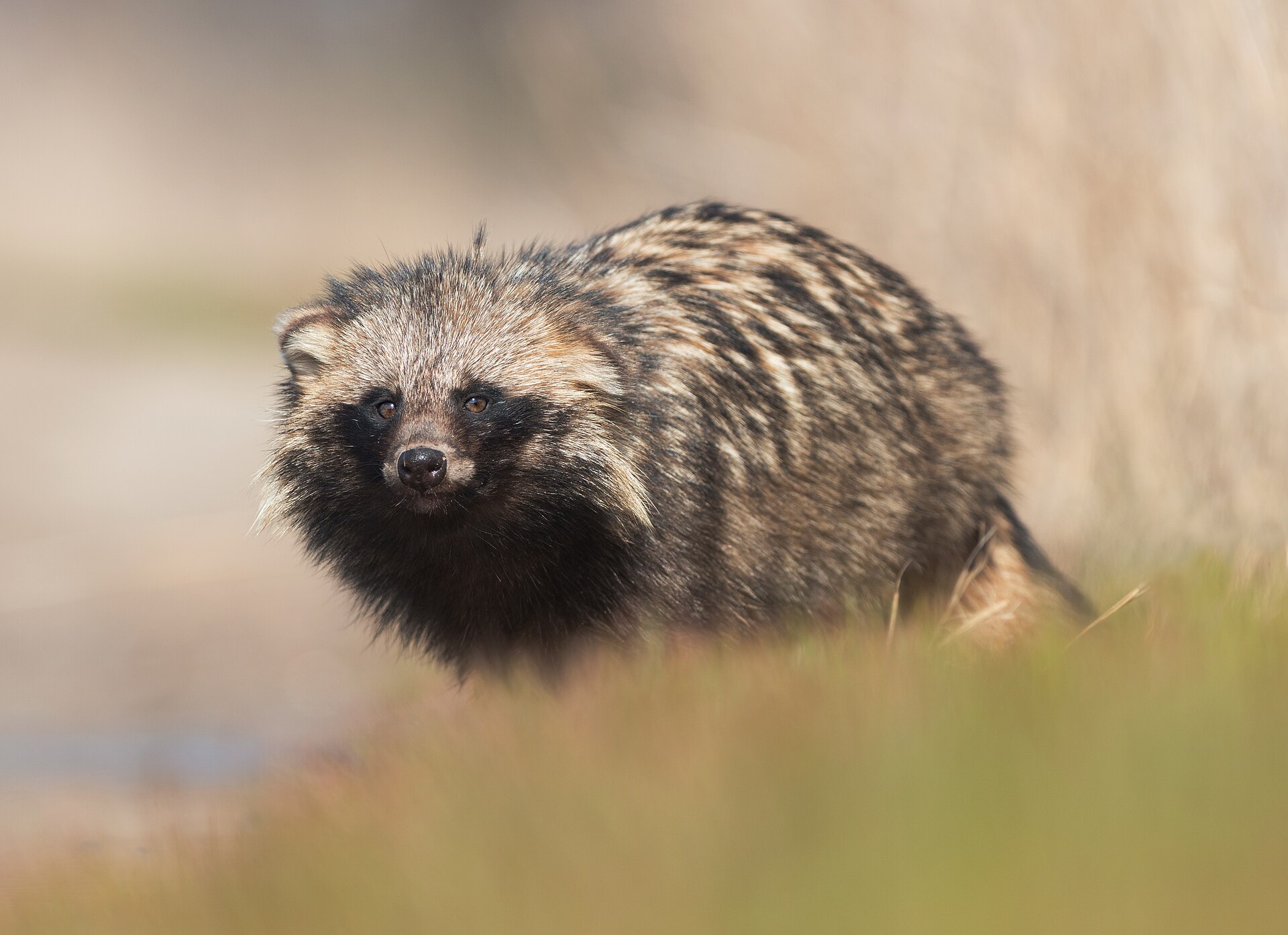
Raccoon Dog (Tanuki)
Nyctereutes procyonoides
Characteristics
Temperament
Crepuscular/nocturnal, monogamous, retiring and non-aggressive. The ONLY CANID IN THE WORLD that hibernates in winter (fattens up in autumn). Looks like a raccoon (black mask) but is a true dog (convergent evolution). Generalist omnivore, excellent swimmer, can climb trees. Does NOT bark (mews and whines). Pairs stay together for life. Feigns death when threatened (thanatosis). The lucky "tanuki" of Japanese folklore. Invasive in Europe.
Diet
Extremely generalist omnivore. Small mammals (rodents), amphibians and reptiles (frogs, lizards, snakes — fond of frogs), fish and aquatic invertebrates (hunts in water), insects, birds and eggs, fruit and berries (key in autumn for fattening), seeds, acorns, carrion and refuse (opportunist). Often forages in pairs. The flexible diet is the key to its success as an invader.
The Raccoon Dog (Nyctereutes procyonoides), known in Japan as "tanuki", is a wild canid unique in the world, native to East Asia. Famous for:
- THE ONLY CANID THAT HIBERNATES! In cold parts of its range it accumulates fat in autumn and enters winter torpor (partial hibernation) — behaviour UNIQUE among all the world's canids!
- Looks like a raccoon but is a true dog: has the raccoon's black facial mask but is a genuine canid (Canidae) — a case of convergent evolution
- The "tanuki" of Japanese folklore: a playful, lucky shapeshifting spirit (yokai) whose pot-bellied statues decorate restaurants and bars in Japan
- Generalist omnivore: eats almost anything (rodents, frogs, fish, insects, fruit, berries, carrion)
- Monogamous: pairs stay together and the male helps raise the pups
- Swims and climbs: one of the few canids that climb trees
- Doesn't bark: makes mews, whines and growls instead
IUCN status: Least Concern (LC) in its native range. However, it is an invasive species in Europe, spreading west after introductions in Russia, and is considered problematic (vector of rabies and echinococcus).
Classification and category
Order Carnivora, family Canidae, genus Nyctereutes. A "basal" canid — an ancient, distinct branch of the dog family tree, not closely related to wolves/dogs or true foxes. Genus Nyctereutes: 2 recognized species (N. procyonoides this entry; N. viverrinus, the Japanese tanuki, often now a separate species). Etymology: "Nyctereutes" Greek "night hunter"; "procyonoides" means "raccoon-like" (Procyon = raccoon genus) for its convergent look. It is NOT a raccoon (family Procyonidae) — a true canid that merely resembles one. Shows primitive traits: hibernation, large litters, reduced sexual dimorphism, non-barking voice. Parameters: Body 50-70 cm. Tail 15-25 cm. Weight 4-10 kg (up to 12 in autumn before hibernation). Longevity 7-11 years. Monogamous, gestation ~60-65 days, very large litters (6-8, up to 16!).
Habitat and distribution
Native (East Asia): Japan, Korea, eastern China, SE Siberia, Mongolia, N Vietnam. Introduced (Europe): brought to European Russia for the fur industry (1920s-50s), spread west to Finland, Poland, Germany, Scandinavia, Central Europe — now invasive. Habitats: deciduous/mixed forests with dense undergrowth (ideal), wetlands (marshes, river/lake banks — loves water), scrub and reedbeds, farmland and peri-urban areas (very adaptable). Prefers water and dense cover. The only canid that uses dens for winter hibernation: in cold regions accumulates large fat reserves in autumn and spends the harshest months in torpor (not deep hibernation like marmots — can wake on mild days); in warmer regions (parts of Japan) stays active year-round. IUCN: Least Concern (native); strongly expanding invasive in Europe.
Diet
Extremely generalist omnivore — one of the most varied diets among canids: small mammals (rodents, shrews, moles), amphibians and reptiles (frogs, toads, lizards, snakes — fond of frogs!), fish and aquatic invertebrates (catches in water — swims well), insects (beetles, larvae), birds and eggs (ground nests), fruit and berries (key in autumn for fattening), seeds/acorns/roots, carrion and refuse (opportunist near humans). Strategy: opportunistic seasonal foraging, hunts in water (unlike many canids), autumn fattening on fruit/berries for hibernation, often forages in pairs. This flexible diet underpins its success as an invasive species.
Physical features
Unmistakable stocky "raccoon-like" look. Coat: brown-grey/fulvous with black guard hairs, BLACK FACIAL MASK around eyes and cheeks (identical to raccoon — convergence), very dense long fur especially in winter (farmed for fur as "tanuki"/"finn raccoon"), puffed rounded appearance. Body: stocky and low (robust trunk, short legs — unlike the slender wolf/fox silhouette), pointed canid muzzle, small rounded ears barely protruding from the fur, bushy tail (relatively short, no raccoon rings). Physiology: winter hibernation/torpor (UNIQUE among canids), excellent swimmer (hunts in water), able to climb trees (rare among canids), does NOT bark (mews, whines, growls, yelps), reduced sexual dimorphism.
Behaviour and curiosities
Crepuscular/nocturnal, monogamous, retiring. Lives in stable pairs defending a territory; shy and non-aggressive — when threatened tends to freeze or feign death rather than fight or flee. Strong monogamy: pairs stay together for life and cooperate, the male actively raising pups (brings food, guards). Huge litters (6-8, up to 16), among the largest in canids.
Famous: winter hibernation — the ONLY canid in the world to enter winter torpor. In cold regions it eats voraciously in autumn to add up to 50% of body weight in fat, then dens up and sleeps through the harshest months, lowering metabolism and body temperature (not deep like marmots — can wake on mild days). All other canids stay active all winter. "Tanuki" folklore: in Japan the tanuki is a beloved playful, lucky shapeshifting yokai; its pot-bellied statues (straw hat, sake bottle) stand outside restaurants and shops for good fortune (famous in Ghibli's "Pom Poko"). "Plays dead": when cornered it performs thanatosis (the "tanuki sleep"). "Convergence with raccoon": unrelated to the raccoon (Procyon lotor) but strikingly similar (mask, stocky body, omnivory, water habits) — classic convergent evolution. "Doesn't bark": mews and whines (a primitive trait). Fur: heavily farmed ("finn raccoon"). Invasive in Europe: introduced via Russia, now one of Europe's worst invasive species (rabies/echinococcus reservoir). Pair life: monogamous pairs hibernate together, curled up to keep warm.
Pros
- Unico canide al mondo che va in letargo — straordinario
- Monogamo fedele, padre molto presente coi cuccioli
- Icona culturale del Giappone (tanuki portafortuna)
- IUCN Least Concern nell'areale nativo
Cons
- Specie invasiva problematica in Europa
- Vettore di rabbia ed echinococco
- Sfruttato dall'industria delle pellicce
- Non è un animale domestico (canide selvatico)