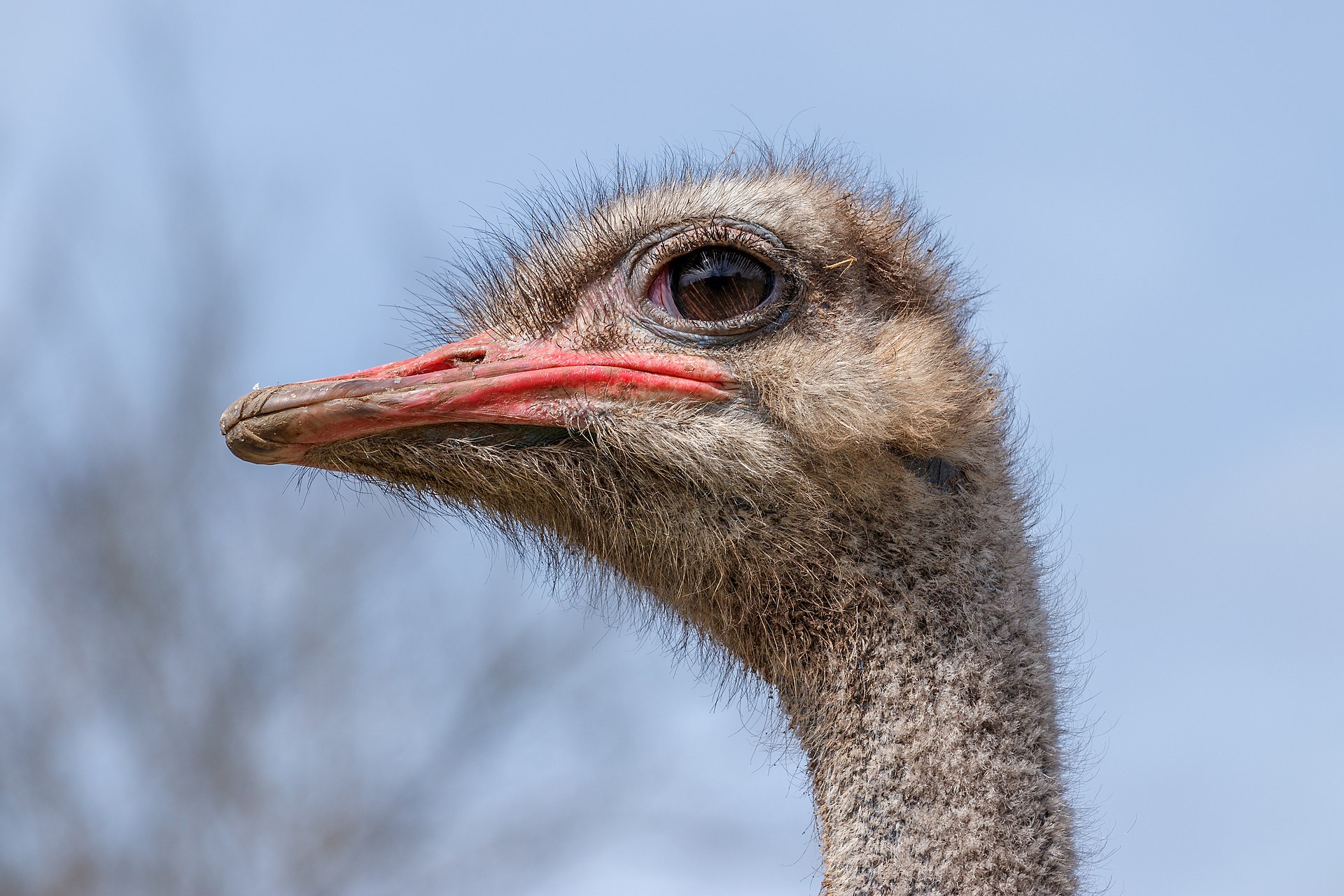
African Ostrich
Struthio camelus
Characteristics
Temperament
Diurnal, social, gregarious, polygamous. Largest living bird. Fastest terrestrial bird (70 km/h sustained). Delivers kicks at 2,000 N (can kill lions). Parents share incubation (M night, F day). "Head in sand" myth false.
Diet
Generalist omnivore (60-80% vegetable): grasses, leaves, seeds, fruit + insects, lizards, small snakes. Ingests 1 kg of gastroliths (stones) to grind food. Survives 2 weeks without drinking. Need 3-4 kg/day.
The African Ostrich (Struthio camelus) is the world's largest living bird, reaching a height of 2.1-2.8 metres and a weight of 100-150 kg (record 156.8 kg). Native to the savannas and deserts of Africa, it is the fastest terrestrial bird with sustained peaks of 70 km/h for 30 minutes — faster than a racehorse. Although it is a bird, it is completely flightless: the skeleton does not possess a sternal keel (for flight muscles); the wings, reduced, are used for balance, courtship and thermoregulation. The ostrich lays the largest eggs of the living animal kingdom (15-20 cm long, 1.4-2 kg in weight — equivalent to 24 chicken eggs). Its kicks, delivered with legs equipped with a large central claw, have a force capable of killing a lion. The ostrich is also famous for the myth of "putting its head in the sand" (in reality, it never does: it is a popular legend born from misunderstandings) and for eyelashes longer than any terrestrial bird. The global IUCN conservation status is Least Concern (LC), but some subspecies are in decline.
Classification and category
The Ostrich belongs to the order Struthioniformes (in the past also called Palaeognathae in the broad sense), family Struthionidae, genus Struthio. The genus comprises 2 living species: S. camelus (Common/African Ostrich) and S. molybdophanes (Somali Ostrich, recognised as a distinct species since 2014). The species was scientifically described by Linnaeus in 1758 with its current name. The scientific name derives from the Greek "στρουθιοκάμηλος" (struthiokámēlos) which literally means "sparrow-camel" — reference to the resemblance of the long neck and legs to a camel, and to its still being a bird (a large "sparrow" in ancient Greek).
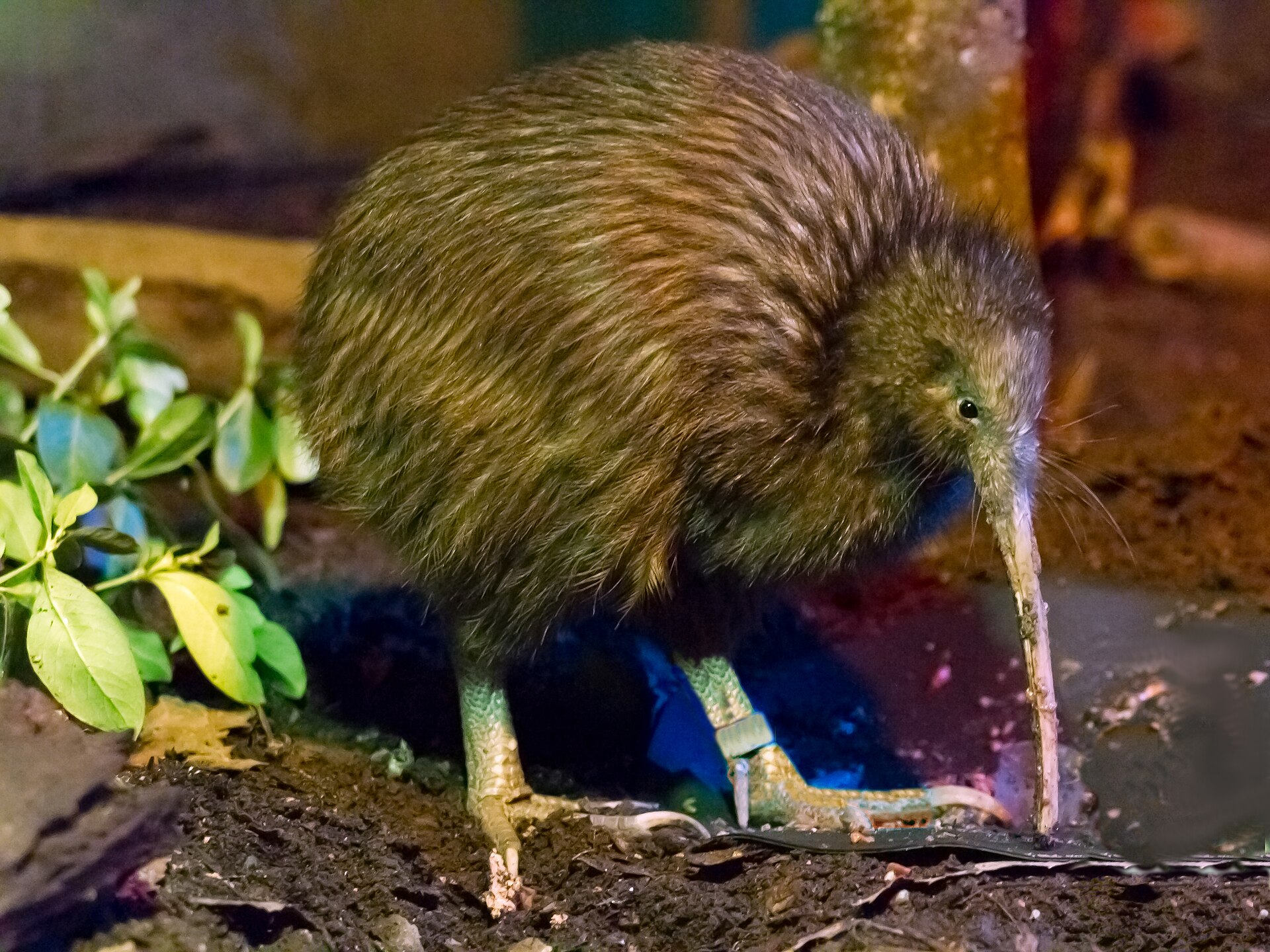
The ostrich belongs to the subgroup of ratites (Palaeognathae), flightless birds characterised by the absence of a sternal keel: it includes emus, cassowaries, kiwis, rheas, and extinct species such as the Madagascar elephant bird and the New Zealand moas. The ostrich is the largest of all ratites. The currently recognised subspecies of S. camelus are: S. c. camelus (North African of the Sahel), S. c. massaicus (Masai), S. c. syriacus (Syrian — extinct since 1966), S. c. australis (South African). The size records are: adult male 2.1-2.8 m, weight 90-150 kg (record 156.8 kg); female 1.8-2.2 m, weight 90-110 kg. Longevity is 40-50 years in nature, up to 62 years in captivity documented.
Habitat and distribution
The habitat of the African Ostrich consists of semi-arid savannas, steppes, deserts, semi-deserts, wooded grasslands. It tolerates extreme environments: from the southern Sahara at +50°C to the Ethiopian mountains at -10°C. It prefers open spaces with good visibility at great distance to detect predators and with sparse vegetation that could hide ambushes. It is extremely adapted to arid conditions: it can survive without drinking for weeks, obtaining water from food and lipid metabolism.
The current distribution of the ostrich is fragmented in Sub-Saharan Africa: main populations in South Africa, Namibia, Botswana, Zimbabwe, Mozambique, Kenya, Tanzania, Ethiopia, Sudan, Chad. Historically the species was also widespread in North Africa (today only small relicts in Mauritania and Niger) and in the Arabian Peninsula/Syria (subspecies syriacus, extinct in 1966 — the last specimen was killed in the Syrian desert). The global IUCN conservation status is Least Concern (LC): the total population is estimated at 150,000-200,000 wild specimens, of which over 50% in South Africa. The species is subject to intensive commercial breeding in South Africa, USA, Australia, Israel, Romania: the world breeding population is 2-3 million individuals, raised for: meat (red, lean, similar to beef, rich in protein), leather (for fine leather goods), feathers (for ceremonial plumes, decoration, industrial dusters), eggs. Current threats to wild populations are: habitat loss for agriculture and livestock, hunting for meat and feathers (illegal in many countries), conflicts with livestock breeders (ostriches do not damage livestock, but are killed for unfounded retaliation), sport hunting in some Southern African countries.
Diet
The African Ostrich is a generalist omnivore with a predominantly herbivorous diet (60-80% vegetable). It feeds on plants: grasses, leaves, flowers, seeds, fruit, roots, bulbs. It also eats small animals: insects (grasshoppers, ants), lizards, small snakes, rodents, and other invertebrates. Unique feature: not having teeth, the ostrich ingests small stones (gastroliths) — up to 1 kg of stones in the crop and gizzard — which serve to mechanically grind food in the muscular stomach (gizzard). Documented research by paleontologists has found gastroliths of 200+ g in some adult ostriches.
The ostrich is exceptionally adapted to arid conditions: it can survive up to 2 weeks without drinking, obtaining water from moist food (vegetable juice) and from the metabolism of accumulated lipids. Its urine is very concentrated; salts are expelled through specialised nasal glands. The digestive capacity is exceptional: the digestive system is 14 m long, with an enlargement called "proventricular ventricle" that acts as a fermentative rumen (like in ruminant herbivores). Symbiotic bacteria break down cellulose producing nutritious volatile fatty acids. An adult's food requirement is 3-4 kg of food per day. Water consumption in captivity is 5-15 L/day if accessible. The ostrich also eats its own chicks' faeces (parental coprophagy): a practice that acquires useful intestinal bacteria and which adult females use to teach the chicks which foods are safe.
Physical features
The African Ostrich is characterised by exceptional dimensions: height 2.1-2.8 m, weight 90-150 kg in males, 90-110 kg in females. The body is compact, massive, supported by very long and powerful legs. The neck is extraordinarily long (1.1-1.3 m), thin, mobile in all directions. The head is small in proportion to the body, with a flat, broad beak, of horny colour. The eyelids are equipped with very long eyelashes (up to 6 cm) — the longest of any terrestrial bird — that protect the eyes from dust and sun. The eyes are enormous (5 cm in diameter, the largest among terrestrial vertebrates), with exceptional visual acuity: the ostrich detects predators at 4-5 km away.
The legs are the most impressive feature: long, dry, muscular. The ostrich is the only bird with only 2 toes per foot (other birds have 3 or 4); the inner toe has a large claw 10 cm long, blade-like. The ostrich's kicks, delivered with this claw, have a measured force of 2,000 newtons (200 kg) and can kill a lion. The running speed is 50-70 km/h sustained for 30 minutes, with peaks of 72 km/h (measured record) — the fastest bipedal terrestrial animal in the world. The stride is wide (3.5 metres per stride). The wings are reduced (length 80 cm), composed of soft and decorative feathers; they do not serve for flight but for: balance in curves at high speed, sexual display, thermoregulation (by raising them they expose bare skin to dissipate heat). The plumage of adults is dimorphic: males black with white feathers on the tail and wings; females uniform grey-brown (mimetic for brooding). The plumage is not waterproof (ostriches do not swim). The bare skin of the neck, head and thighs is pink-red (mating males) or grey (females, young). Chicks at birth weigh 1-1.5 kg, are covered with mimetic striped down (snake camouflage to discourage predators).
Behaviour and curiosities
The African Ostrich is a diurnal, social, gregarious animal. It lives in groups of 5-50 individuals called "flocks": mixed composition of adult and young males and females. In nesting season the groups fragment into "polygamous families": 1 dominant male (alpha) controls a harem of 2-6 females. The ostrich is therefore polygynandrous: alpha males mate with multiple females, and subordinate females lay eggs in a common nest with the dominant female. The courtship dances are spectacular: the male crouches, opens its wings, sways its neck and blinks its eyelids rapidly, showing the contrasting black-white plumage and the pink skin of the neck.
The nest is a simple depression in the sand 3 metres in diameter, dug by the male. The dominant female lays 5-10 eggs; subordinate females add their own in the common nest (up to 40-60 total eggs). The eggs are the absolute record of living birds: 15-20 cm in length, 1.4-2 kg in weight, equivalent to 24-30 chicken eggs. They have a 2 mm thick shell, ivory-coloured. Incubation lasts 42-46 days; it is practised by both parents in turn: male at night (camouflage with darkness thanks to the black plumage), female by day (camouflage with sand thanks to the grey-brown plumage). The chicks emerge already feathered and mobile (precocial); at 1 month they weigh 3-4 kg and at 12 months 45 kg, reaching adult dimensions at 2-3 years. Sexual maturity is at 3-4 years. Families with multiple chicks (even from different females) are called "crèches" (nurseries): they can contain up to 200-300 chicks under the supervision of few adults, a rare phenomenon in the animal kingdom.
Famous ethological and cultural curiosities: the "head in the sand myth" is false: the ostrich does NOT hide its head in the sand to "not see the danger". The myth dates back to Pliny the Elder (Naturalis Historia, 1st century AD) who reported it as superstition. The reality: the ostrich lowers its head to the ground when: (1) it is looking for food, (2) it is turning the eggs in the nest, (3) it flattens itself to camouflage making itself appear from afar like a bush. From a distance it may seem that "it puts its head in the sand", but it never does. Scientific curiosity: ostriches sing! They produce powerful low-frequency resonant booms (10-30 Hz) audible at 4 km, produced by inflating an air sac in the neck — similar to a lion's roar, and initially confused with it. Record curiosity: the ostrich egg is the largest single egg of living birds (it was surpassed only by the eggs of the extinct Aepyornis of Madagascar, up to 2 kg per egg, 33 cm). Historical curiosity: the ancient Egyptians considered the ostrich sacred to Ma'at, the goddess of justice, and used an ostrich feather in the ceremony of weighing the soul. Ethological curiosity: the "strarchitect effect": the ostrich is considered one of the dumbest birds in the world by popular myth but actually has a relatively small brain (40 g, less than its eyes which weigh 60 g) and relatively simple behaviours; however, it manages to find food in deserts where mammals die. Sports curiosity: ostrich racing is a traditional practice in South Africa, where jockeys ride domestic ostriches in 1 km races. Dangerous sport: frightened ostriches are unpredictable and kicks can be fatal. Food curiosity: from the 18th century it has been cultivated in captivity; in South Africa an important agricultural sector has emerged (Oudtshoorn = "Ostrich Capital"), with tourist races, breeding, ostrich meat dietary products (high protein content, low fat). Anatomical curiosity: the ostrich is one of the few birds with a visible external erectile phallus (present in males); 97% of birds have no external penis.
Pros
- Più grande uccello vivente del mondo (record 2,8 m e 157 kg)
- Uccello terrestre più veloce (record 72 km/h)
- Depone l'uovo più grande del regno animale vivente (2 kg)
- Longevità eccellente (40-50 anni, 62 in cattività)
Cons
- Specie selvatica e pericolosa: calci possono uccidere (2.000 N)
- Detenzione richiede permessi e ampi spazi (recinti 1+ ha)
- In declino in alcune zone (caccia, perdita habitat)
- Sottospecie syriacus estinta nel 1966