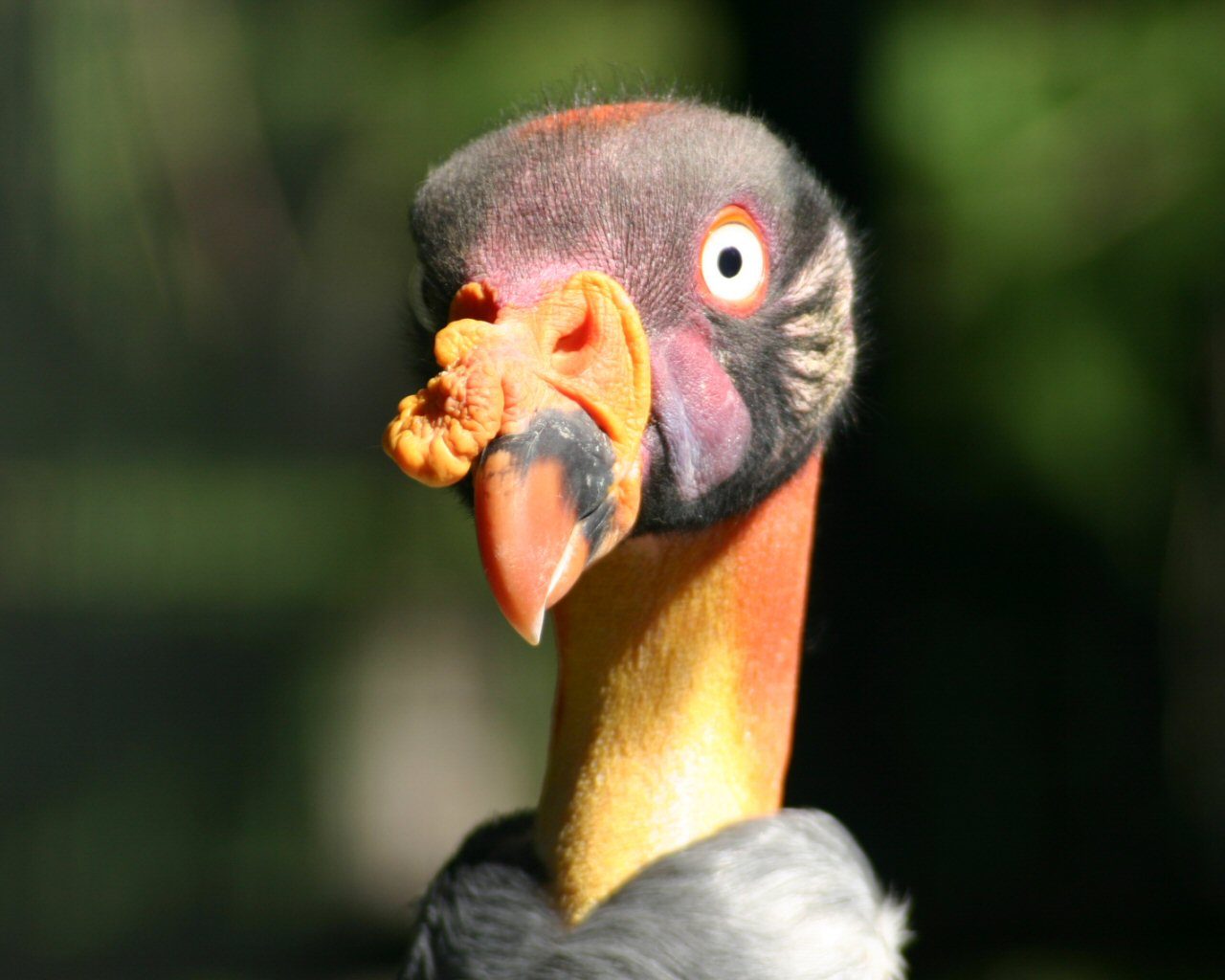
King vulture
Sarcoramphus papa
The king vulture is the most colourful of the New World vultures: a large scavenger of American tropical forests, with a vividly coloured bare head.
Characteristics
Temperament
Solitary and dominant at carcasses; soars high.
Diet
Scavenger: carcasses of animals of all sizes.
The king of American vultures
The king vulture (Sarcoramphus papa) is one of the most striking of the New World vultures and the only living species of the genus Sarcoramphus. Its body, 71–81 cm long with a wingspan of nearly two metres, has cream-white plumage with black wings and tail and a distinctive grey collar. Its head and neck are bare and gaudy — orange, yellow, red and purple — with white eyes and a prominent fleshy caruncle on the bill. It weighs between 2.7 and 4.5 kg.
Habitat and range
It lives in tropical lowland forests of Central and South America, from southern Mexico to northern Argentina. It soars high over the forest canopy in search of carcasses, but also frequents savannahs and open areas next to the forest.
Behaviour and diet
It is a scavenger, feeding on animal carcasses and playing a key ecological role in cleaning up the environment. With its powerful bill it is often the first to tear open the tough hide of large dead animals, opening the carcass for smaller vultures too. Thanks to its size and strength, it dominates other American vultures at food — hence the name "king".
Did you know?
Unlike Old World vultures, New World vultures such as this one have an excellent sense of smell as well as keen sight for finding food. It appears in many Mesoamerican codices and myths. In captivity it may live around thirty years.
Conservation
The IUCN lists it as Least Concern, but deforestation and a decline in prey are growing pressures across much of its range.
Pros
- The most colourful of the New World vultures
- A key ecological role in cleaning the environment
- Least Concern, still widespread
Cons
- Locally threatened by deforestation
- Depends on the availability of carcasses
- Slow breeding, a single egg per clutch