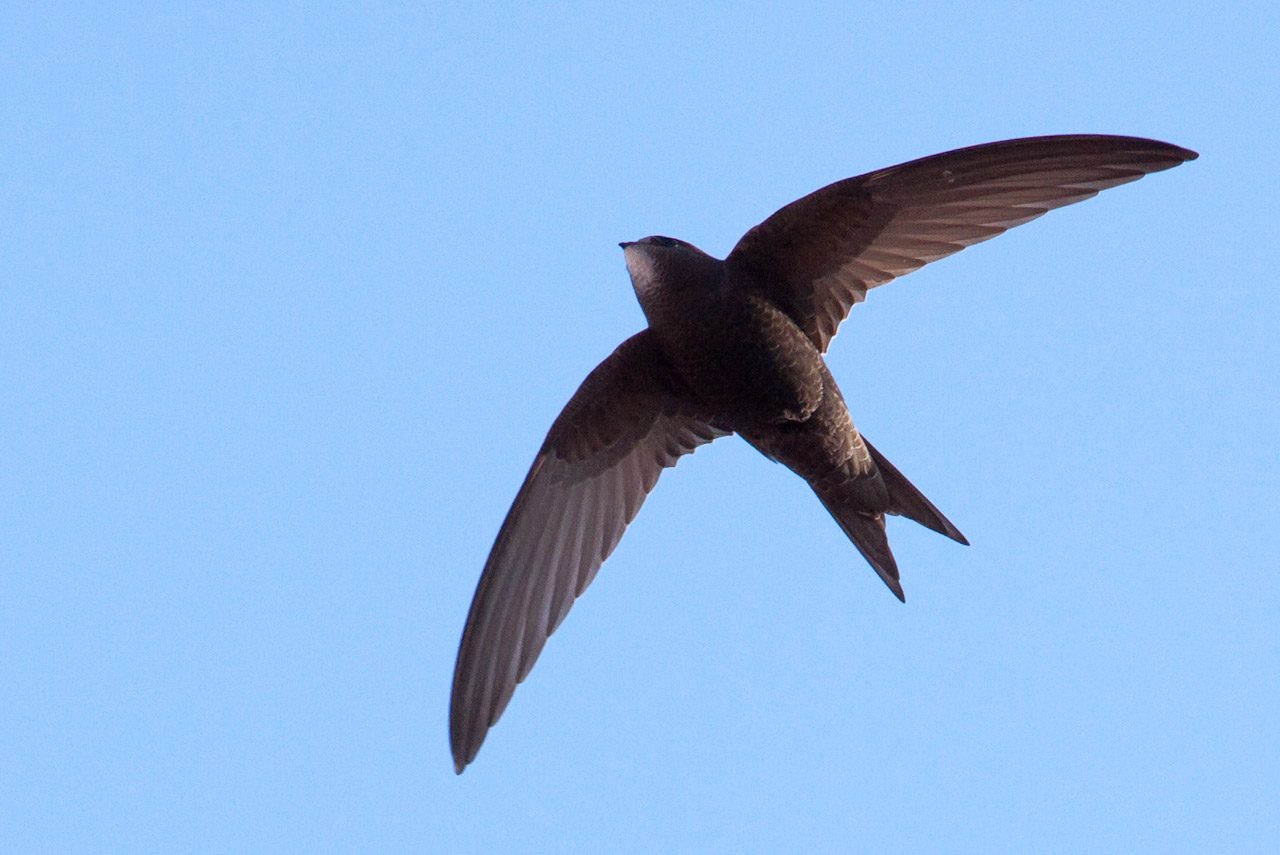
Photo: pau.artigas · CC BY-SA 2.0
Common swift
Apus apus
The common swift is a migratory bird with an extraordinary aerial life: it eats, sleeps and mates on the wing, landing only to nest.
Characteristics
Temperament
Aerial, migratory, gregarious
Diet
Insectivore: small flying insects
Description
The common swift is a medium-sized bird with uniform blackish-brown plumage and a paler throat. It superficially resembles swallows but is not related to them: the likeness is due to convergent evolution. It has long, narrow, sickle-shaped wings, a streamlined body and tiny feet, poorly suited to perching. In flight its silhouette recalls a small scythe.
Habitat and distribution
It breeds across much of Eurasia and winters in sub-Saharan Africa. It is closely tied to urban environments, where it nests in cavities of buildings, lofts and old walls. In summer it fills city skies with its acrobatic flights and characteristic screams.
Behaviour and flight
It is the most aerial bird there is: it spends almost its whole life on the wing. It eats, drinks, gathers nest material, sleeps and even mates in the air. A young swift, after leaving the nest, can stay in flight uninterrupted for many months, until its first breeding. It feeds exclusively on small flying insects, the so-called 'aerial plankton'.
Did you know?
To sleep, the swift climbs to high altitude and glides in a kind of half-brain sleep. Its very short feet give it the scientific name Apus, meaning 'footless': it cannot walk, only cling to vertical surfaces.
Conservation
It is classed as least concern, but in many cities it is declining due to building renovation, which removes the cavities where it nests. Putting up special nest boxes helps to conserve its urban populations.
(Note: the mass value given by Wikidata, 3.5 kg, is clearly wrong: the swift actually weighs about 36–50 grams.)
Pros
- Life almost entirely on the wing, unique in the world
- Valuable controller of flying insects
- Long-lived, can exceed fifteen years
Cons
- Declining through loss of cavities in buildings
- A migrant, present only a few months a year
- Cannot walk, depends on vertical surfaces