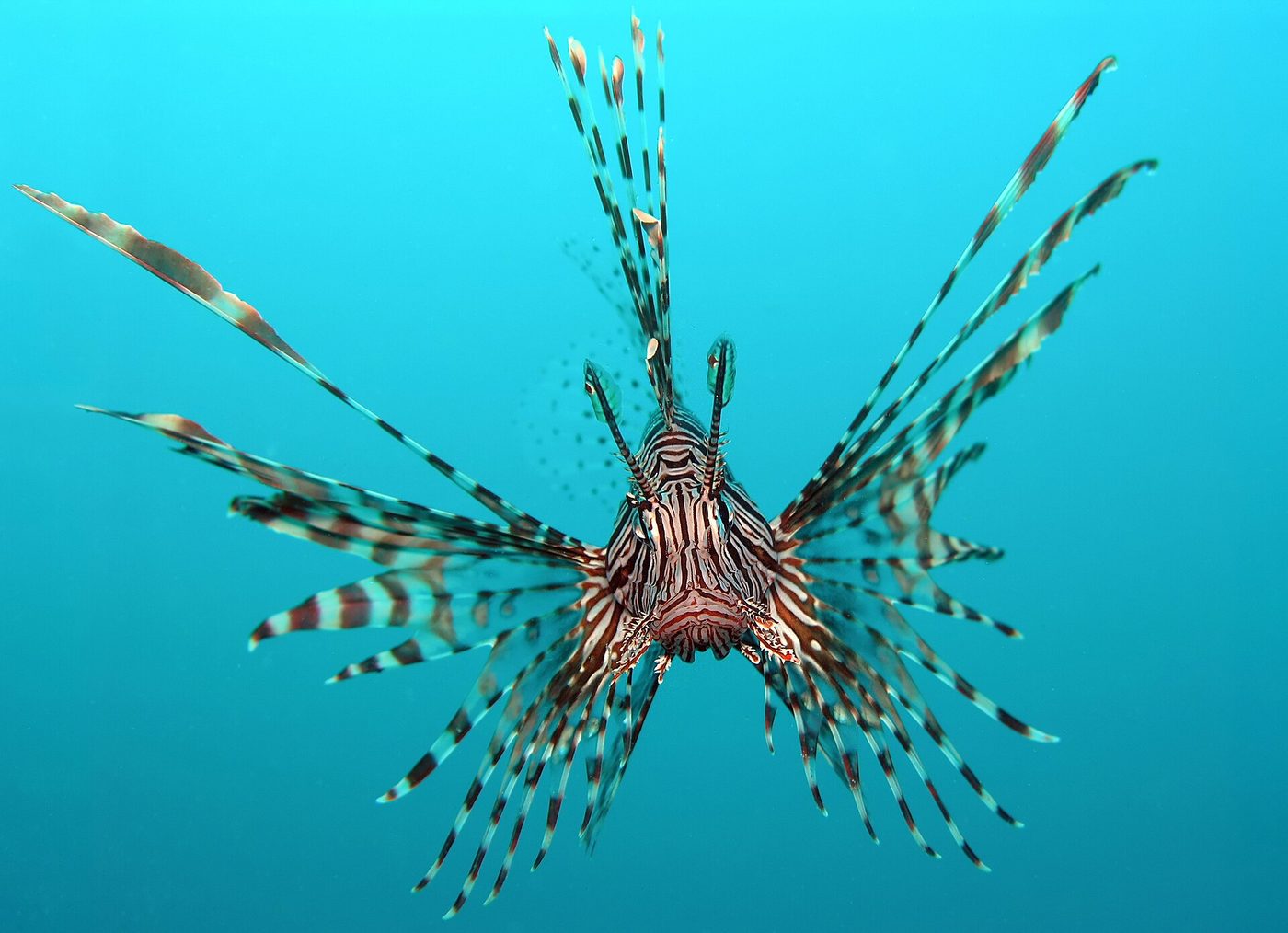
Photo: Photo by Jens Petersen, Edited by User:Olegiwit (cloned in part of fins) and Fir0002 (removed spots and noise) · CC BY 2.5
Red lionfish
Pterois volitans
Elegant and spectacular, with its long fan-like fins and red and white stripes, the red lionfish is as fascinating as it is venomous.
Characteristics
Temperament
Predator, crepuscular, territorial
Diet
Carnivore: small fish and crustaceans
A fish of regal appearance
The red lionfish is a marine fish of unmistakable, sumptuous appearance. Its body is crossed by alternating vertical stripes of red, brown and white, while its fins are long, broad and feathery, spread out like the rays of a fan or like a mane, from which it takes its name. This spectacular 'crown' of fins is not, however, merely ornamental: many of its rays are spines connected to venom glands. It belongs to the scorpionfish family.
Habitat and distribution
It is native to the coral reefs of the Indo-Pacific, where it lives among the corals, rocks and crevices. But it has also become sadly famous as an invasive species: accidentally introduced by humans, it has spread into the Caribbean Sea, along the Atlantic coast of the United States and into the eastern Mediterranean, where, lacking natural predators, it causes serious damage to local ecosystems.
Behaviour and venom
It is a predator that hunts mainly at dusk and at night. It approaches its prey slowly, often ending up cornering it with its large open fins, before sucking it into its mouth with a lightning-fast movement. It feeds on small fish and crustaceans. Its dorsal spines are venomous and serve mainly for defence: their sting is very painful to humans, though rarely life-threatening. For this reason it should always be observed without touching it.
Conservation and curiosities
The species is classified as of least concern. The real problem linked to the red lionfish is not its conservation, but the opposite: in the areas where it has been introduced as an invasive species, it multiplies rapidly and threatens native fish. In these areas its fishing is even encouraged to contain its spread. It is much prized in aquariums for its beauty, but requires care because of its venom.
Pros
- Elegant, spectacular appearance
- Skilful, fascinating predator
- Much prized in aquariums
- Unthreatened populations
Cons
- Venomous spines, very painful sting
- Fearsome invasive species in several seas
- Damages ecosystems where introduced