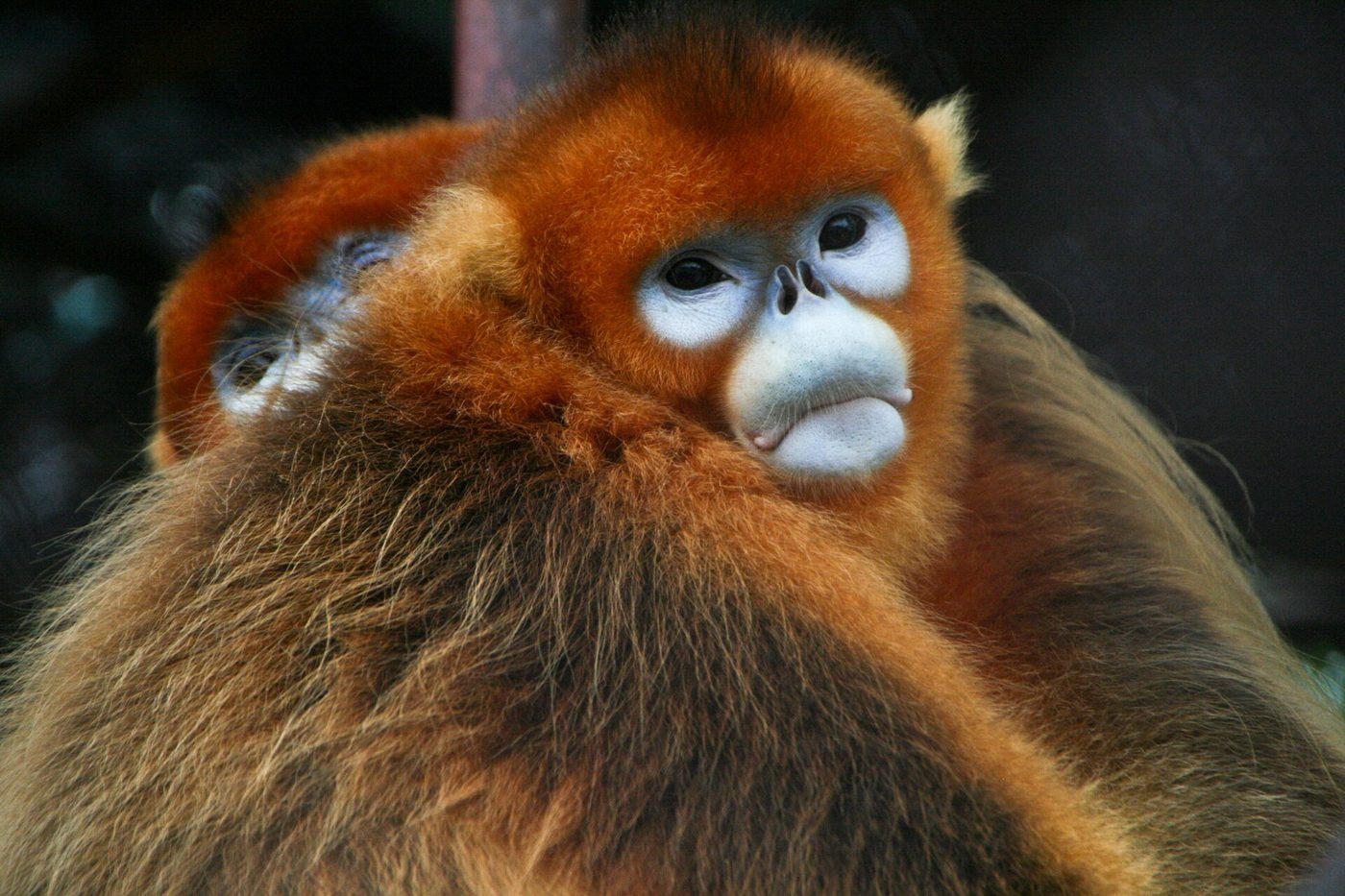
Photo: Jack Hynes · CC BY-SA 2.0
Golden snub-nosed monkey
Rhinopithecus roxellana
The golden snub-nosed monkey is a golden-furred, blue-faced monkey of China's cold mountain forests, one of the most frost-tolerant primates.
Characteristics
Temperament
Diurnal, arboreal and highly social; large groups.
Diet
Folivorous: lichens, leaves, bark, shoots, fruit and seeds.
A golden monkey with a blue face
The golden snub-nosed monkey (Rhinopithecus roxellana) is an Old World monkey of the Colobinae subfamily, unmistakable for its long golden-orange fur, pale blue face and small, upturned, almost absent nose — hence "snub-nosed". Adult males are larger than females and sport a thick mane over the shoulders. It is one of the most cold-tolerant monkeys, able to survive harsh, snowy winters.
Habitat and range
It is endemic to the temperate mountain forests of central and southwestern China, in the Hengduan, Qinling and Shennongjia mountains, at 1,500 to 3,400 metres. In winter it faces snow and very low temperatures, coping with its thick fur and a change of diet.
Behaviour and diet
It is arboreal, diurnal and highly social: it lives in large groups that can number hundreds of individuals, organised into family units. It feeds mainly on lichens, but also on leaves, bark, shoots, fruit and seeds; in winter, when food is scarce, tree lichens become its main resource.
Did you know?
Its scientific name roxellana is inspired by Roxelana, the famous consort of an Ottoman sultan, perhaps for her hair colour. In China it is called the "Sichuan golden-haired monkey" and is a much-loved animal, a symbol of mountain wildlife.
Conservation
The IUCN lists it as Endangered. Fragmentation and loss of mountain forests are the main threats; it is protected in numerous Chinese reserves, where populations are monitored.
Pros
- Spectacular golden fur and blue face
- One of the most cold-tolerant primates
- Complex social life in large groups
Cons
- Endangered
- Depends on fragmented mountain forests
- Restricted range in a few parts of China