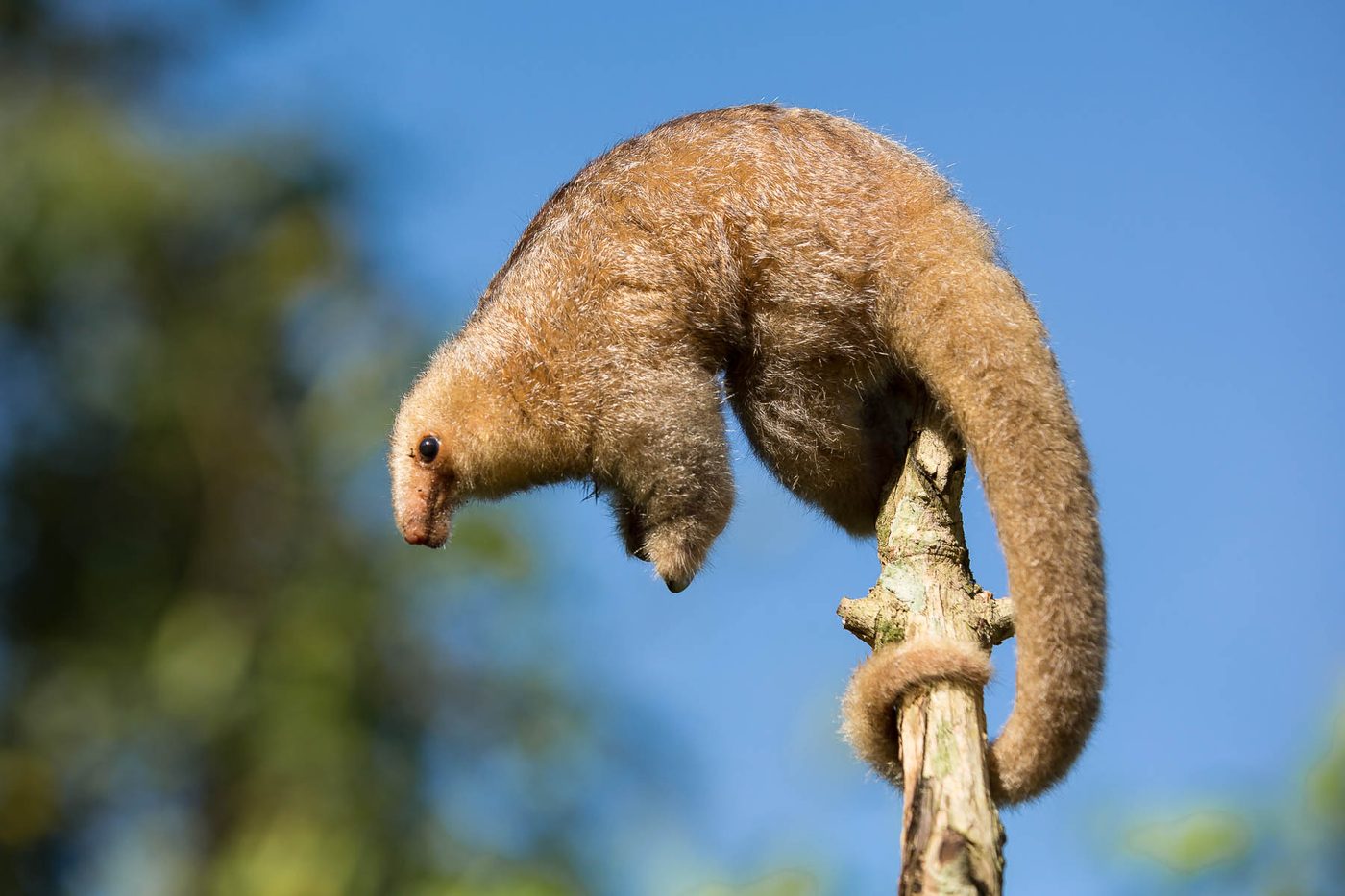
Photo: Quinten Questel · CC BY-SA 3.0
Silky anteater
Cyclopes didactylus
As small as a squirrel and covered in soft golden fur, the silky anteater is the tiniest of the anteaters, a nocturnal inhabitant of the tropical canopy.
Characteristics
Temperament
Nocturnal, solitary, strictly arboreal
Diet
Insectivore: mainly ants
The smallest of the anteaters
The silky anteater, also called the pygmy anteater, is the smallest of all anteaters, comparable in size to a squirrel. Its most fascinating feature is its fur: dense, extremely soft and silky, of a golden or yellowish-brown colour, often crossed by a darker band along the back. It has an elongated snout, small eyes and a long prehensile tail, which it uses like a fifth limb to grip the branches. Its hind feet are highly modified for climbing, and it has strong claws on its forelimbs.
Habitat and distribution
It lives in the tropical forests of Central and South America, from southern Mexico into the heart of South America. It is a strictly arboreal animal: it spends its entire life among the treetops and almost never comes down to the ground. By day it rests curled up on itself, hidden among the foliage or the vines, where its golden fur camouflages it splendidly.
Behaviour and feeding
It is a nocturnal, solitary animal, which moves slowly and cautiously among the branches. It feeds almost exclusively on ants, which it catches with its long sticky tongue after opening the nests with its claws, supplementing its diet with other small insects. If threatened, it can adopt a defensive pose, rising on its hind legs and holding its front claws ready.
Curiosities and conservation
A curious theory links its golden fur to the fruit of the kapok (or silk-cotton) tree: when these open they release a pale, soft fibre, and the silky anteater, curled up among the branches, may blend in with it, thus escaping predators. It is classified as a species of least concern, but being tied to the tropical forests, deforestation represents a local threat.
Pros
- The smallest of the anteaters
- Soft, camouflaged golden fur
- Prehensile tail used as a fifth limb
- Valuable controller of ants
Cons
- Tied to the tropical forests
- Hard to observe, very elusive
- Locally threatened by deforestation