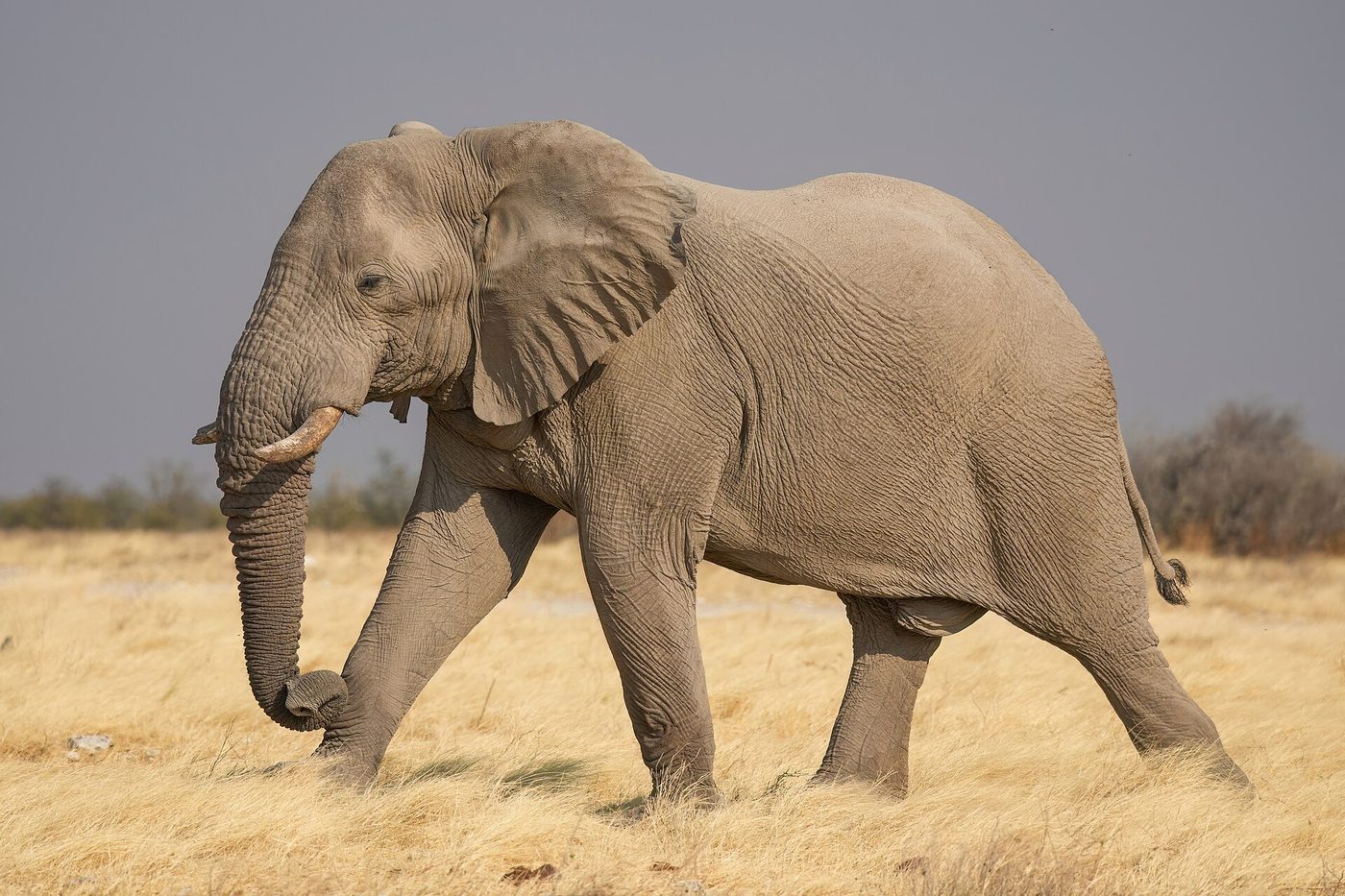
Photo: Giles Laurent · CC BY-SA 4.0
African elephant
Loxodonta africana
The largest land animal on the planet: an intelligent, social giant of the savanna, the African elephant fascinates with its trunk and its proverbial memory.
Characteristics
Temperament
Intelligent, social and empathetic. It lives in family groups led by a matriarch; usually peaceful, it can become aggressive if threatened or in defence of the young.
Diet
Herbivore: grasses, leaves, bark, roots and fruit, in amounts that can exceed a hundred kilograms a day.
The giant of the savanna
The African bush elephant is the largest living land animal. An adult male can reach four metres at the shoulder and exceed six tonnes in weight. Its most extraordinary feature is the trunk, an extension of the nose and upper lip fitted with tens of thousands of muscles: it uses it to breathe, smell, drink, grasp food and communicate, with a precision able to pick up both a log and a single blade of grass. Its large ears, much wider than those of the Asian elephant, also act as radiators to disperse heat.
Its tusks, present in both sexes, are elongated incisors that grow throughout life.
Where it lives
It lives in sub-Saharan Africa, in a great variety of settings: savannas, grasslands, bushland and forests. It needs vast territories and large amounts of food and water, which makes it very sensitive to habitat fragmentation. Elephants travel long distances following routes handed down from generation to generation.
A matriarchal society
Elephants live in family groups led by an old female, the matriarch, who keeps the memory of the routes, the waterholes and the dangers. Adult males tend to live apart, alone or in groups. They are animals of remarkable intelligence, capable of empathy, of recognising their own kind and even of showing behaviours reminiscent of mourning towards dead companions. They communicate with a range of sounds, many at frequencies so low as to be imperceptible to the human ear.
Diet
It is a herbivore with an enormous appetite: it can consume over a hundred kilograms of vegetation a day, among grasses, leaves, bark, roots and fruit. Precisely through this activity, elephants shape the landscape, felling trees and opening clearings, so much so that they are called 'ecosystem engineers' for the role they play to the benefit of many other species.
Conservation
The African bush elephant is classified as an endangered species. The main threats are poaching for the ivory of its tusks and the loss of habitat due to human expansion. Despite protection efforts and the fight against illegal trade, its long-term survival depends on the ability to secure safe and connected territories for these populations.