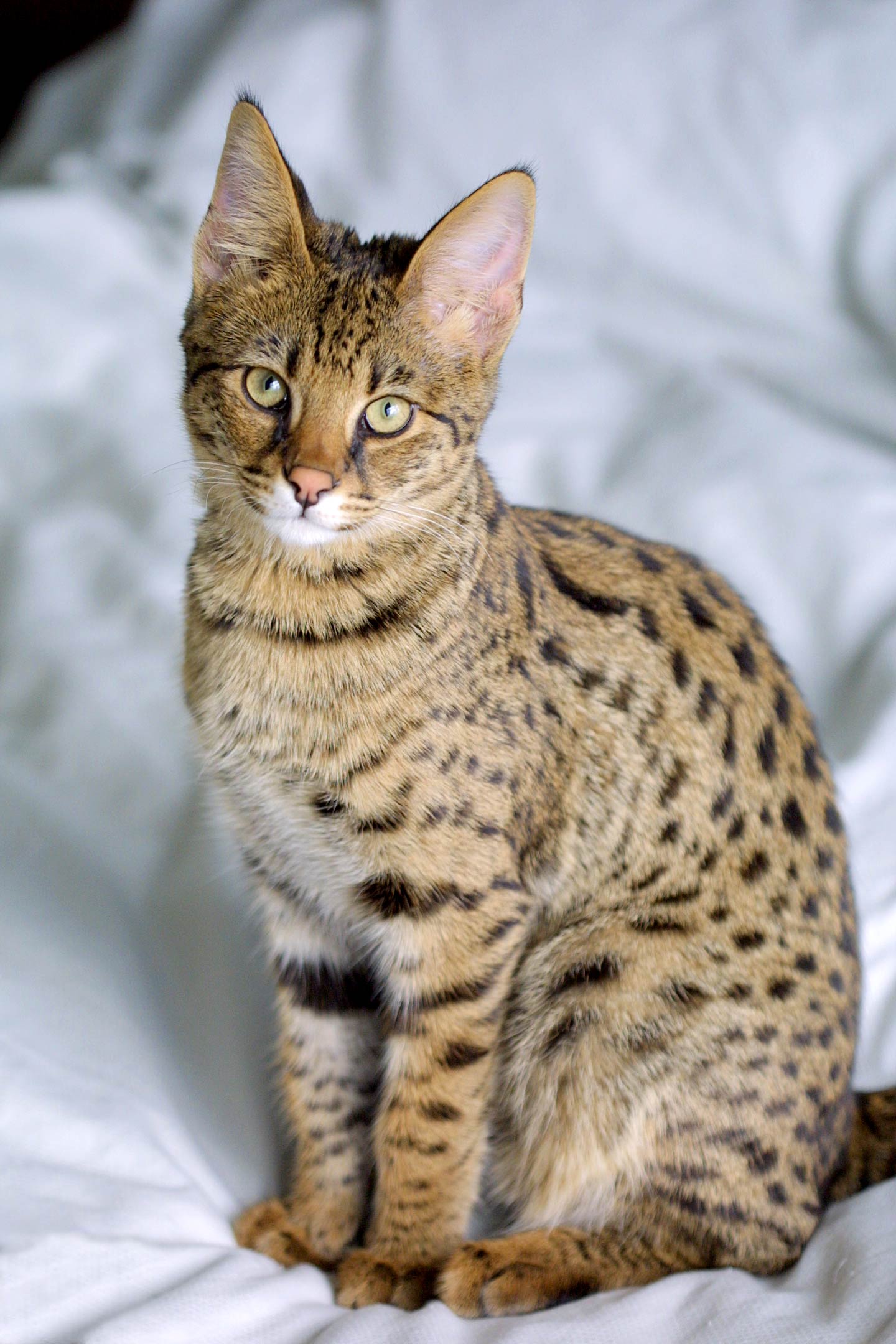
Savannah Cat
Leptailurus serval
Characteristics
Temperament
Extremely lively, intelligent, curious and deeply attached to its human: a temperament often described as "more dog than cat". It learns to fetch, responds to its name, walks on a leash and loves water. Athletic and tireless, it needs lots of space, play and company, and bores easily. Not a calm cat nor one for beginners; the early generations keep markedly wild traits inherited from the serval.
Diet
An obligate carnivore like every cat: it needs a diet rich in high-quality animal protein. It eats good-quality cat food and, depending on breeders' and owners' choices, also meat (sometimes raw, under veterinary supervision). Given its size and great liveliness it has a high energy requirement and needs a balanced, controlled diet. It keeps a strong predatory instinct: play and feeding enrichment matter for its welfare.
The Savannah is one of the newest, most spectacular and "wild-looking" domestic cat breeds, born from a cross with an African wild cat. Famous for:
- Its hybrid origin: it descends from crossing the domestic cat with the serval (Leptailurus serval), an elegant wild cat of the African savannas already in this portal
- Imposing size: it is among the largest and tallest domestic cats in the world, with a lean body and very long legs
- A "mini-cheetah" look: a coat spotted black on golden, large erect ears, hooded eyes and dark "tear" lines on the face
- A "dog-like" character: very active, intelligent and loyal, it can learn to fetch, walk on a leash and loves to play with water
- The F1, F2, F3... generations: classified by how "close" they are to the serval ancestor
- Special rules: because of its wild ancestry, in some countries and regions its ownership is restricted or banned
It is a young breed, developed from the 1980s and officially recognized in the early 2000s. The Savannah is the perfect example of how a wild cat (the serval) and the domestic cat can give rise to a new animal — fascinating but also demanding, suited only to those who can offer it adequate space, activity and attention.
Classification and category
The Savannah is a pedigree domestic cat (Felis catus), but obtained by hybridization with a wild species of another genus, the serval (Leptailurus serval). It is therefore, in origin, an inter-generic hybrid, later "stabilized" as a breed through successive generations. The filial generations are marked with the letter F and a number: F1 (direct offspring of a serval and a domestic cat — the largest, most "wild" and demanding, about half serval); F2, F3, F4... (later generations, progressively smaller, more "domestic" and manageable as they move away from the serval). Not to be confused with: the serval itself (a true wild cat, not a pet); and the Bengal (another spotted domestic breed, but derived from the Asian leopard cat, not the serval). Etymology: the name "Savannah" recalls the African savanna, the serval's habitat. Parameters (very variable with generation): Weight ~4-9 kg (F1 the heaviest; later generations lighter). Height among the tallest of domestic cats — the largest individuals have held the world record for tallest domestic cat. Build slender, athletic, with long legs and neck. Longevity about 12-20 years. Reproduction: as a hybrid breed it has peculiarities — males of the early generations (roughly F1-F3) are often sterile, so breeding usually proceeds through hybrid females back-crossed with domestic (or serval) males.
Habitat and distribution
Being a domestic breed, the Savannah has no natural "range": it lives at home, beside humans, wherever it is bred and kept as a pet (mainly in North America and Europe, where the breed is most common). Its ideal "habitat", however, is particular and demanding: large, enriched environments (it needs lots of space, climbing structures, toys and stimulation, far more than an ordinary cat); safe outdoor access (fenced gardens, protected areas) or long play and exercise sessions; and company and interaction (it suffers boredom and loneliness, and does best with present, active people). An important point concerns legislation: because of its wild ancestry, in several countries, states or regions ownership of the Savannah (especially the early F1-F2 generations) is regulated, permit-bound or entirely banned, so anyone wanting this cat must carefully check local rules. Being a breed, it has no IUCN conservation status: conservation concerns instead its wild ancestor, the serval.
Diet
The Savannah is, like every cat, an obligate carnivore: it needs a diet rich in high-quality animal protein. It eats: high-quality cat food rich in animal protein; and meat (many breeders and owners favour especially protein-rich diets, sometimes raw-meat-based, under veterinary supervision). Dietary notes: a high energy requirement (given its great liveliness and size, it may need more food and attention to energy balance than an ordinary cat); a balanced, controlled diet (for large, active breeds a well-formulated diet matters, avoiding deficiencies or excesses); and individual sensitivities (some Savannahs, especially of the early generations, may have delicate digestion to manage with suitable diets). Crucially, though a domestic cat, the Savannah keeps a heightened predatory instinct and the energy of an animal "close to the wild"; play, simulated hunting and feeding enrichment matter for its welfare.
Physical features
The Savannah has an elegant, athletic, almost "exotic" look closely recalling the serval. Coat: a ground colour from golden/fulvous to silver or blackish, depending on the variety; covered in round, well-defined black or brown spots of clear "wild" inspiration; typical dark "tear" lines running from the eyes, as in the cheetah and serval; short, dense fur. The body: a tall, lean build, with long legs and an elongated neck; very large, tall, erect ears, often with "false eyes" (ocelli) on the back, as in wild cats; a small head relative to the body, with an alert air; and hooded eyes with a characteristic attentive expression. Performance: an exceptional jump (it can leap to great heights from standing); agility and speed (extremely athletic and quick); curiosity and intelligence (it solves "puzzles", opens doors and drawers); and a love of water (it often plays with water and is not at all afraid of it).
Behaviour and curiosities
The Savannah is a lively, sociable, intelligent cat deeply attached to its human, with a temperament many describe as "more dog than cat". It needs activity, play and company, and can develop problem behaviours if bored or left alone for long. It is not the ideal cat for someone seeking a calm, independent animal.
The "dog-cat": the Savannah is famous for dog-like character traits — many learn to fetch objects, respond to their name, can be leash-trained and follow their owner around the house like shadows; it is an interactive, "conversational" companion, very different from the classic aloof cat. The world's tallest cat: the Savannah holds height records among domestic cats — particularly large individuals, especially of the early generations, have won the Guinness World Record for tallest domestic cat thanks to the very long legs inherited from the serval; note, though, that generations further from the serval (F4, F5...) are closer in size to a normal cat. The F generations: understanding "filiation" is essential for the Savannah — an F1 is the direct offspring of a serval and is half wild: big, energetic and demanding; each later generation (F2, F3, F4...) moves away from the serval, becoming progressively smaller, gentler and more like a traditional domestic cat; the generation affects size, character, price and even the legality of ownership. The water-lover: contrary to the cliché that cats hate water, the Savannah is often drawn to it — playing with taps, dipping its paws in bowls, getting into the shower or bath; a behavioural inheritance that makes it even more unusual among house cats. The legal question: precisely because it arises from a cross with a wild animal, the Savannah is subject to special rules — in some US states, in Australia (where it is entirely banned for fear of impact on native wildlife) and in other jurisdictions, owning a Savannah — especially of the early generations — requires permits or is forbidden; a responsibility every potential owner must check in advance. The bond with the serval: the Savannah is a fascinating "bridge" between the domestic and wild worlds — looking at it, you immediately recognize the serval's elegance (the huge ears, long legs, spotted coat), softened and adapted to life at home; it is a living reminder of how close, genetically, our domestic cats are to their wild cousins.
Pros
- Aspetto spettacolare ed esotico, simile a un piccolo felino selvatico
- Intelligentissimo e interattivo: impara giochi, riporto e guinzaglio
- Molto legato alla famiglia, vivace e giocherellone
- Legame educativo affascinante con il suo progenitore, il Serval
Cons
- Carattere impegnativo: serve tanto spazio, attività e attenzione
- Non adatto ai principianti né a chi cerca un gatto tranquillo
- Detenzione regolamentata o vietata in molti paesi/stati (ascendenza selvatica)
- Maschi delle prime generazioni spesso sterili; costi elevati